

What Is an Automated Material Handling System?

An automated material handling system is a combination of equipment, software, and controls that moves, stores, retrieves, and sorts materials through a facility with reduced manual handling.
| Automated Material Handling Systems at a Glance | Details |
|---|---|
| Purpose | Move, store, retrieve, sort, stage, and route materials with less manual handling |
| Common technologies | Conveyors, AS/RS, AMRs, AGVs, robotics, sortation, pallet handling, WMS, WCS, WES, and controls |
| Best for | Warehouses, distribution centers, fulfillment operations, manufacturing facilities, and high-volume shipping environments |
| Key benefit | Improves throughput, labor efficiency, accuracy, ergonomics, storage utilization, and material flow when properly integrated |
| Integrator role | Evaluates facility data, designs the system, integrates equipment and software, and supports implementation |
Material handling automation is most effective when equipment, software, controls, and workflows are designed around the facility’s actual SKU profile, throughput targets, labor model, and growth requirements.
Most warehouse performance problems are not caused by poor effort. They happen when manual processes, facility layouts, and disconnected systems can no longer support growing volume.
Order volumes grow. Labor gets harder to find and retain. Customers expect faster, more accurate fulfillment. At some point, adding headcount stops being a viable answer.
That’s where automated material handling becomes a strategic decision — not just an operational upgrade.
This guide is designed to help operations, supply chain, and engineering leaders evaluate the right approach for their facility. We’ll cover the core technologies, how they compare, what integration actually requires, and how to build a business case that holds up.
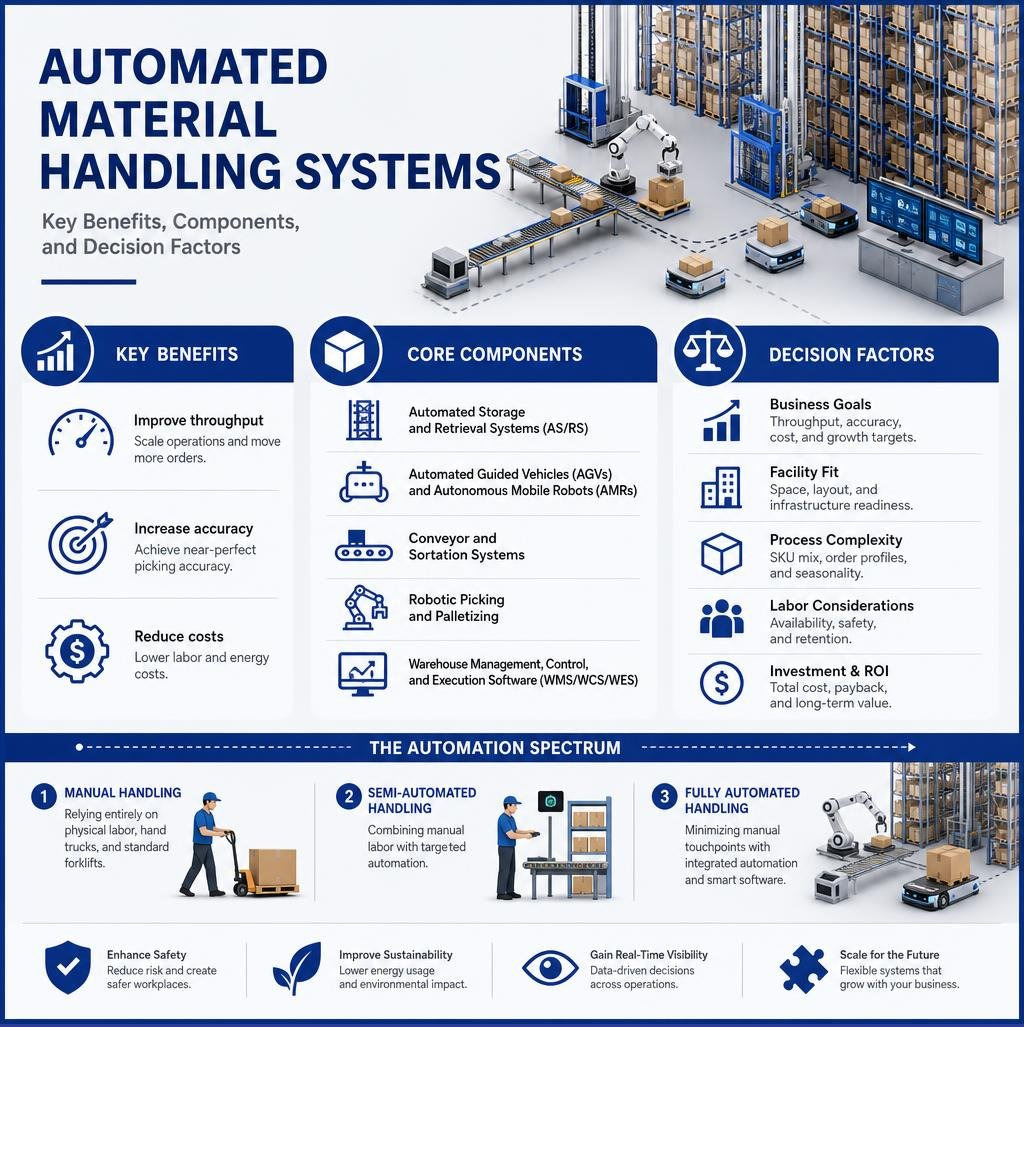
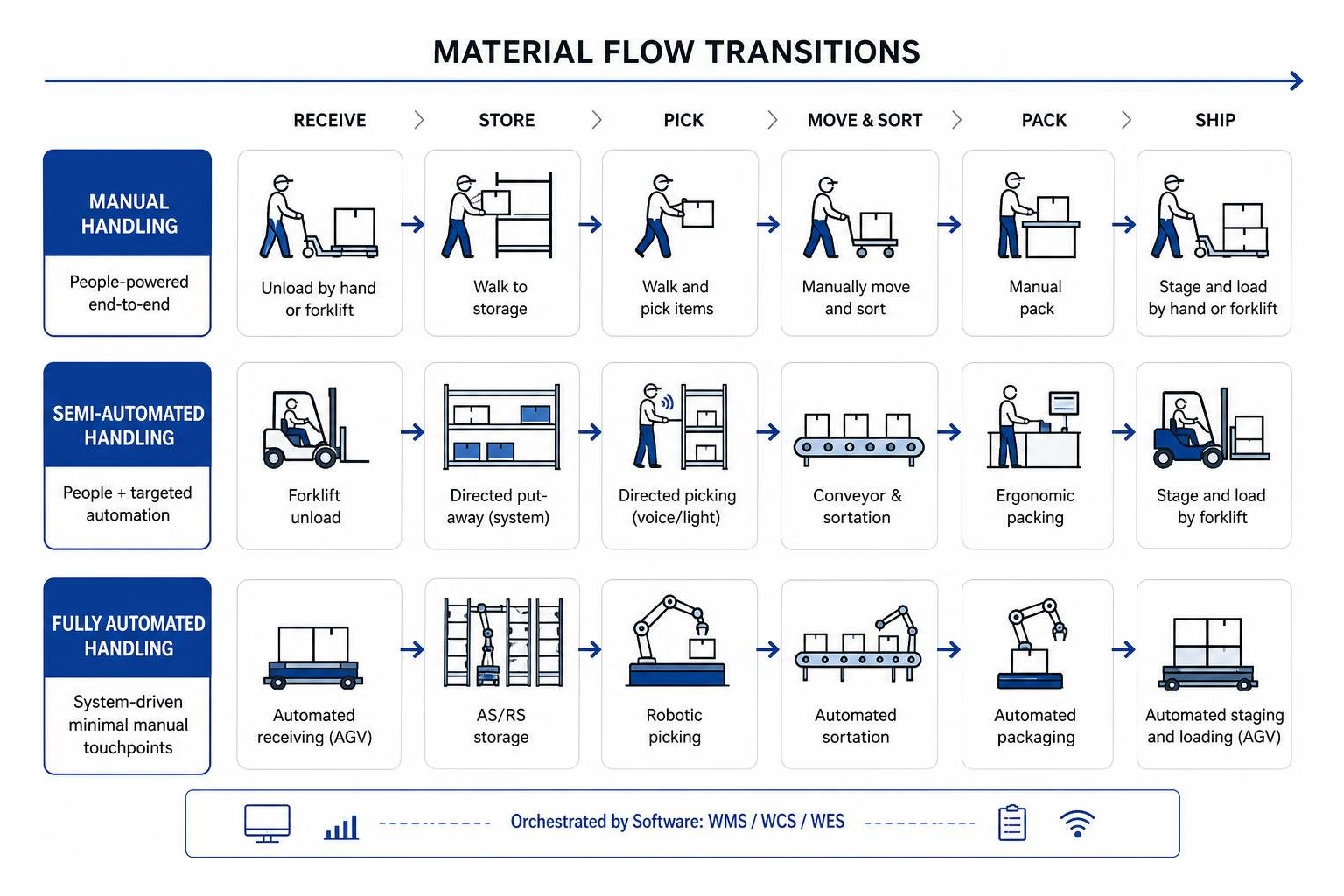
To understand how these systems transform a business, it helps to look at the spectrum of automation. During warehouse assessments, operations are typically categorized into three stages:
- Manual Handling: Relying entirely on physical labor, hand trucks, and standard forklifts. Every step—from picking a product to traveling across the facility—depends on a human operator.
- Semi-Automated Handling: Combining manual labor with targeted automation. For example, operators might use voice- or light-directed picking systems, but still walk the aisles to retrieve goods.
- Highly Automated Handling: Reducing manual touchpoints significantly. Goods flow dynamically through the warehouse via automated systems. Robotics, autonomous vehicles, and automated storage units handle much of the physical movement, while software orchestrates the process and people oversee operations, exceptions, replenishment, maintenance, and safety.
Replacing manual steps with a synchronized material flow directly addresses the core bottlenecks that limit growth: travel time, physical fatigue, and human error.
Evaluating the Core Technologies and Equipment
No single technology fits every facility. The right automated material handling system is highly dependent on your specific SKU profiles, throughput demands, and layout constraints.
Evaluating these technologies objectively requires looking at their performance characteristics side-by-side.

| Technology Type | Throughput Capability | Storage Density | Payload Capacity | Modularity & Scalability | Ideal Application |
|---|---|---|---|---|---|
| Fixed Conveyors | Very High | Low | Medium | Low | Fixed, high-volume transport paths |
| Automated Guided Vehicles (AGVs) | Medium | Low | High to Very High | Medium | Heavy pallet transport, repeatable routes |
| Autonomous Mobile Robots (AMRs) | Medium to High | Low to Medium | Low to Medium | Very High | Dynamic case/tote picking, flexible layouts |
| Automated Storage & Retrieval (AS/RS) | High to Very High | Extremely High | Low to High | Medium to High | High-density storage, goods-to-person fulfillment |
Key Components of an Automated Material Handling System
To build a reliable automated material handling system, several core technologies must work together:
- Automated Storage and Retrieval Systems (AS/RS): These systems maximize vertical space and reduce manual search time. By utilizing high-density racking and automated inserter/extractor mechanisms, automated storage and retrieval systems can help facilities improve storage density without expanding the building footprint. For a neutral industry overview, the MHI AS/RS overview defines AS/RS as systems that use equipment and controls to handle, store, and retrieve materials under a defined degree of automation.
- Robotic Warehouse Systems: Incorporating articulated arms, smart gantry systems, and unified end-effectors, robotic warehouse systems automate repetitive tasks like palletizing, depalletizing, and piece picking.
- Automated Guided Vehicles (AGVs): For structured, heavy-duty transport, automated guided vehicles navigate along defined, pre-programmed paths using guidance infrastructure or mapped routes. They are often used for moving pallets, raw materials, or work-in-process inventory across repeatable paths.
- Autonomous Mobile Robots (AMRs): Unlike AGVs, an autonomous mobile robot (AMR) uses onboard sensors and digital mapping to navigate more dynamically. If an obstacle blocks its path, it can calculate an alternative route, making it flexible for changing warehouse environments.
- Industrial and Heavy Material Handling: In manufacturing and heavy industrial environments, automation may need to coordinate cranes, hoists, conveyors, pallet handling, robotics, and controls around large, awkward, or high-value materials. LD Systems evaluates the full material flow and integrates the right mix of equipment, software, and controls for the application instead of forcing a single vendor approach.
Goods-to-Person and Robotic Picking Solutions
One of the most effective ways to boost fulfillment speed is transitioning from a “person-to-goods” model to a “goods-to-person” model. Instead of workers walking long distances to find items, automated systems bring inventory to ergonomic workstations.
Deploying advanced robotic storage retrieval and pick systems allows operations to fulfill orders more continuously. Modern AS/RS and robotic picking systems can include several specialized designs:
- High-Density Cube Storage: This approach stacks storage bins vertically in a dense grid. Robots retrieve bins and deliver them to picking ports. It can be useful where inventory profiles, order mix, and facility constraints justify a compact goods-to-person design.
- Shuttle Systems: Operating within high-density racking, rapid shuttles travel horizontally along specific levels to retrieve totes or cartons. They are ideal for high-throughput operations that require fast access to a large volume of SKUs.
- Vertical Lift Modules (VLMs): Operating like an enclosed vertical elevator with trays on both sides, a VLM delivers the correct tray to an ergonomic access window at the touch of a button or scan of a barcode.
- Bin-to-Person Workflows: By combining mobile robots with vertical storage, systems can retrieve individual bins and deliver them to picking stations, reducing travel requirements while maintaining accuracy when the system is properly designed and integrated.
Material Handling Automation Benefits and ROI
Implementing an automated material handling system requires a capital commitment, which is why operations leaders must focus on clear, quantifiable business outcomes.
Labor Efficiency and Ergonomics
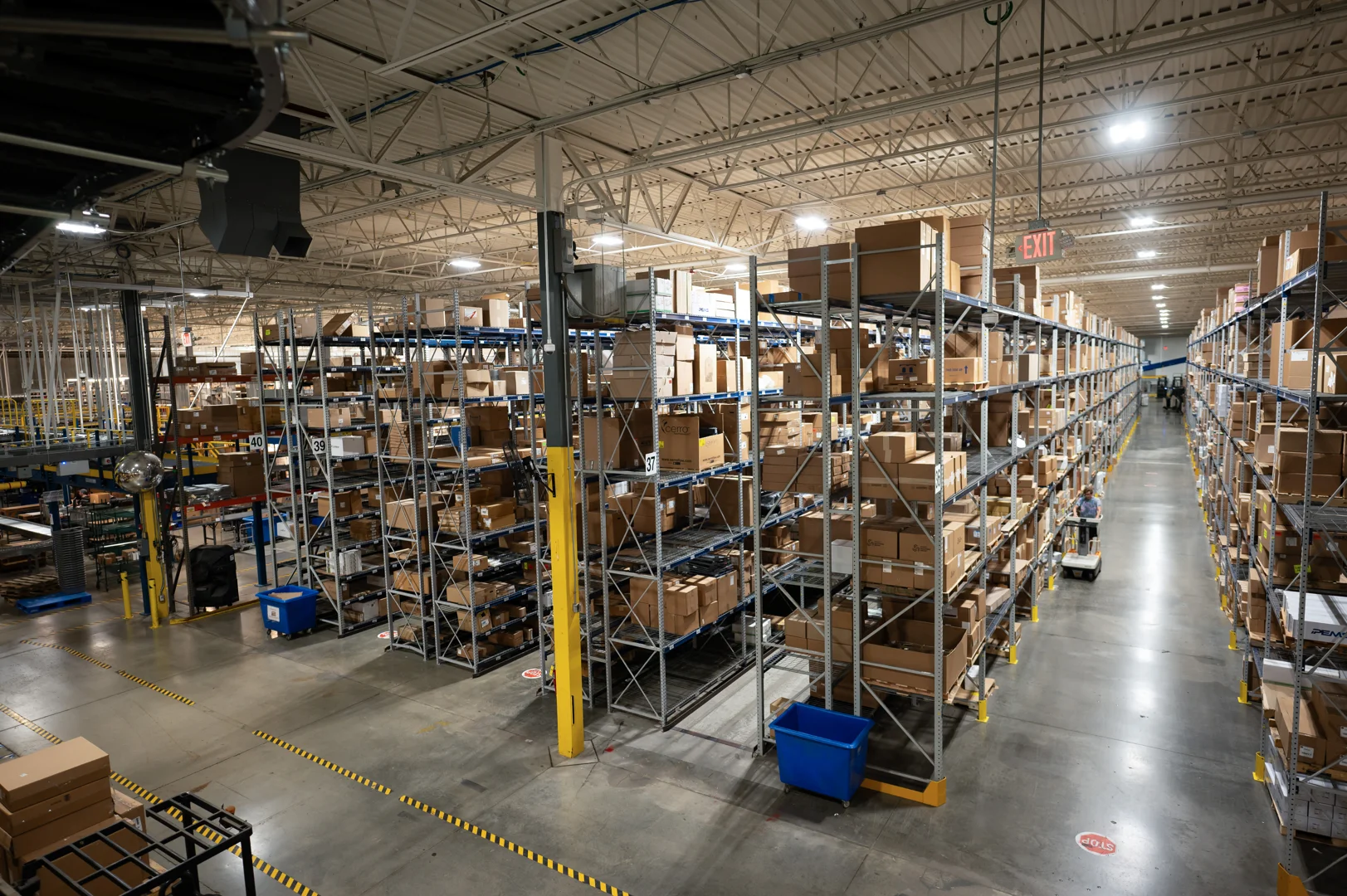
Automation does not necessarily mean eliminating your workforce; rather, it optimizes your labor model. By automating repetitive, physically demanding travel and lifting, facilities can reduce worker exposure to fatigue, strain, and unnecessary manual handling.
OSHA identifies ergonomics, material handling, powered industrial trucks, conveyors, and robotics as key hazard areas in warehousing, which is why automation planning should account for both productivity and worker safety. See OSHA’s warehousing safety guidance for a neutral safety reference.
This ergonomic improvement can reduce turnover pressure and workers’ compensation exposure while allowing your team to focus on higher-value supervisory, exception-handling, and maintenance roles.
Operational Accuracy
Manual picking processes are inherently prone to errors, especially when order profiles are complex or labor is stretched during peak periods. Automated sorting, picking, storage, and conveyor systems can improve accuracy when the equipment, controls, software, and operator workflows are properly integrated.
Reducing mispicks can lower costs tied to return shipping, inventory reconciliation, rework, and customer dissatisfaction. The strongest proof points should come from comparable projects rather than broad vendor-style benchmarks.
Space Optimization and Capacity Gains
By maximizing vertical space and improving slotting, automated systems can help facilities store more inventory without expanding their physical footprint. The impact depends on the storage medium, SKU profile, building height, aisle requirements, replenishment strategy, and how the automation is integrated into picking and order processing workflows.
For space-constrained facilities, the strongest business case often comes from delaying expansion, improving pick-face accessibility, increasing usable storage density, and creating more consistent material flow within the existing footprint.
Real-World Case Studies
Documented LD Systems case studies show how automated material handling systems can improve facility performance when equipment, software, controls, and workflows are properly integrated. In the Rite Aid distribution facility case study, LD Systems helped support a new facility that achieved a 300% increase in throughput, a 40% productivity boost, and 99.93% order accuracy.
In the HSN order cycle time case study, an automated garment-on-hanger system reduced order cycle time from 2 hours to 20 minutes, achieved 99.94% order accuracy, and delivered a 50% productivity boost.
In the Chico’s e-commerce distribution case study, LD Systems helped reduce order cycle time from 3 hours to 30 minutes, tripled picking productivity, and reduced order errors.
These are project-specific results, and outcomes depend on facility layout, SKU profile, order volume, labor model, software integration, and automation scope.
When an Automated Material Handling System May Not Be the First Step
Automation can be a strong investment when the operation has enough volume, process discipline, and facility stability to support payback. In some cases, however, the first step is improving data quality, slotting, replenishment, or workflow consistency before adding automation.
| Automation may be a strong fit when… | Process improvements may come first when… |
|---|---|
| Order volume is growing faster than labor capacity | SKU data, inventory accuracy, or WMS discipline is unreliable |
| Picker travel or material movement is limiting throughput | The true bottleneck is poor slotting or replenishment |
| Facility space is constrained | The operation may relocate before payback |
| Accuracy requirements are rising | Order volume is too low to justify automation |
| Multiple systems need to work together | Existing workflows are not standardized |
This decision point is important because automation should amplify a well-designed process, not lock in inefficient workflows. A readiness assessment can help determine whether the facility should move directly into engineered automation or first address the process issues that would limit system performance.
Software Integration and Real-Time Material Flow
An automated material handling system is only as good as the software directing it. Without proper coordination, high-speed hardware simply moves bottlenecks from one area of the warehouse to another.
To achieve coordinated material flow, facilities rely on a three-tier software stack:
- Warehouse Management System (WMS): The brain of the operation. It manages inventory levels, tracks order locations, and decides which orders need to be fulfilled.
- Warehouse Execution System (WES): The dynamic coordinator. It evaluates real-time capacity at workstations, directs order release, and balances workloads across different zones.
- Warehouse Control System (WCS): The direct controller. It communicates directly with the physical hardware—sending routing instructions to conveyors, directing AGVs, and telling AS/RS cranes which bin to pull.
Connecting these software layers with physical hardware requires following systems integration best practices.
The controls layer is especially important when older conveyor systems, proprietary controls, or limited data visibility prevent a facility from scaling. In the Neuco conveyor control system modernization case study, LD Systems replaced proprietary conveyor controls with an open, industry-standard PLC-based architecture, improved access to operational and historical data through SQL databases, enabled real-time routing adjustments, and established a scalable WCS architecture for future automation expansion.
In modern facilities, this integration is further enhanced by connected operational data. Sensors, scanners, PLCs, and equipment data can help operators monitor system performance, identify bottlenecks, adjust routing logic, and support preventive maintenance.
Strategic Planning and Implementation Frameworks
Successfully adopting automation is not about buying the flashiest equipment; it is about thorough preparation and engineering. One factor many operations overlook is the detailed data analysis required before selecting a technology.
When planning a transition, operations leaders can consult a comprehensive warehouse automation guide to map out their journey. The initial planning phases should always include:
- SKU Profile Analysis: Evaluating the dimensions, weight, and velocity of every product. Fast-moving items require different handling than slow-moving, bulky goods.
- Throughput Analysis: Measuring peak-season demands, hourly order volumes, and average lines per order to size the system correctly.
- Facility Constraints: Mapping columns, ceiling heights, floor loading capacities, and seismic requirements to ensure the physical structure can support the automation.
- Future Growth Planning: Designing modular systems that can scale. If your business grows by 20% next year, the system should allow you to add more robots or racking modules without rebuilding the entire operation.
Overcoming Integration Complexity in an Automated Material Handling System
Integrating new technology into an active warehouse is complex. Operations often struggle with legacy software compatibility, physical layout constraints, and employee resistance.
Ensuring the successful integration of automation requires a clear change management strategy. Staff must be trained on how to interact safely with the new machinery, and maintenance teams must learn basic upkeep protocols to minimize downtime.
Furthermore, if your facility includes production or assembly lines, the automation must bridge the gap between manufacturing and warehousing. That may require coordinated pallet handling, conveyors, cranes or lifts, robotics, controls, WMS/WCS/WES logic, and clear handoffs between raw material flow, work-in-process inventory, finished goods storage, and outbound shipping.
Frequently Asked Questions About Warehouse Automation
What is the difference between an AGV and an AMR?
The primary difference lies in navigation and flexibility. Automated Guided Vehicles (AGVs) travel along fixed, pre-determined paths using physical infrastructure like magnetic tape or laser targets. If an obstacle blocks an AGV, it stops and waits for assistance.
Autonomous Mobile Robots (AMRs) navigate using onboard sensors, cameras, and digital maps. If they encounter an obstacle, they dynamically route around it, making them highly flexible for busy, changing environments.
How does an automated storage and retrieval system (AS/RS) improve space utilization?
An AS/RS improves space utilization by maximizing vertical height and reducing the wide aisle requirements associated with many traditional forklift-based layouts.
As detailed in our guide on how automated storage and retrieval systems work, these systems store inventory in narrow, high-density configurations. Actual space savings depend on the building, SKU profile, storage medium, load dimensions, and how the system is integrated into the broader material flow.
What is the typical ROI timeline for material handling automation?
ROI timelines vary based on SKU profile, order volume, labor model, facility layout, technology selection, software integration, and implementation scope.
In certain applications, LD Systems has helped automation projects target measurable ROI in as little as 17 months, but each project should be evaluated using facility-specific data.
Engineering Your Next-Generation Automated Material Handling System
There is no single “perfect” piece of equipment that solves every warehouse challenge. True efficiency comes from how different technologies—conveyors, robotics, AS/RS, and software—are engineered to work as a unified system.
As a technology-agnostic systems integrator, LD Systems does not manufacture individual products. Instead, we evaluate your facility, analyze your unique data, and design custom-engineered automation systems tailored to your specific operational goals.
With over 50 years of combined experience, our engineering team manages the entire process—from initial design and controls engineering to installation, software integration, and long-term support.
Based in Daytona Beach, Florida, and serving operations throughout the United States and Canada, we help midsize and large organizations reduce material-flow constraints, optimize labor, and scale throughput.
Ready to design a more efficient, scalable operation? Request a warehouse systems integration consultation with the LD Systems engineering team today.
