
What Are Conveyor Systems?
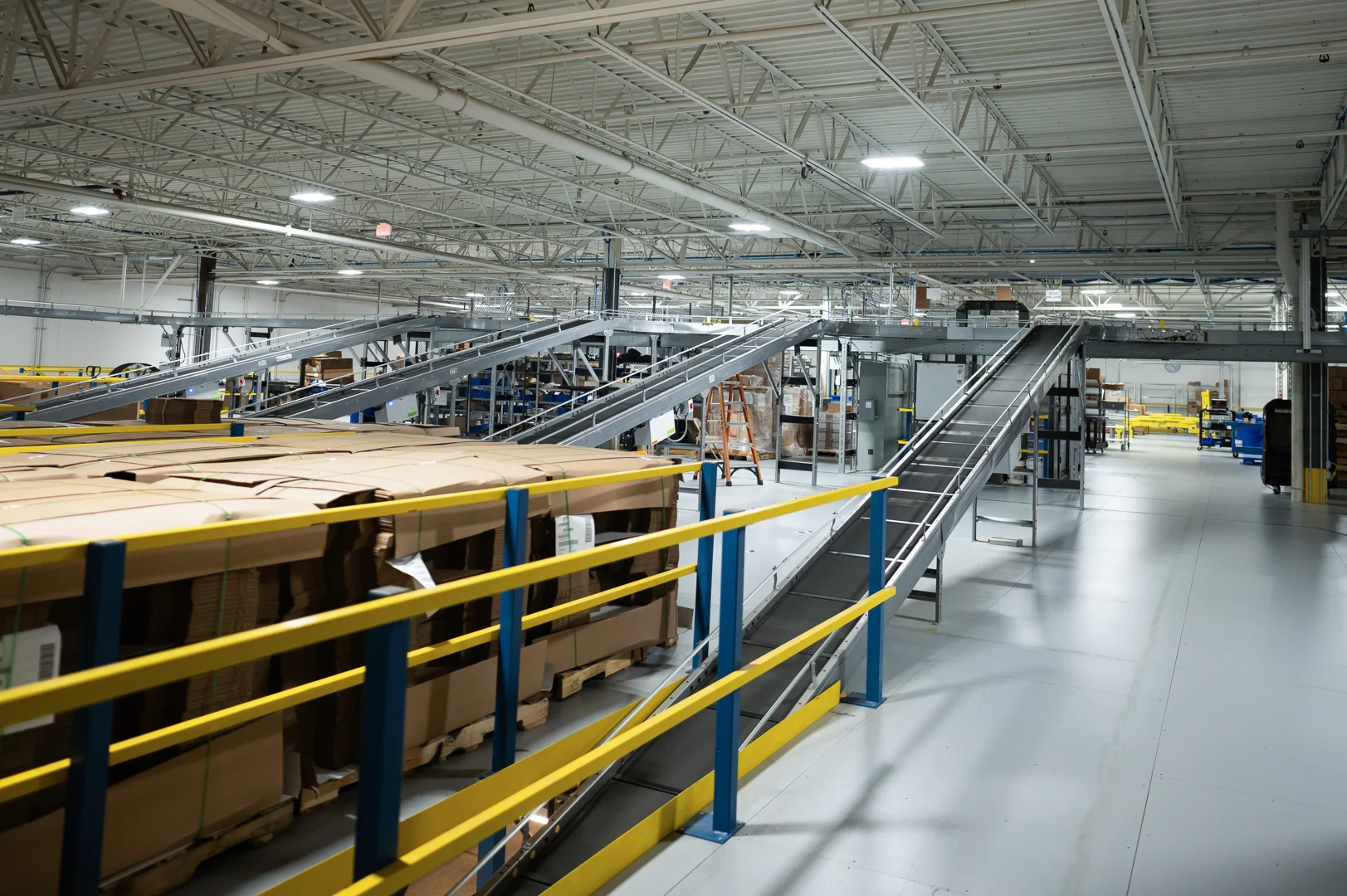
Conveyor systems are material handling systems that move cartons, totes, pallets, parcels, parts, or products through a warehouse, distribution center, fulfillment operation, or manufacturing facility. A conveyor system may include powered rollers, belts, transfers, curves, merges, accumulation zones, lifts, diverts, scanners, sensors, controls, and software integration.
In warehouse and distribution environments, conveyors are used to connect receiving, picking, packing, sortation, staging, shipping, replenishment, production support, and returns processing. The goal is not simply to move product from one point to another. The goal is to create controlled material flow that supports the facility’s order profile, labor model, equipment capacity, and service requirements.
Conveyance systems and conveying systems should be designed around the items being handled, the route those items need to travel, and the downstream process that receives them. A conveyor that works well for rigid cartons may not work for polybags, pallets, fragile items, irregular products, or mixed SKU flows.
For LD Systems, conveyor engineering starts with the operation, not the equipment catalog. The right conveyor systems depend on item profile, throughput requirements, facility layout, WMS/WCS/WES integration, controls architecture, safety requirements, maintenance access, labor model, and long-term scalability.
Types of Conveyor Systems Used in Warehouses
Different types of conveyor systems are designed for different item profiles, facility layouts, and workflow requirements. The best choice depends on what the facility moves, how items are inducted, where they need to go, and how the conveyor system must connect with upstream and downstream processes.
| Conveyor System Type | Common Fit | Key Design Question |
|---|---|---|
| Belt conveyor | Cartons, parcels, polybags, small parts, or items needing continuous support | Does the item need a continuous surface because rollers would create gaps, slipping, or instability? |
| Roller conveyor | Cartons, totes, trays, and rigid-bottom loads | Are the item dimensions, weight, and bottom surface compatible with roller spacing and transfers? |
| Motorized roller conveyor | Zone control, accumulation, carton flow, and controlled release | Does the operation need accumulation, buffering, or controlled flow between process areas? |
| Chain or drag conveyor | Pallets, heavy loads, or durable unit loads | Does the load require a more rugged conveying method than carton or tote conveyor? |
| Spiral, incline, decline, or lift conveyor | Moving items between levels, mezzanines, platforms, or elevated conveyor runs | How should vertical movement be handled without creating congestion, unsafe access, or product instability? |
| Accumulation conveyor | Buffering work between picking, packing, sortation, staging, and shipping | Where does the operation need controlled queuing so downstream work does not block upstream flow? |
| Sortation conveyor | Routing cartons, totes, parcels, or polybags to assigned destinations | Does the operation need scan-driven routing, diverts, destination lanes, or carrier/staging separation? |
Actual conveyor performance depends on item profile, induction quality, controls logic, merge design, accumulation strategy, downstream capacity, and maintenance condition. Conveyor systems should be evaluated as part of the full material handling system rather than as isolated equipment.
Industrial conveyor systems should be designed conveyor systems, not generic equipment layouts. In warehouse, distribution, fulfillment, and manufacturing environments, conveyor design should reflect the facility’s load profile, workflow sequence, software architecture, available space, safety requirements, and future growth plan.
Conveyor Systems vs. General Material Handling Systems
Conveyor systems are one category within a broader material handling system. A material handling system may include conveyors, sorters, lifts, storage systems, robotics, pallet handling, picking modules, workstations, software, controls, and manual processes.
The distinction matters because conveyors only solve the movement portion of the operation. If picking is unbalanced, packing lacks capacity, scan data is unreliable, or shipping lanes are overloaded, adding conveyor length may simply move the bottleneck somewhere else.
For broader system context, conveyors often work alongside material handling systems that connect receiving, picking, packing, staging, and shipping into a coordinated facility flow.
Conveyor Engineering and Facility Layout Considerations
Conveyor engineering should start with the movement problem the facility needs to solve. Before selecting equipment, operations teams should understand what is moving, where it starts, where it ends, what happens before and after the conveyor, and what constraints exist in the building.
| Design Area | What to Evaluate | Why It Matters |
|---|---|---|
| Item profile | Dimensions, weight, packaging, bottom surface, fragility, and conveyability | The item profile determines conveyor type, transfers, belt/roller selection, and exception handling. |
| Facility layout | Travel path, column spacing, dock locations, mezzanines, aisles, workstations, and maintenance access | Layout determines whether conveyors improve flow or create congestion and access problems. |
| Process flow | Receiving, picking, packing, sortation, staging, shipping, returns, or production support | Conveyors need to match the actual sequence of work, not just the physical distance between points. |
| Accumulation and buffering | Where work needs to queue between asynchronous processes | Poor buffer design can create line backups, starve downstream work, or overload operators. |
| Controls and data | Sensors, scanners, PLCs, WCS, WES, WMS, order data, and exception logic | Conveyors need reliable controls and data handoffs to move the right item to the right destination. |
| Safety and maintenance | Guarding, access, emergency stops, service areas, ergonomics, and maintenance procedures | These requirements should be reviewed with qualified safety, facility, and maintenance stakeholders before implementation. |
How Conveyor Systems Integrate with WMS, WCS, and WES
Warehouse conveyor systems are most effective when the physical equipment and software architecture are designed together. A conveyor may move the item, but warehouse software and controls determine when work is released, where items should go, how they are tracked, and what happens when an exception occurs.
The WMS may provide order, inventory, wave, route, or destination information. The WCS may coordinate equipment-level activity such as conveyor zones, sensors, scanners, motors, merges, diverts, and PLC communication. A WES may help balance work across picking, replenishment, conveyor flow, sortation, packing, staging, and shipping when the facility requires more dynamic execution.
Conveyor systems often connect directly with sortation, scanning, print-and-apply systems, packaging equipment, pallet handling, robotics, AS/RS, and shipping workflows. These integration points should be evaluated early so conveyor decisions support the full material flow rather than a single equipment zone.
LD Systems evaluates conveyor systems as part of the full warehouse environment, including facility layout, item profile, WMS/WCS/WES integration, controls architecture, maintenance access, operator workflow, and downstream capacity.
Conveyor System Safety, Maintenance & Reliability Considerations
Conveyor systems should be designed with safety, maintenance access, uptime, and operator interaction in mind. The right approach depends on conveyor type, load profile, operating environment, facility layout, traffic patterns, and applicable site requirements.
Important considerations include guarding, emergency stop access, lockout/tagout procedures, service clearances, operator walkways, traffic separation, spare parts planning, sensor access, belt or roller maintenance, and clear procedures for jams or exceptions.
LD Systems does not replace qualified safety, legal, or code professionals. Conveyor safety and compliance requirements should be reviewed with the appropriate internal stakeholders, equipment providers, and qualified safety or facility professionals before installation and operation.
When Conveyor Systems May Not Be the First Step
Conveyor systems can improve flow when the process is ready for fixed or semi-fixed movement paths. They may not be the best first step when SKU data is unreliable, the layout changes frequently, order profiles are unstable, upstream picking is unbalanced, or downstream packing and shipping areas cannot absorb the added flow.
In some facilities, the better first step is slotting improvement, workstation redesign, better scan discipline, WMS configuration, labor planning, process standardization, or smaller material handling improvements before adding a larger conveyor system.
Conveyor System Manufacturers vs. Warehouse Systems Integrators
Conveyor system manufacturers and conveyor systems manufacturers build conveyor equipment, components, and related technologies. Their role is important, but equipment selection is only one part of a successful warehouse conveyor project.
A warehouse systems integrator evaluates how the conveyor system should fit the facility’s layout, process flow, software environment, labor model, safety requirements, and long-term operating goals. That includes coordinating conveyors with controls, scanners, WMS, WCS, WES, sortation, packing, staging, shipping, and other material handling systems.
LD Systems is not a conveyor manufacturer. LD Systems is a technology-agnostic warehouse systems integrator that helps evaluate, design, integrate, and implement conveyor systems based on facility requirements.
This distinction matters because the best conveyor system manufacturers still need the right application, layout, controls strategy, software integration, and implementation plan to fit the warehouse environment.
Conveyor System Case Studies from LD Systems
LD Systems case studies show why conveyor systems should be evaluated alongside controls, software integration, picking flow, packing requirements, sortation, storage, and facility layout.
- Neuco controls modernization case study: LD Systems replaced proprietary conveyor controls with open, industry-standard PLC architecture, improved access to operational data, and supported more scalable warehouse control logic.
- Thomson ecommerce storage, picking, conveyor, and sorter case study: LD Systems documented a 50% productivity boost, 99.93% order accuracy, and a cycle time reduction from 2 hours to 25 minutes.
- HSN order cycle time case study: LD Systems supported an automated garment-on-hanger system that reduced order cycle time from 2 hours to 20 minutes, achieved 99.94% order accuracy, and delivered a 50% productivity boost.
- Chico’s ecommerce distribution case study: LD Systems helped reduce order cycle time from 3 hours to 30 minutes, tripled picking productivity, and reduced order errors.
These results are project-specific, but they show why conveyor systems should be designed around facility data, material flow, controls, software integration, and downstream fulfillment requirements.
Frequently Asked Questions About Conveyor Systems
What Is a Conveyor System?
A conveyor system is a material handling system that moves items such as cartons, totes, pallets, parcels, parts, or products between process areas. In warehouses and distribution centers, conveyor systems often connect receiving, picking, packing, sortation, staging, shipping, returns, or production support.
What Are the Main Types of Conveyor Systems?
Common types of conveyor systems include belt conveyors, roller conveyors, motorized roller conveyors, chain conveyors, accumulation conveyors, incline and decline conveyors, spiral conveyors, lift conveyors, and sortation conveyors. The right type depends on item profile, facility layout, throughput requirements, controls, and downstream processes.
What Is the Difference Between Conveyor and Conveyance Systems?
The terms conveyor systems, conveyance systems, and conveying systems are often used to describe equipment and processes that move materials through a facility. In warehouse design, the practical question is how the system moves the right item to the right destination while supporting the operation’s layout, labor model, software, and material flow.
Does LD Systems Manufacture Conveyor Systems?
No. LD Systems is not a conveyor manufacturer. LD Systems is a technology-agnostic warehouse systems integrator that helps evaluate, design, integrate, and implement conveyor systems using the right mix of equipment, controls, software, and material handling strategy for the facility.
How LD Systems Supports Conveyor System Design and Integration
Choosing a conveyor system is not just an equipment decision. It requires a coordinated plan for item profile, layout, induction, accumulation, transfers, merges, diverts, WMS/WCS/WES integration, controls, safety, maintenance access, packing flow, shipping lanes, and long-term scalability.
LD Systems helps warehouses, distribution centers, fulfillment operations, and manufacturing facilities evaluate conveyor systems as part of a broader material handling and warehouse automation strategy. As a technology-agnostic warehouse systems integrator, LD Systems does not force one equipment type or manufacturer into every operation.
The team helps align conveyors, controls, software integration, sortation, storage, robotics, and material flow with the facility’s actual operating requirements.
Ready to evaluate conveyor systems for your warehouse or distribution center? Request a consultation with LD Systems to review your item flow, layout, WMS/WCS/WES integration, conveyor constraints, and automation opportunities.
