


What Is a Material Handling System?
A material handling system is the coordinated layout, equipment, software, controls, and workflows used to move, store, protect, and track materials through a warehouse, distribution center, fulfillment operation, or manufacturing facility. It includes everything from pallet racks, forklifts, conveyors, cranes, and workstations to AS/RS, AMRs, WMS, WCS, and WES integration.
The phrase “materials handling system” is often used interchangeably with “material handling system,” but the operational goal is the same: create a safer, more efficient flow of goods from receiving through storage, picking, packing, shipping, and returns.
| Material Handling System at a Glance | Details |
|---|---|
| Purpose | Move, store, protect, control, and track materials throughout a warehouse, distribution center, fulfillment, or manufacturing operation. |
| Common components | Pallet racks, forklifts, conveyors, cranes, ergonomic workstations, AS/RS, AMRs, WMS, WCS, and WES software. |
| Benefits | Safer material flow, improved inventory accuracy, reduced unnecessary travel and handling, better space utilization, and more coordinated operations. |
| Best for | Warehouses, distribution centers, manufacturing facilities, fulfillment operations, and facilities with receiving, storage, picking, packing, shipping, or returns workflows. |
Material Handling System vs. Automated Material Handling System
A material handling system is the broader facility design that includes manual, mechanized, engineered, and automated methods. An automated material handling system is a more specific type of material handling system that uses automation equipment, controls, and software to reduce manual transport, storage, picking, or sortation work.
For example, pallet racks, forklifts, conveyor zones, pick modules, cranes, WMS-directed workflows, and ergonomic workstations may all be part of a material handling system. AS/RS, AMRs, automated sortation, robotic picking, and WCS/WES-driven execution are examples of automation that may be added when the operation requires more throughput, density, accuracy, or scalability.
A properly designed system creates two important advantages:
- Time utility: Products arrive where they are needed with fewer delays, handoffs, and bottlenecks.
- Space utility: Warehouse space is organized to support storage density, accessibility, and efficient movement.
Historically, many warehouses managed these functions in silos, with separate teams selecting storage equipment, transport systems, and software independently.
The storage team bought racks, the shipping team bought conveyors, and the IT team struggled to make the software speak to both. Modern warehouse and manufacturing operations often require a more integrated approach. By viewing these components as an integrated whole, operations can reduce friction points between different stages of a product’s journey. For a deeper look at how to bring these elements together, explore LD Systems’ warehouse systems integration capabilities.
Why Material Flow Matters in System Design
Every unnecessary touch, move, or temporary storage step adds cost without improving the product. This is the fundamental challenge of warehouse management. Material handling often represents a major share of manufacturing and distribution cost, so even minor inefficiencies in your material flow can directly erode your bottom line.
Optimizing this flow does more than just shave pennies off your cost per pick; it can unlock hidden capacity within your existing four walls. When material flow is erratic or uncoordinated, facilities quickly hit artificial throughput limits. Aisles become congested, workers spend more time walking than picking, and shipping docks experience constant peaks and valleys of activity.
An optimized system can smooth out these fluctuations by coordinating receiving, storage availability, replenishment, picking workload, packing flow, and outbound staging so materials move through the facility with fewer delays and handoffs.
- Throughput: Reduce congestion and unnecessary handoffs so more work can move through the same facility.
- Inventory accuracy: Use controlled locations, scanning, and system-directed movement to reduce misplaced stock.
- Fulfillment speed: Shorten the path from receiving to storage, picking, packing, and shipping.
- Labor efficiency: Reduce unnecessary walking, searching, lifting, and repeated handling.
Types of Material Handling Methods
Most warehouses operate somewhere on the spectrum between manual handling, mechanized equipment, and targeted automation. Understanding where your facility sits today—and where it needs to be tomorrow—requires a clear classification of material handling methods.
The choice between these methods is rarely an all-or-nothing decision. Most high-performing distribution centers utilize a hybrid approach, matching the level of technology to the specific requirements of each operational zone.
Manual and Mechanized Equipment
Manual material handling relies entirely on human physical effort to lift, lower, push, pull, or carry materials. In its simplest form, this involves workers manually lifting cartons onto static shelving. While manual handling offers flexibility and typically requires lower upfront equipment investment, it is highly constrained by human physical limits, can create higher ergonomic and injury risks as volume increases, and becomes expensive as order volumes scale.
Mechanized equipment introduces machines to handle the heavy lifting, while keeping a human operator in direct physical control. This category includes the workhorses of the traditional warehouse:
- Forklifts and Reach Trucks: Essential for vertical pallet movement and bulk transport over medium distances.
- Hand Trucks and Pallet Jacks: Ideal for low-volume, short-distance transport in tight spaces.
- Workstation Cranes and Hoists: Overhead lifting solutions that allow operators to move heavy, awkward loads safely within a defined work area. Solutions like workstation bridge cranes, gantry cranes, and wall bracket jib cranes are excellent examples of mechanized systems that protect workers from strain while handling heavy industrial components.
Mechanized systems significantly increase a single worker’s capability and reduce physical strain, but they still tie labor directly to throughput. If you need to move twice as many pallets, you generally need twice as many forklifts and twice as many operators.
Engineered and Automated Systems
Engineered and automated systems shift some physical labor and operational control from people to equipment, controls, and software. In these systems, software helps coordinate material movement while specialized equipment performs selected transport, storage, picking, or sortation tasks with less manual handling.
These technologies are often used in higher-throughput or more complex warehouse environments:
- Conveyor Systems: Fixed-path transport systems that move high volumes of goods continuously between operational zones.
- Automated Guided Vehicles (AGVs): Driverless vehicles that follow fixed paths (such as magnetic tape or laser navigation) to transport heavy loads, such as pallets or large containers, throughout a facility.
- Autonomous Mobile Robots (AMRs): Fleet-managed robots that use onboard sensors, cameras, and digital maps to navigate around obstacles, making them useful for facilities that need more flexible routing than fixed-path equipment can provide.
- Automated Storage and Retrieval Systems (AS/RS): High-density storage structures paired with robotic inserter/extractor mechanisms that automatically store and retrieve goods from precise locations. Automated storage and retrieval systems can help reduce search time and make better use of vertical space when the application fits the product profile and throughput requirement.
Conveyor systems remain one of the most widely deployed automation technologies for moving cartons, totes, and pallets between warehouse processes.
When automation is a good fit, companies can reduce the degree to which throughput depends on manual travel, repetitive handling, and headcount growth.
Core Areas of a Material Handling System
A material handling system is not selected by choosing one technology first. It is designed by looking at how materials enter, move, pause, change form, and leave the facility. Each system area should answer a specific operational question.
| System Area | Material Handling Question | Example Equipment or Support |
|---|---|---|
| Receiving | How do materials enter the facility and become usable inventory? | Dock equipment, pallet jacks, forklifts, scanners, receiving conveyors, WMS workflows |
| Storage | Where should inventory be held based on velocity, size, accessibility, and safety? | Pallet rack, shelving, flow rack, VLMs, AS/RS, pallet shuttles, location control |
| Movement | How should materials travel between receiving, storage, picking, packing, and shipping? | Carts, forklifts, conveyors, cranes, AGVs, AMRs, pallet handling systems |
| Picking and Packing | How are orders selected, consolidated, checked, packed, and prepared for shipment? | Pick modules, carts, goods-to-person systems, workstations, scanners, put walls, packing benches |
| Shipping and Returns | How are outbound orders staged and how are returned goods inspected and reintroduced? | Sortation, dock staging, label systems, scan tunnels, returns workstations, WMS reverse-logistics workflows |
| Software and Controls | How is material flow coordinated and tracked? | WMS, WCS, WES, PLCs, sensors, scanners, dashboards, controls engineering |
High-Density Storage and Retrieval
Storage design is one of the most important parts of a material handling system. The right storage method depends on SKU velocity, product dimensions, load profile, accessibility requirements, replenishment strategy, and available building height.
High-density options such as VLMs, AS/RS, pallet shuttles, carton flow, and deep-lane racking may help facilities improve space utilization, but storage density should not be evaluated in isolation. A storage system must also support putaway, replenishment, picking, safety, and future SKU changes.
To explore how these technologies integrate into a broader warehouse design, compare LD Systems’ automated storage and retrieval systems capabilities across crane, shuttle, carousel, and other storage configurations.
Robotic Transport and Automated Picking
Robotics, AMRs, AGVs, and automated picking technologies may be part of a material handling system when manual travel, replenishment delays, or order volume exceed what a conventional layout can support. The right fit depends on SKU variability, load profile, aisle layout, throughput requirements, software integration, and exception handling.
The 10 Principles of Material Handling System Design
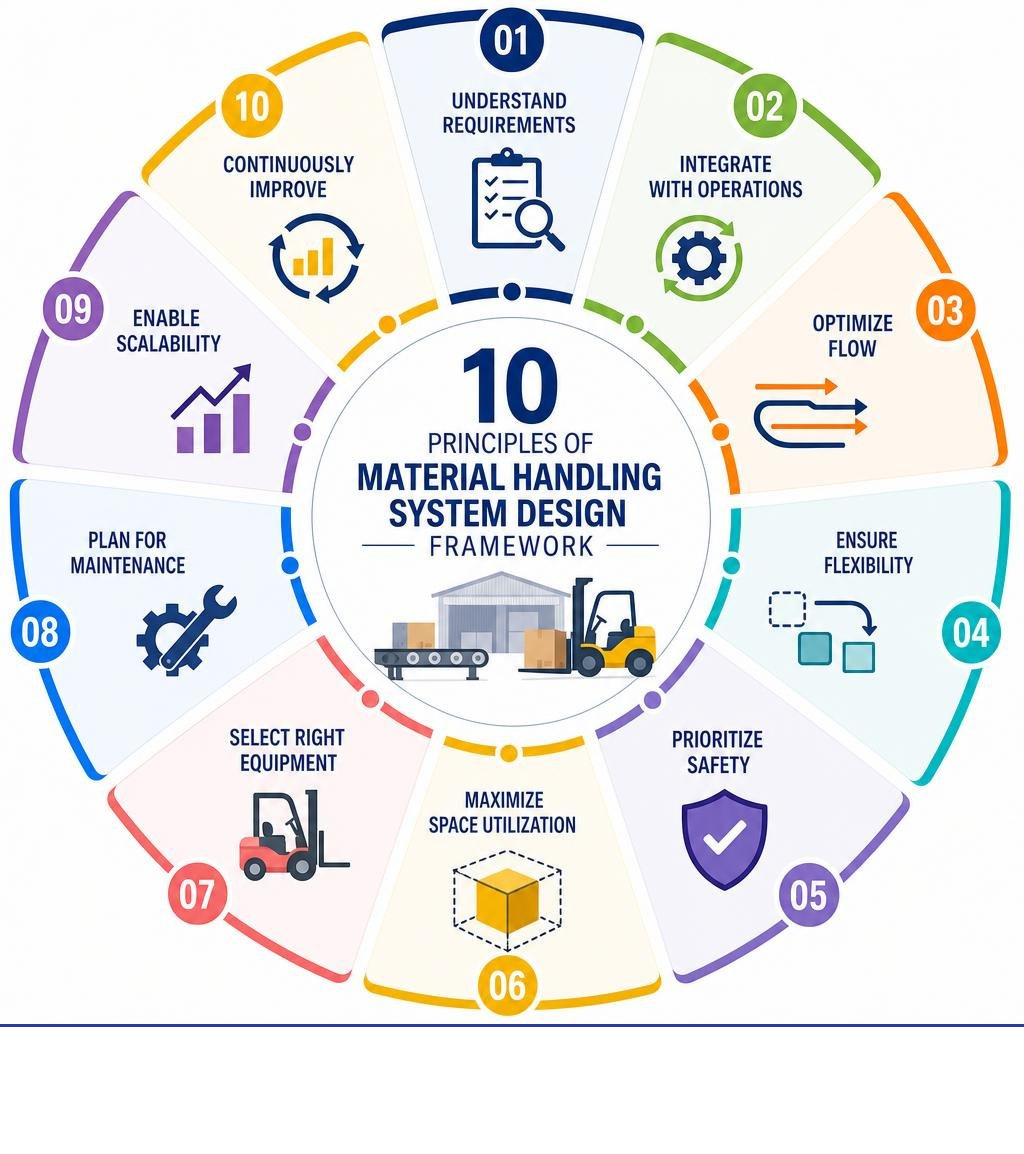
System design should be guided by the Material Handling Institute’s 10 Principles of Material Handling. Instead of treating the principles as a checklist after equipment is selected, use them early to evaluate layout, workflow, safety, automation, and total cost decisions.
| Principle Group | What It Means for System Design |
|---|---|
| Planning and standardization | Define operational goals, material characteristics, workflows, facility constraints, controls, and equipment standards before buying technology. |
| Work and ergonomics | Reduce unnecessary touches, travel, lifting, bending, reaching, and unsafe manual handling while keeping workstations practical for people. |
| Unit load and space utilization | Move materials in practical load sizes, such as pallets, totes, cartons, or containers, while using the building cube effectively. |
| System integration and automation | Connect storage, transport, controls, and software into one coordinated material flow, then automate where the process has been simplified and standardized. |
| Environmental and life cycle cost | Evaluate energy use, waste, maintenance, support, replacement, software updates, and total cost over the full life of the system. |
When designing these systems, partnering with an experienced, technology-agnostic systems integrator helps ensure these principles are applied objectively. An integrator can evaluate the exact mix of storage, transport, automation, controls, and software that fits your operational goals. LD Systems’ warehouse systems integration approach is built around aligning equipment, software, controls, and facility flow before implementation.
Mapping Material Flow Across the Six Stages of Warehousing
The strongest material handling system designs start with facility flow, not with a list of equipment. A warehouse or manufacturing facility is a connected sequence of handoffs: every decision made at receiving affects putaway, storage, replenishment, picking, packing, shipping, and returns. When those stages are planned separately, the result is often excess travel, dock congestion, poor slotting, late replenishment, and avoidable touches.
Use the six-stage flow below as the core framework for evaluating a material handling system. For each stage, identify the common material handling problem, the design decision that affects flow, and the equipment or software support that may help.
| Warehouse Flow Stage | Common Material Handling Problem | System Design Consideration | Possible Equipment or Software Support |
|---|---|---|---|
| Receiving | Trailers are unloaded faster than products can be checked, staged, and released, creating dock congestion and inventory delays. | Plan dock doors, staging lanes, inspection space, scan points, and exception areas so inbound goods can be verified without blocking the next load. | Dock equipment, pallet jacks, forklifts, receiving conveyors, dimensioning/scanning, WMS receiving workflows, and barcode/RFID capture. |
| Putaway | Products sit in temporary staging because operators do not have clear destination rules or efficient travel paths. | Match putaway logic to SKU velocity, storage type, load size, aisle capacity, and replenishment needs so inventory moves to the right location the first time. | Forklifts, reach trucks, AGVs/AMRs, pallet conveyors, directed putaway in WMS, slotting rules, and location control. |
| Storage | Inventory consumes floor space inefficiently or becomes difficult to access because storage methods do not match product movement. | Balance storage density with accessibility, selectivity, safety, and future SKU changes instead of optimizing for cube alone. | Pallet rack, shelving, carton flow, push-back or deep-lane rack, VLMs, AS/RS, pallet shuttles, WMS location management, and inventory tracking. |
| Replenishment | Forward-pick locations run empty during active waves, forcing pickers to wait, search, or pull from reserve storage. | Set min/max levels, trigger points, reserve-to-forward paths, and labor or automation timing so replenishment supports picking instead of interrupting it. | WMS replenishment tasks, conveyors, lift trucks, AMRs/AGVs, goods-to-person storage, pick-face monitoring, and WES/WCS coordination. |
| Picking/Packing | Workers spend too much time walking, searching, consolidating, or correcting errors before orders can be packed. | Design pick paths, zone boundaries, workstation layout, order consolidation, cartonization, and ergonomic presentation around the actual order profile. | Pick modules, carts, conveyors, AMRs, goods-to-person systems, put walls, pick-to-light, voice picking, scanners, packing benches, WMS/WES task orchestration, and cartonization software. |
| Shipping/Returns | Completed orders, carrier pickups, and returned goods compete for dock space, causing staging errors and late shipments. | Separate outbound staging, carrier sortation, route sequencing, returns inspection, and restocking workflows so reverse flow does not disrupt outbound flow. | Sortation conveyors, label print-and-apply, dock scheduling, carrier integration, shipping software, scan tunnels, returns workstations, WMS reverse-logistics workflows, and staging lane controls. |
Receiving: Create a Controlled Starting Point
Receiving is the first control point in the material handling system. If inbound goods are unloaded without enough dock space, inspection capacity, or scanning discipline, the facility starts the day with inventory that exists physically but is not yet usable operationally.
The design goal is to create a clean release from trailer to verified inventory. That may mean dedicated staging lanes, inline scanning, dimensioning, exception areas for damaged or mismatched goods, and WMS receiving workflows that make inventory visible before it moves deeper into the building.
Putaway: Move Inventory to the Right Location the First Time
Putaway problems often look like labor problems, but the root cause is usually system logic. If operators are making location decisions manually, fast-moving SKUs may end up too far from pick areas, reserve stock may be stored in inconvenient zones, and aisles can become congested with avoidable travel.
A stronger material handling system uses directed putaway rules based on SKU velocity, load type, location capacity, replenishment requirements, and equipment access. Forklifts, reach trucks, conveyors, AGVs, or AMRs may all support putaway, but the larger design question is whether the system is sending each load to a location that supports the next downstream step.
Storage: Balance Density, Access, and Future Change
Storage is where many material handling systems become either efficient or rigid. High-density storage can recover floor space, but excessive density may slow access, complicate replenishment, or make SKU changes harder to manage.
The right storage design balances cube utilization with selectivity, safety, product protection, and operational flexibility. Pallet rack, shelving, carton flow, VLMs, AS/RS, pallet shuttles, and other storage technologies should be selected according to product dimensions, turnover rate, load profile, and the need for accurate location control.
Replenishment: Protect the Picking Operation
Replenishment is the bridge between storage and order fulfillment. When it is poorly timed, pickers arrive at empty locations, reserve stock blocks aisles, and supervisors are forced into constant expediting.
A well-designed system treats replenishment as a planned flow rather than a reaction. WMS min/max rules, forward-pick monitoring, reserve-to-forward travel paths, and WES/WCS coordination can help ensure that inventory arrives before pick demand exceeds available stock. Depending on the facility, replenishment may be supported by lift trucks, conveyors, AMRs, AGVs, or goods-to-person storage.
Picking and Packing: Reduce Travel, Touches, and Errors
Picking and packing are often where material handling design has the greatest effect on labor efficiency and order accuracy. Common problems include long walking paths, poor slotting, excessive order consolidation, unclear packout flow, and workstations that force bending, reaching, or unnecessary handling.
System design should connect pick method, pick path, cartonization, order batching, packing station layout, and quality checks. Support may include pick modules, carts, conveyors, AMRs, goods-to-person systems, put walls, pick-to-light, voice workflows, barcode scanning, ergonomic benches, and WMS/WES task orchestration.
Shipping and Returns: Keep Outbound and Reverse Flow from Colliding
Shipping is the final handoff to the customer, but it is also where upstream problems become visible. If packing output is not synchronized with carrier cutoffs, dock doors, route sequencing, and staging lanes, completed orders can pile up in the wrong place at the wrong time.
Returns add another layer of complexity because reverse flow competes for labor, space, inspection capacity, and inventory updates. A complete material handling system separates outbound staging, carrier sortation, returns inspection, disposition, and restocking workflows. Sortation conveyors, scan tunnels, label print-and-apply, dock scheduling, shipping software, and WMS reverse-logistics workflows can all help coordinate this final stage without disrupting outbound throughput.
By mapping these six stages together, facility teams can evaluate a material handling system as an end-to-end flow problem. The best design is not necessarily the most automated one; it is the one that reduces handoffs, protects inventory accuracy, improves space utilization, and keeps each stage ready for the next.
Designing the Right Material Handling System
Designing a material handling system is not about buying the most advanced technology on the market. It is about engineering a solution that specifically addresses your unique operational challenges, fits within your physical constraints, and scales with your business growth.
Selecting the Right Material Handling System for Your Facility
The design process must always begin with a deep, data-driven assessment of your current warehouse, distribution center, or manufacturing facility. This assessment should analyze:
- SKU Profiles: What are the physical dimensions, weights, and packaging styles of your products? Are you handling individual items, full cartons, or heavy pallets?
- Turnover Rates and Velocity: Which SKUs represent your fast-movers, and which are slow-movers? High-velocity items require fast-access storage and transport, while slow-movers can be packed into ultra-high-density storage.
- Physical Layout Constraints: The location of your loading docks, column spacing, and ceiling heights will dictate your layout options. Common layouts include U-shaped (shared dock resources for receiving and shipping), I-shaped (straight-through flow for high-security or cross-docking operations), and L-shaped (separate in/out areas that fit specific building footprints).
The right materials handling system depends on SKU characteristics, throughput goals, facility constraints, and future growth plans.
By matching your inventory profile to the correct layout and storage technology, you prevent the common mistake of over-automating or installing rigid systems that cannot adapt to future SKU changes. The strongest designs connect storage, conveyors, robotic transport, controls, and software through a unified warehouse systems integration plan.
Software Orchestration: WMS, WCS, and WES
The physical machinery in a warehouse is only as smart as the software that controls it. In a modern automated facility, three software layers often need to work in close coordination:
- Warehouse Management System (WMS): Tracks inventory, order status, receiving, putaway, picking, and shipping workflows.
- Warehouse Control System (WCS): Coordinates equipment-level movement for conveyors, sorters, AS/RS, scanners, and other automated systems.
- Warehouse Execution System (WES): Helps balance labor, automation, order release, replenishment, and workflow priorities across the facility.
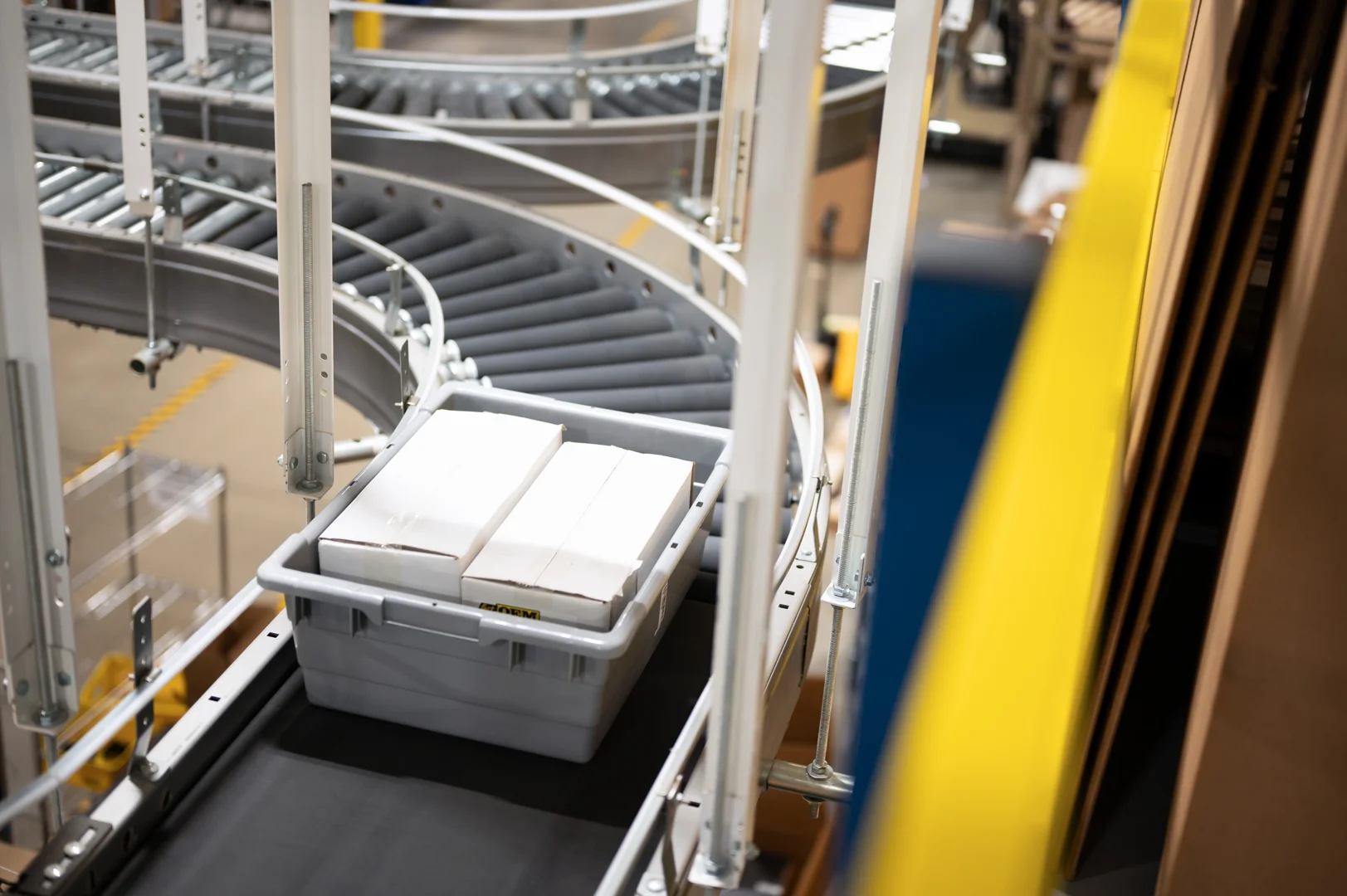
Modern conveyor systems often rely on warehouse control software to synchronize transport, sortation, and downstream equipment.
Integrating these software systems is one of the most complex challenges in warehouse engineering. Without reliable communication, islands of automation may not deliver the throughput, visibility, or coordination the facility needs.
To learn more about how to navigate these software layers and select the right architecture for your facility, read LD Systems’ guide to WCS, WMS, and WES systems.
Prioritizing Safety, Ergonomics, and Sustainability
A truly optimized system does more than just move product quickly; it protects your most valuable asset—your people—and minimizes your environmental footprint.
In 2023, the U.S. Bureau of Labor Statistics reported that the transportation and warehousing sector had a total recordable injury and illness rate of 4.5 cases per 100 full-time workers. Many of these injuries are the result of manual lifting, repetitive bending, or collisions with industrial trucks like forklifts. U.S. Bureau of Labor Statistics injury and illness data
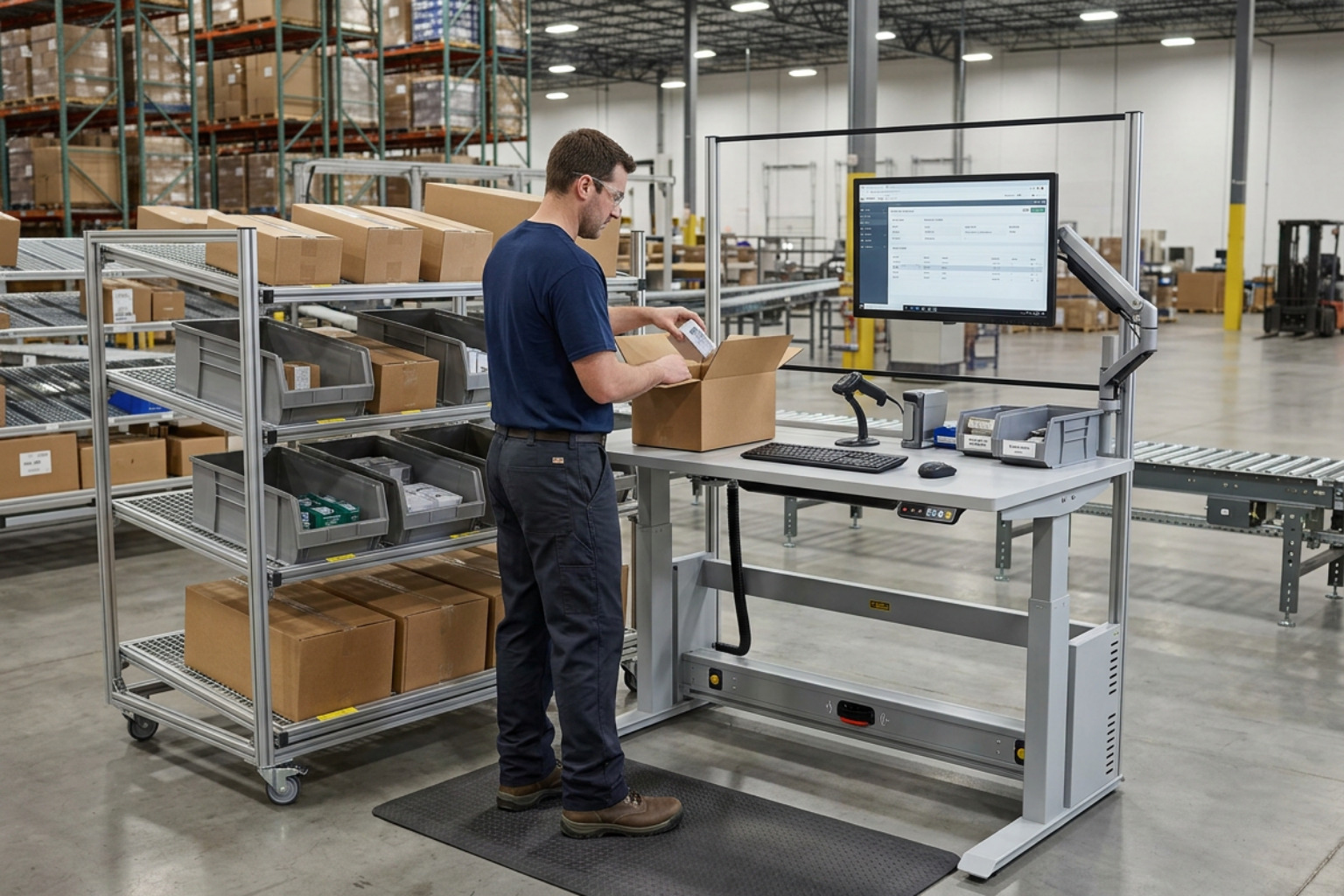
By reducing unnecessary lifting, walking, reaching, forklift travel, and repetitive manual handling, a well-designed material handling system can support safer, more ergonomic work.
Depending on the system design, safety and ergonomic improvements may include:
- Dynamic safety fields: AMRs and AGVs may use LiDAR, cameras, or other sensors to slow or stop when obstacles enter configured safety zones.
- Zone monitoring and access controls: Safety scanners, sensors, barriers, and controlled access points can help separate people from automated equipment.
- Ergonomic workstations: Goods-to-person or workstation-based designs can present materials at better working heights, reducing awkward reaching, bending, and lifting.
Beyond safety, modern system design may also support sustainability goals when space, energy use, or facility expansion are part of the project scope.
High-density storage systems such as VLMs, AS/RS, and pallet shuttles can improve space utilization, which may help some facilities delay expansion or reduce the amount of space required for storage.
Frequently Asked Questions About Material Handling Systems
What is the primary goal of a material handling system?
The core objective is to enhance operational efficiency, increase overall productivity, and ensure workplace safety, all while minimizing waste and controlling operational costs to support long-term business profitability.
How does material handling impact overall product cost?
Material handling often represents a significant portion of manufacturing and distribution costs, making even small efficiency improvements financially meaningful. By optimizing these physical flows, operations can directly reduce non-value-added labor and overhead expenses.
What are the signs that a warehouse material handling process needs improvement?
Common red flags include excessive walking times for picking teams, chronic aisle congestion, slow order cycle times, frequent picking errors, poor slotting organization, and difficulty locating inventory within the facility.
What’s the difference between material handling equipment and a material handling system?
Material handling equipment refers to individual tools or machines, such as conveyors, forklifts, pallet racks, cranes, AMRs, or AS/RS equipment. A material handling system is the integrated design that connects those assets with warehouse layout, workflows, controls, and software so materials move safely and efficiently from receiving through storage, picking, packing, and shipping.
Which industries benefit most from material handling systems?
Material handling systems are especially valuable in industries with high product movement, strict accuracy requirements, or complex storage needs. Common examples include manufacturing, e-commerce fulfillment, food and beverage distribution, healthcare logistics, retail distribution, and third-party logistics (3PL) operations.
LD Systems Examples of Integrated Material Handling Systems
LD Systems case studies show why material handling system design has to consider storage, movement, controls, software, and facility flow together.
- Rite Aid distribution facility case study: LD Systems supported a high-volume distribution operation that achieved a 300% throughput increase, a 40% productivity boost, and 99.93% order accuracy.
- Ocean Spray space utilization case study: LD Systems improved space utilization by 60%, enhanced productivity by 50%, and helped save $11 million in new racking costs by repurposing and relocating existing racking.
- Neuco conveyor controls modernization case study: LD Systems replaced proprietary conveyor controls with an open PLC-based architecture, improved operational and historical data access through SQL databases, and established a scalable WCS architecture for future automation expansion.
These results are project-specific, but they show why material handling system design should consider storage, movement, controls, software, labor, and facility flow together instead of treating each component as a separate purchase.
How LD Systems Designs Integrated Material Handling Systems
Designing a material handling system is not about selecting equipment first. It starts with understanding order profiles, SKU characteristics, facility layout, labor constraints, storage needs, replenishment flow, software environment, safety requirements, and long-term scalability.
LD Systems helps warehouses, distribution centers, fulfillment operations, and manufacturing facilities evaluate material flow, select the right mix of equipment, and integrate storage, conveyors, robotics, controls, and warehouse software into one coordinated system.
As a technology-agnostic warehouse systems integrator, LD Systems does not force operations around a single product line. The team evaluates each facility’s operational data, identifies bottlenecks, designs customized automation strategies, and supports implementation from concept through installation and long-term support.
Ready to improve material flow from receiving to shipping? Explore LD Systems’ material handling and automation solutions or request a facility assessment to evaluate your layout, equipment mix, software integration needs, and material flow constraints.
