

There’s a quiet revolution happening on the floors of the world’s most efficient warehouses and distribution centers. It doesn’t look like a dramatic moment. It centered around “goods to person”. There’s no single announcement or launch event. But if you walk through a high-performing fulfillment operation today and then compare it to what most mid-sized facilities are still running, the gap is jarring.
The top operations are no longer relying on workers to walk the floor and hunt for product. They’re running automated systems that retrieve inventory, transport goods, and deliver items directly to stationary workers, with speed and accuracy that manual processes simply can’t match. The technology making this possible has been developing for years, and it’s now mature, proven, and more accessible than most facility managers realize.
The problem is that a large number of warehouses and production facilities haven’t caught up yet, not because the technology isn’t ready for them, but because they don’t know it exists.
Most Facilities Are Still Running Yesterday’s Playbook

Walk into the average warehouse today and you’ll see the same basic workflow that’s been in place for decades. Workers move through aisles, pull items from static racking, carry product to packing stations, and repeat. It’s familiar. It’s manageable. And for a long time, it was good enough.
But the demands placed on modern warehouses have changed significantly. Order volumes are higher. SKU counts have expanded. Fulfillment windows have compressed. Labor is harder to find and more expensive to keep. The traditional person-to-goods model wasn’t designed to handle those pressures, and it’s starting to show.
What hasn’t changed fast enough is the awareness of what’s actually available. A lot of operations managers and facility directors are making decisions based on a technology landscape that’s a decade out of date. The assumption is still that automation is complicated, expensive, and reserved for companies the size of Amazon. That assumption is wrong.
The Technology Is Already Proven. It’s Being Used Right Now.
This isn’t emerging technology or a concept being tested in a lab. Automated Guided Vehicles (AGVs), Autonomous Mobile Robots (AMRs), and Automated Storage and Retrieval Systems (AS/RS) are running in production environments across distribution, manufacturing, pharmaceutical, and e-commerce operations right now. Companies like Honda, Honeywell, and Ocean Spray have already integrated these systems into their facilities. The results are documented.
These aren’t experimental deployments. They’re operational infrastructure that is actively reducing labor costs, improving order accuracy, cutting injury rates, and enabling facilities to scale without proportional increases in headcount. The technology works. The case studies exist. The ROI is measurable.
The question for most mid-market facilities isn’t whether this technology is viable. It’s whether they know enough about it to make an informed decision.
What These Systems Actually Do

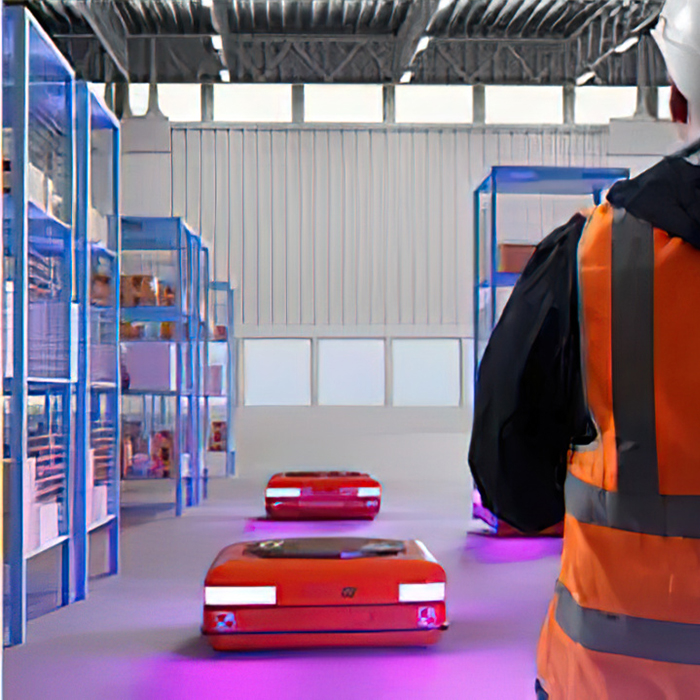

Part of the awareness gap comes from the fact that terms like AGV, AMR, and AS/RS get thrown around without much explanation. Here’s what they actually mean in practice.
Automated Guided Vehicles (AGVs) are robots that follow defined paths through a facility, typically using magnetic strips or floor sensors, to transport goods between zones. They’re reliable, consistent, and well-suited to structured environments where routes don’t change frequently. In a Goods-to-Person setup, AGVs handle the physical movement of product so workers don’t have to.
Autonomous Mobile Robots (AMRs) take that concept further. Rather than following fixed paths, AMRs navigate dynamically using onboard sensors and mapping technology. They make real-time routing decisions, adapt to changes in the environment, and can be redeployed as your operation evolves. For facilities that are growing or frequently reconfiguring their layout, AMRs provide a level of flexibility that AGVs can’t match.
Automated Storage and Retrieval Systems (AS/RS) address the storage side of the equation. Instead of storing inventory in static racking that workers have to navigate, AS/RS uses automated cranes, lifts, or shuttle systems to store and retrieve items from high-density structures, often taking full advantage of vertical space that sits unused in most facilities. When an order comes in, the system retrieves the item and delivers it to the worker’s station automatically.
Together, these systems form the backbone of a Goods-to-Person strategy. The worker stays at a fixed, ergonomically designed workstation. The technology handles all the movement.
Why the Timing Is Right to Move on This Now
A few things have converged that make right now a particularly good moment to evaluate these systems.
The cost of the technology has come down considerably over the past several years. AMRs in particular have become significantly more accessible as the market has matured and competition among manufacturers has increased. What required a large enterprise budget five years ago is now within reach for mid-market operations.
At the same time, the cost of not automating has gone up. Labor costs have increased. Turnover in warehouse roles remains persistently high. Workplace injury rates in manual picking environments create ongoing liability and workers’ compensation exposure. Every month a facility continues running a manual workflow, it’s absorbing costs that an automated system would reduce or eliminate.
The facilities that are moving on this now are the ones that will be in a fundamentally stronger competitive position in three to five years. The ones that wait will be playing catch-up, and in a high-volume fulfillment environment, falling behind on operational efficiency has real consequences for customer relationships and margins.
The Integration Gap Is the Real Barrier
Here’s what actually holds most facilities back from adopting this technology. It’s not cost, and it’s not readiness. It’s the question of how to get from where they are today to a functioning automated system without disrupting operations in the process.
That’s a legitimate concern, and it’s exactly where warehouse systems integration expertise matters. Dropping an AMR fleet or an AS/RS into an existing facility without a thoughtful integration plan creates more problems than it solves. The technology has to be mapped to your specific workflow, your facility layout, your order profile, and your growth trajectory. Done correctly, the transition is structured and phased so operations continue running while the new systems come online.
This is what separates a successful automation project from a failed one. The technology itself is reliable. The implementation approach is what determines the outcome.
What a Modern Automated Facility Actually Looks Like

When warehouse consulting, smart facility layout and design, and the right mix of GTP technology come together, the operational picture changes significantly. Workers are stationed at ergonomic pick stations rather than walking miles of aisle. AGVs and AMRs are moving product through the facility on optimized routes. AS/RS units are retrieving inventory from dense vertical storage and delivering it to the right station at the right time. Conveyor systems are moving completed orders toward shipping without manual carry.
The facility processes more orders, with fewer errors, with a workforce that isn’t being physically worn down by the job. That’s not a vision of what warehouses could look like someday. It’s what the leading operations look like today.
The Gap Between What’s Possible and What Most Facilities Are Running Is Closing
The facilities that are running these systems didn’t get there by waiting until the technology was perfect or the timing was ideal. They got there by working with experienced integration partners who could assess their specific operation, identify the right entry points for automation, and manage the implementation from start to finish.
At LD Systems, that’s exactly what we do. With 500+ completed projects and 50 years of combined integration experience, our team has helped operations across distribution, manufacturing, and e-commerce make the move from manual workflows to modern automated systems, without the disruption that keeps most facilities from pulling the trigger.
The technology is ready. The economics make sense. The only question is whether your facility is going to be among the ones leading this shift or the ones catching up to it.
Ready to See What Modern Automation Can Do for Your Operation?
If you’re running a manual or semi-manual workflow and wondering whether GTP technology is right for your facility, the best starting point is a conversation with someone who’s seen it work across dozens of real-world operations.
📩 Contact LD Systems today to schedule your free consultation and find out where automation can make the biggest difference in your warehouse.