

What Are Automated Material Handling Solutions?

Automated material handling solutions use conveyors, robotics, AS/RS, controls, and warehouse software to move, store, pick, sort, and track goods with less manual handling. The goal is not simply to add equipment. The goal is to select the right technologies, connect them through WMS, WES, WCS, and ERP systems, and create one coordinated material flow from receiving through shipping.
| Automated Material Handling Solutions at a Glance | Details |
|---|---|
| Purpose | Move, store, pick, sort, track, and route materials with less manual handling |
| Common technologies | Conveyors, AS/RS, AMRs, AGVs, sortation, robotics, WMS, WCS, WES, and controls |
| Best for | Warehouses, distribution centers, fulfillment operations, and manufacturing facilities |
| Key benefit | Improves throughput, accuracy, space utilization, labor efficiency, and material flow when properly integrated |
| Integrator role | Connects equipment, software, controls, data, and workflows into one coordinated system |
As automation in warehousing becomes more complex, the biggest performance gains often come from connecting equipment, software, controls, and workflows into one coordinated system.
Here is what that means in practice:
- Physical automation reduces manual handling in picking, putaway, replenishment, sortation, storage, and transport using conveyors, AS/RS, AMRs, robotic picking systems, and related equipment.
- Controls and software integration connect that equipment to PLCs, sensors, WCS, WES, WMS, and ERP platforms so data and work instructions move in step with the physical flow of goods.
- System design determines which technologies fit the facility’s order profile, SKU mix, throughput targets, space constraints, labor model, and growth plan.
The pressure on warehouse operations right now is real. Facilities are being asked to handle higher order volumes, tighter service expectations, labor constraints, and more complex inventory profiles. Many operations respond by purchasing robots, conveyors, or storage automation. But equipment alone rarely solves the problem.
In fact, one of the most common mistakes we see during warehouse assessments is deploying automation without a complete integration plan. A conveyor may move cartons efficiently, an AMR fleet may reduce walking, and an AS/RS may increase storage density — but if those systems do not communicate with warehouse software and controls, they can create new bottlenecks instead of removing old ones.
The real value of automated material handling comes from connected execution. WMS and ERP systems define inventory, orders, and business rules. WES and WCS platforms sequence work and direct equipment. PLCs, sensors, scanners, conveyors, robotics, and AS/RS execute the physical movement. When these layers are designed together, the facility can operate as one coordinated system rather than a collection of disconnected automation assets.
How Automated Material Handling Solutions Work
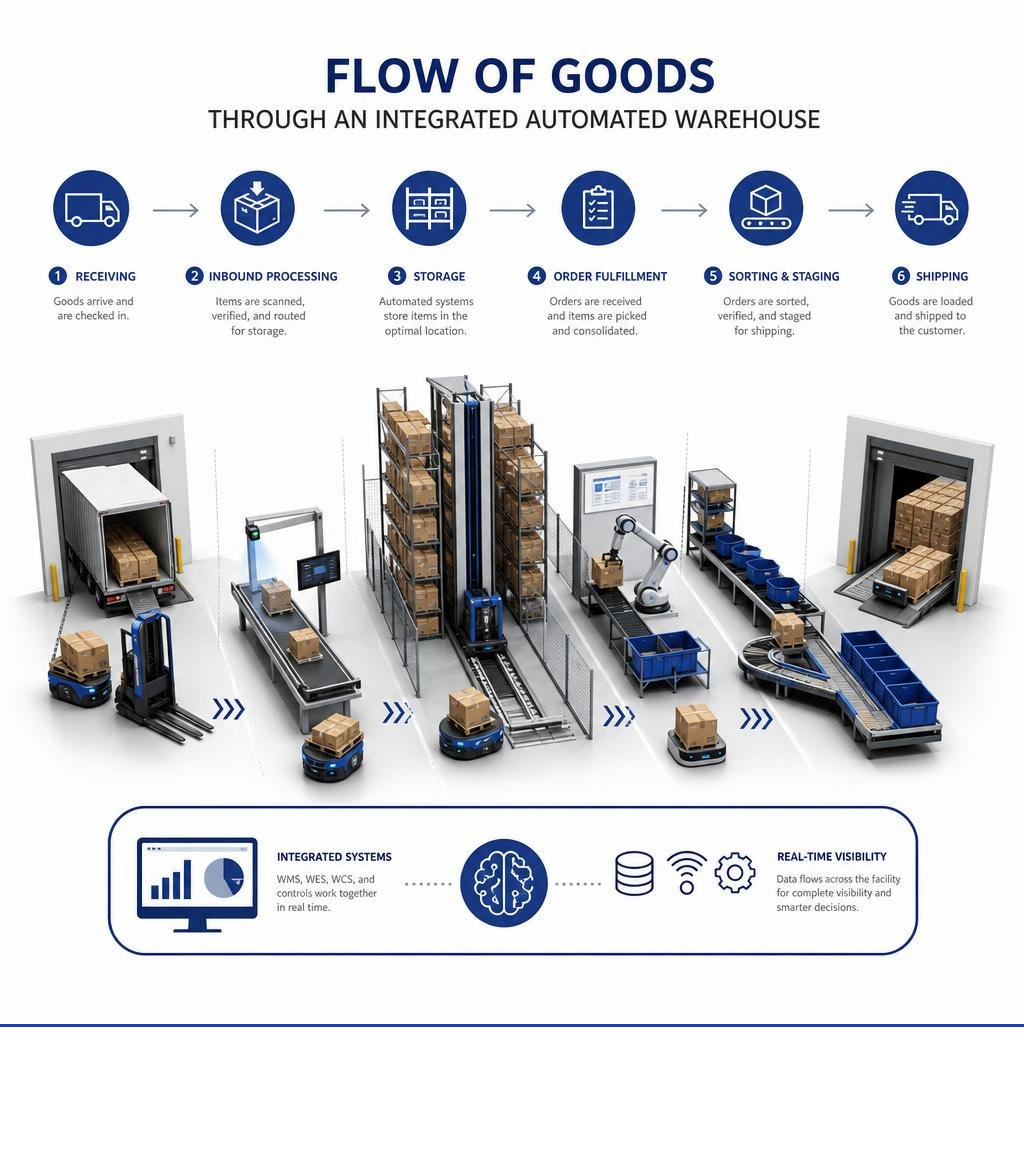
Automated material handling solutions are engineered systems that move, store, control, and track materials through a warehouse, distribution center, fulfillment operation, or manufacturing facility. They may include conveyors, sorters, pallet handling systems, AMRs, robotic picking cells, automated storage and retrieval systems (AS/RS), barcode or RFID capture, dimensioning systems, controls, and warehouse software.
A useful way to think about the system is in layers. The physical equipment provides the movement. Controls translate decisions into machine actions. Warehouse software determines what work should happen next. Systems integration connects these layers so the operation can respond to orders, inventory changes, exceptions, and capacity constraints in real time.
Why Buying Robots or Conveyors Is Not Enough
A common misconception in the logistics industry is that purchasing robotics or automated equipment will instantly solve throughput and labor challenges. In reality, buying hardware without a comprehensive integration plan often leads to isolated automation.
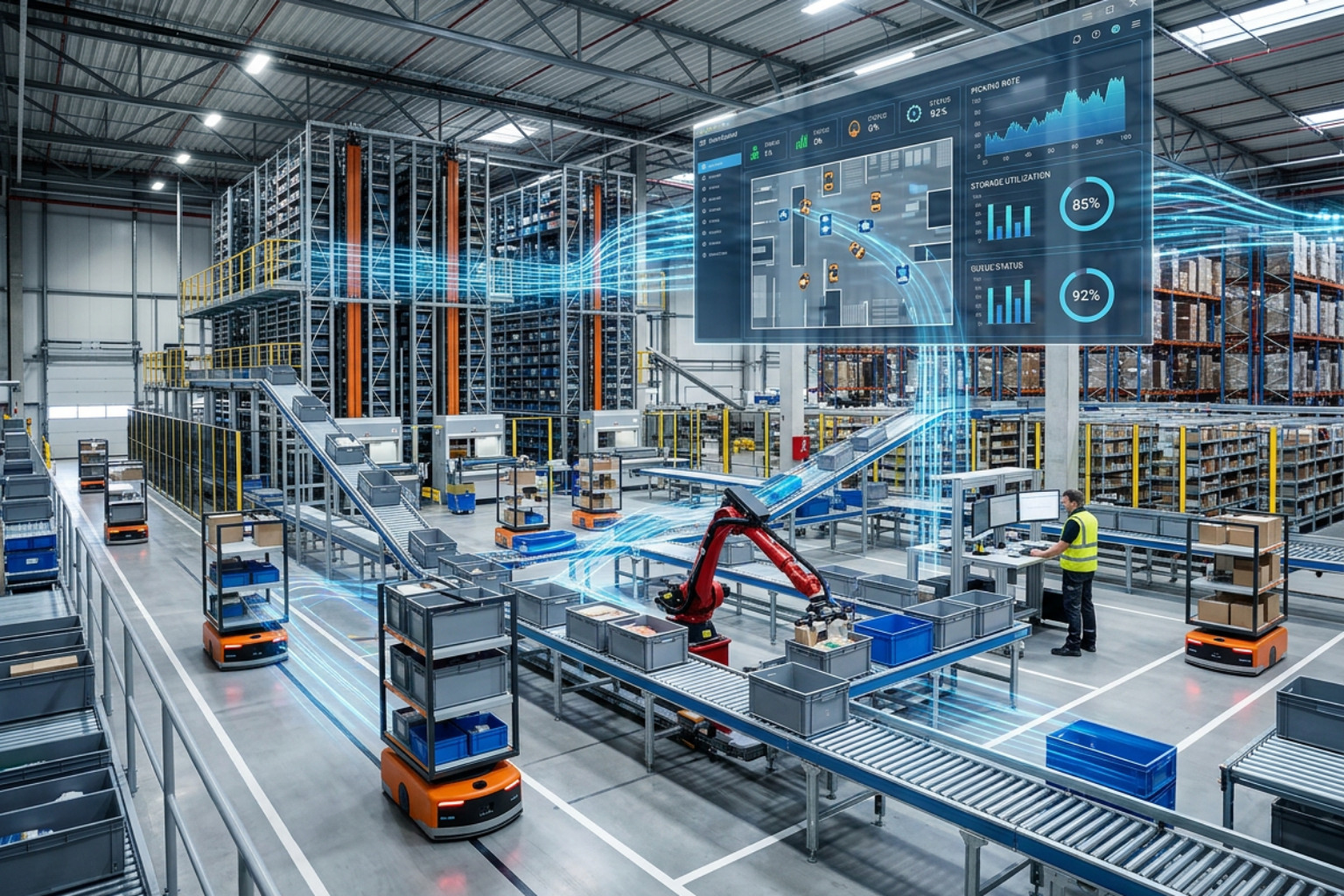
For example, an operation might deploy a fleet of AMRs to transport picked goods. However, if those robots cannot communicate with conveyor controls, the WCS, or the broader warehouse software stack, operators may still need to manually transfer totes, confirm movements, or resolve handoff points. The robots may reduce walking in one area while downstream sortation or packing becomes the new constraint.
To achieve a true return on investment, the automation must support the broader operational strategy rather than restrict it. This requires understanding the crucial role of systems integrators who evaluate the entire facility, design the physical and digital connections, and ensure that every piece of equipment works toward a common performance goal.
Successful automation in warehousing depends on more than adding robotics or conveyors; it requires clean data, process discipline, and software-connected material flow.
The Core Software Layers: WMS, WES, WCS, and ERP
Operating an automated facility requires a clear division of labor among software platforms. These systems must exchange the right data at the right time. Warehouse automation software helps coordinate orders, inventory, work queues, equipment status, and exception handling across the facility.
- Enterprise Resource Planning (ERP): The business system of record. ERP platforms often manage purchasing, finance, customer orders, inventory ownership, and enterprise-level transactions.
- Warehouse Management System (WMS): The inventory and warehouse operations platform. The WMS manages receiving, storage locations, inventory status, order allocation, picking tasks, replenishment, and shipping workflows.
- Warehouse Execution System (WES): The real-time orchestration layer. The WES can balance workloads, release orders, prioritize work queues, and coordinate activity across people, zones, and automation assets.
- Warehouse Control System (WCS): The equipment control layer. The WCS communicates with PLCs, scanners, sensors, drives, conveyors, sorters, AS/RS cranes, and other automated equipment to direct physical movement.
Successfully navigating complex software systems is one of the most critical aspects of any automation project. When these layers are properly aligned, they form a cohesive software stack that keeps the facility running smoothly. Understanding how WCS, WMS, and WES systems work together allows supply chain leaders to avoid software conflicts that can stall operations. The right warehouse automation software environment depends on the existing WMS, WCS, WES, ERP, and the level of real-time control required.
Key Challenges in Connecting Legacy Systems and New Hardware
One of the most complex hurdles in any integration project is connecting modern automation with legacy Enterprise Resource Planning (ERP) and WMS platforms. Many older, home-grown ERP systems were designed long before the advent of real-time robotics. They often lack modern Application Programming Interfaces (APIs) and rely on batch processing rather than instant data exchange.
This technical limitation can make real-time orchestration difficult. If a legacy WMS can only release orders in large, static batches (pick waving), it may not fully support the dynamic order release capabilities of modern execution software. This mismatch can lead to starvation or congestion on conveyor lines and AMR paths. Achieving reliable automation may require a middleware layer or custom-engineered interfaces that translate legacy data protocols into real-time, event-driven communications. Industry organizations such as the Material Handling Institute provide broader education and resources on material handling technologies and supply chain operations.
Overcoming Workflow Misalignment
Even the most advanced technology will fail if the facility’s physical processes are not adapted to an automated environment. Standard operating procedures (SOPs) that worked perfectly in a manual, paper-based warehouse can create massive friction when physical machinery is introduced.
For instance, manual receiving processes often allow for informal sorting or delayed data entry. In an automated system, inventory must be scanned, dimensioned, and entered into the system immediately upon arrival to allow downstream systems to execute automated putaway and replenishment.
During warehouse assessments, engineers carefully evaluate these transition points to ensure successful automation integration across all departments. Below is an example of structured SOPs required to keep an automated receiving dock running at peak efficiency:
- Advance Shipping Notice (ASN) Validation: Match incoming trailer data with the ERP prior to physical unloading.
- Automated Dimensioning and Weighing: Run inbound pallets or cases through an inline checkweigher and dimensioning system to verify physical specs against database records.
- Barcode/RFID Capture: Scan unique identifiers at the induction point to register the inventory into the WMS as part of the receiving workflow.
- Quality Control Divert: Route damaged or unidentifiable items to a dedicated manual inspection station without stopping the main flow when the system is designed for exception handling.
- Dynamic Putaway Routing: Direct the automated transport system, such as conveyor or AMR, to deliver the validated load to the appropriate storage zone based on system rules.
Mitigating the Risk of Unplanned Downtime
In a manual warehouse, if an operator’s forklift breaks down, another worker can often step in to keep the shift moving. In a highly automated facility, a component failure on a main sortation conveyor, AS/RS crane, or critical controls point can have a broader operational impact if redundancy and recovery plans are not built into the system.
To protect against this vulnerability, integrated systems can use advanced control software to provide diagnostics and real-time machine monitoring. By tracking signals such as motor temperatures, vibration levels, sensor response times, and fault patterns, the system can alert maintenance teams to potential issues before they become larger disruptions.
| Operational Metric | Manual Warehouse Workflow | Integrated Automated Workflow |
|---|---|---|
| Order Picking Travel Time | Often requires operators to spend significant time walking between aisles and work areas. | Goods-to-person systems can bring items directly to stationary operators, reducing travel when properly designed. |
| Inventory Accuracy | Dependent on manual cycle counts and data entry discipline. | Automated scans and system-directed confirmations can improve inventory accuracy when data and workflows are maintained correctly. |
| Throughput Control | Highly variable; dependent on labor availability and individual speed. | More consistent pace managed by software orchestration, equipment capacity, and real-time work sequencing. |
| Downtime Impact | Lower systemic risk in some areas because failures may be isolated to individual manual processes. | Higher systemic risk if critical automation points lack redundancy; managed through diagnostics, maintenance planning, and lifecycle support. |
Evaluating the Business Impact: ROI, Throughput, and Customer Experience
Investing in automation is a major financial commitment, and the business case depends on the scale of the facility, the technologies selected, the current labor model, and the complexity of the software integration. Many automation projects are evaluated over a multi-year payback period. ROI depends on labor savings, space recovery, throughput gains, error reduction, avoided expansion costs, and system scope.
Documented LD Systems case studies show how integration can produce measurable results when the technology matches the operation. In the HSN case study, LD Systems supported an automated garment-on-hanger system that reduced order cycle time from 2 hours to 20 minutes, achieved 99.94% order accuracy, and delivered a 50% boost in productivity. In the Tucson Electric Power case study, LD Systems helped reduce retrieval time by 75%, improve accuracy to 99.7%, and boost productivity by 50%. These examples show why systems integration matters: the performance gains came from the full workflow design, not from isolated equipment alone.
Automated material handling solutions can improve storage density, throughput, accuracy, and labor efficiency, but results depend on facility layout, SKU profile, software integration, order volume, peak demand patterns, and system design. A well-integrated system uses the right mix of storage automation, transport equipment, controls, and software orchestration to lower friction in the highest-impact parts of the operation.
How Systems Integration Drives Measurable ROI
The financial return on an integration project is driven by direct, measurable improvements in daily operations. In manual picking environments, walking, searching, waiting, and exception handling can consume a meaningful share of productive labor time. By integrating goods-to-person systems, conveyors, AMRs, or other automated workflows, facilities can reduce unnecessary travel and allow operators to focus more time on value-added picking, packing, replenishment, or exception-resolution tasks.
For example, an operation may improve putaway or fulfillment efficiency by integrating automated transport, storage, and conveyor systems with the WMS and controls layer. The improvement is not simply the result of buying high-performing equipment; it comes from coordinating handoffs between robots, conveyors, storage systems, operators, and warehouse software. In documented LD Systems projects, integrated automation has produced outcomes such as reduced order cycle time, improved productivity, higher order accuracy, and increased pick faces, depending on the facility, technology, and implementation scope.
Additional LD Systems case studies show how different material handling designs can support different operational goals. The Chico’s case study documents tripled picking productivity, reduced order errors, and reduced order cycle time from 3 hours to 30 minutes. The WIX Filters case study documents a 400% increase in product facings, a 60% improvement in productivity, and a two-thirds reduction in order cycle time. The Thomson case study documents a 50% improvement in productivity, 99.93% order accuracy, and reduced order cycle time from 2 hours to 25 minutes.
By focusing on warehouse optimization through unified systems design, businesses can identify the workflows where automation is most likely to improve capacity, labor efficiency, accuracy, or space utilization.
Elevating the End-Customer Experience
In the modern supply chain, the speed and reliability of your warehouse operations directly impact your brand’s reputation. Customers and downstream partners expect timely fulfillment, accurate orders, and clear visibility into order status.
When warehouse systems are fully integrated, order release, picking, verification, packing, and shipping can move with fewer manual handoffs and fewer disconnected data steps. Automated barcode verification, pick-to-light systems, weight checks, and system-directed workflows can reduce errors before packages leave the facility. This level of operational discipline helps support faster shipping windows, stronger service level performance, and more reliable customer communication.
Best Practices for Planning and Executing an Integration Project
A successful integration project is built on careful planning, detailed data analysis, and structured engineering phases. The journey begins long before any equipment is purchased.
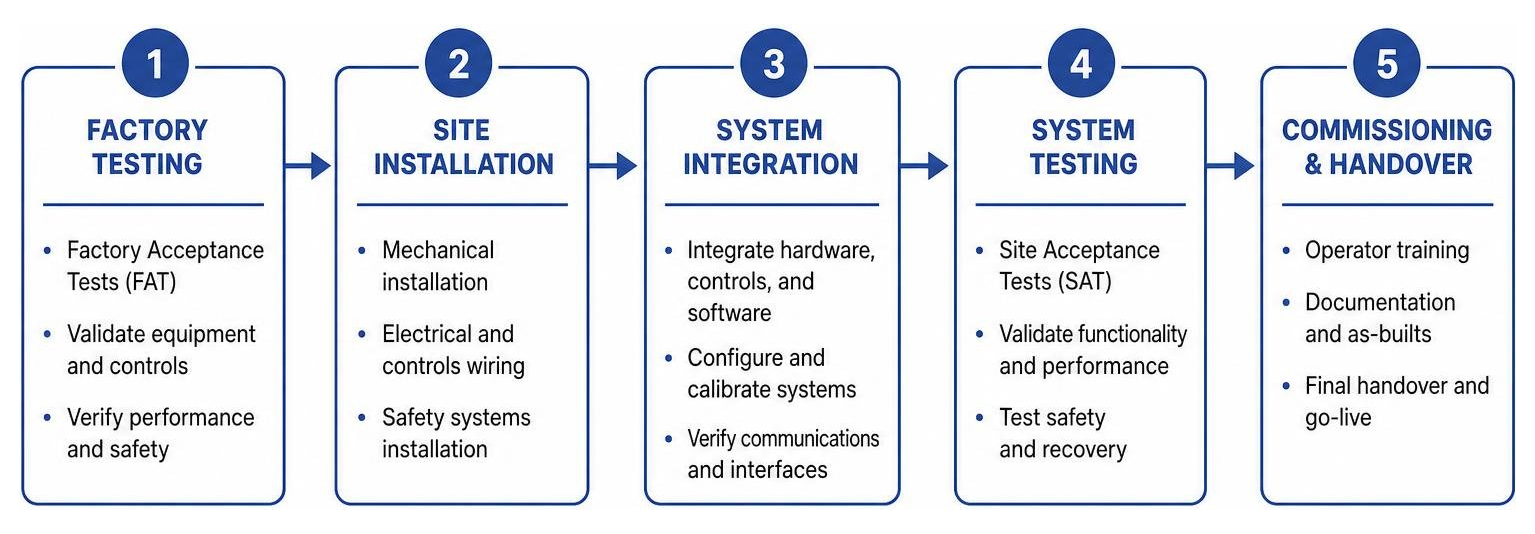
During the initial design-build evaluation, engineers gather historical order profiles, inventory data, and growth projections to model material flows through the facility. This data-driven approach ensures the selected technology is right-sized for the operation’s peak demand periods, rather than its average daily volume. Once the design is finalized, the implementation must follow a structured path of mechanical installation, controls wiring, software configuration, and rigorous testing.
Selecting the Right Integration Partner
Choosing an integration partner is one of the most critical decisions a company will make. For many automation projects, an independent, technology-agnostic integrator can help evaluate the best-fit combination of equipment, software, controls, and workflows.
Furthermore, working with an integrator who provides single-point accountability helps reduce the common “finger-pointing” that can occur when multiple vendors are left to connect their own equipment. Understanding why use a systems integrator who manages the entire lifecycle — from initial consulting through post-go-live support and lifecycle service — is the best way to ensure project success.
Designing for Long-Term Scalability
Your business will not look the same in three to five years, and your automation shouldn’t either. A forward-looking integration design prioritizes modularity. Modular conveyor systems, scalable AMR fleets, and flexible software platforms allow you to expand your throughput and storage capacity without rebuilding your core infrastructure.
This scalability is equally important whether you are executing a brownfield retrofit (upgrading an existing, operational facility) or building a greenfield distribution center from the ground up. By navigating warehouse automation options with a focus on future-ready designs, you protect your capital investment from technology obsolescence and ensure your supply chain can grow alongside your business.
Frequently Asked Questions About Warehouse Systems Integration
What is the difference between a robotics supplier and a systems integrator?
A robotics supplier manufactures and sells specific automated hardware, such as robotic arms or AMRs. Their focus is on the mechanical performance of their specific product. A systems integrator is an engineering partner that designs the entire automated system. They select the right equipment from various manufacturers, design the physical layouts, write the controls logic, and build the software interfaces to connect everything into a single, cohesive workflow.
How long does a typical warehouse systems integration project take?
Timelines vary based on project scope, equipment lead times, facility readiness, software integration, installation phasing, and commissioning requirements. A focused storage, conveyor, or controls upgrade may move faster than a full-facility automation project involving AS/RS, robotics, custom software interfaces, and complex commissioning.
Can automation be integrated into an existing brownfield facility?
Yes. Retrofitting existing brownfield facilities is common, but it requires careful phasing, installation planning, software testing, and commissioning to limit disruption.
How LD Systems Supports Automated Material Handling Integration
Achieving a high-performing, automated warehouse requires more than just purchasing advanced machinery. It requires a dedicated engineering partner who can bridge the gap between physical hardware and complex software systems.
LD Systems brings more than 50 years of combined experience to help midsize and large organizations design, engineer, and implement tailored, scalable warehouse automation systems. By taking a technology-agnostic approach, LD Systems focuses entirely on your specific operational goals — improving throughput, increasing storage density, supporting labor planning, and reducing operational friction.
From initial consulting and data-driven design-build evaluations to installation coordination and lifecycle support, LD Systems provides the single-point accountability needed to help reduce bottlenecks, data silos, and inefficiencies across the operation.
Ready to evaluate automated material handling solutions for your warehouse, distribution center, or manufacturing facility? LD Systems can assess your material flow, identify integration gaps, and design a scalable automation strategy built around your facility’s real operational requirements. Explore how LD Systems uses systems integration for warehouse process improvement, or contact the team to start a facility assessment.
