

What Is Industrial Automation?

Industrial automation is the use of equipment, controls, sensors, robotics, and software to move, store, process, track, or route materials with less manual intervention. In warehouses, distribution centers, fulfillment operations, and manufacturing facilities with warehouse-side material handling workflows, industrial automation often includes conveyors, sortation systems, AS/RS, AMRs, AGVs, robotic handling, PLC controls, WMS, WCS, and WES integration.
For LD Systems, industrial automation is not about choosing one product or platform first. It is about evaluating the facility’s material flow, SKU profile, throughput requirements, labor model, storage constraints, software environment, and growth plan before designing an integrated automation system.
| Industrial Automation Area | Warehouse-Side Example | Operational Goal |
|---|---|---|
| Material movement | Conveyors, sortation, AMRs, AGVs, pallet handling | Reduce manual travel and improve flow between zones |
| Storage and retrieval | AS/RS, VLMs, pallet shuttles, high-density storage | Improve storage density and controlled access |
| Picking and fulfillment | Goods-to-person, pick-to-light, voice picking, robotic picking | Improve speed, accuracy, and ergonomics |
| Controls and software | PLCs, WMS, WCS, WES, scanners, sensors | Coordinate equipment, inventory, and execution logic |
| Systems integration | Connected equipment, controls, software, and workflows | Turn isolated technologies into one coordinated system |
Industrial Automation vs. Warehouse Automation
Industrial automation is the broader category of using equipment, controls, sensors, robotics, and software to improve operational processes. Warehouse automation is one application of industrial automation focused on how materials move through receiving, storage, replenishment, picking, packing, sortation, shipping, and returns.
For warehouses, distribution centers, fulfillment operations, and manufacturing facilities with warehouse-side material handling workflows, the most important question is not which automation product to buy first. It is how conveyors, storage systems, robotics, controls, WMS, WCS, WES, and facility workflows should work together to improve material flow.
This guide explains how industrial automation applies to warehouse automation, material handling systems, distribution center automation, and manufacturing facilities with warehouse-side material handling workflows. It focuses on which technologies fit which operational problems, what integration requirements matter, and how to plan ROI around facility-specific data rather than broad industry averages.
Industrial Automation in Modern Warehouse Operations
Industrial automation has evolved from isolated machine control to integrated systems that connect physical equipment, software, controls, and operational data. In a warehouse or distribution center, that means conveyors, storage systems, scanners, robotics, WMS, WCS, WES, and PLC controls need to work together rather than operate as separate islands of automation.
The most important shift is integration. A conveyor, AS/RS, AMR fleet, or robotic cell may solve one local problem, but the full value comes when those technologies are coordinated with inventory rules, replenishment timing, order release, picking, packing, sortation, and shipping.
For operations leaders, this makes industrial automation a planning discipline as much as a technology decision. The right system depends on how materials move through the building, where labor is concentrated, how orders are released, which SKUs create exceptions, and where current systems fail to share timely data.
That is why LD Systems evaluates automation through the lens of material flow, controls engineering, warehouse systems integration, and implementation risk. The goal is not simply to add equipment. The goal is to create a coordinated operating environment where equipment, software, people, and processes support measurable outcomes.
Core Layers of Industrial Automation
In warehouse and distribution environments, industrial automation typically works across three connected layers: physical equipment, controls, and software.
| Automation Layer | What It Includes | Why It Matters |
|---|---|---|
| Physical equipment | Conveyors, sorters, AS/RS, AMRs, AGVs, robotics, pallet handling, scanners, sensors | Moves, stores, retrieves, sorts, or verifies materials |
| Controls | PLCs, sensors, actuators, safety devices, routing logic, equipment-level commands | Ensures equipment responds correctly and safely |
| Software | WMS, WCS, WES, ERP connections, dashboards, operational data | Coordinates inventory, order flow, labor, automation, and execution priorities |
This warehouse-side architecture keeps the focus on how materials move through the operation. A conveyor, sorter, AS/RS, AMR fleet, robotic cell, scanner network, or pallet handling system only creates full value when the controls and software layers are designed to support the same material flow.
Physical Equipment and Controls in Industrial Automation
At the physical and controls layers, equipment reliability determines whether the automation strategy can support daily throughput. PLCs, sensors, actuators, drives, safety devices, scanners, and routing logic help equipment move, verify, and sequence materials in a predictable way.
In warehouse and distribution environments, this layer may include conveyors, sorters, pallet handling systems, AS/RS, VLMs, AGVs, AMRs, robotic palletizing, depalletizing, case handling, and goods-to-person systems. If you are new to these technologies, reviewing a robotic solutions beginner’s guide can help clarify how articulated arms, gantry systems, AMRs, and other robotic approaches fit different material handling applications.
When these components are integrated correctly, they can help facilities manage varied carton sizes, pallet profiles, storage locations, routing rules, and order priorities without relying on manual intervention at every step.
The Software Layer: WMS, WCS, WES, and Systems Integration
If physical equipment is the muscle of industrial automation, software and controls integration are the nervous system. WMS, WCS, WES, ERP connections, dashboards, and operational data coordinate how work is released, routed, verified, and reported.
One of the main challenges of modern automation is not buying software or equipment in isolation. During warehouse assessments, engineering teams frequently find islands of automation, such as a standalone palletizer, sorter, AS/RS, or conveyor zone that cannot communicate cleanly with upstream processes, downstream equipment, or the WMS.
Achieving a unified operational flow requires coordinated warehouse systems integration. This integration connects scanners, PLCs, databases, ERPs, WMS, WCS, WES, and material handling equipment into a coordinated environment, turning siloed machine data into more useful visibility for inventory management, labor planning, exception handling, and performance improvement.
Four Types of Industrial Automation Systems
Not all automation is created equal. Depending on your order volume, SKU profile, product variety, facility layout, and long-term business goals, your operation may be better suited to a specific type of automation system.
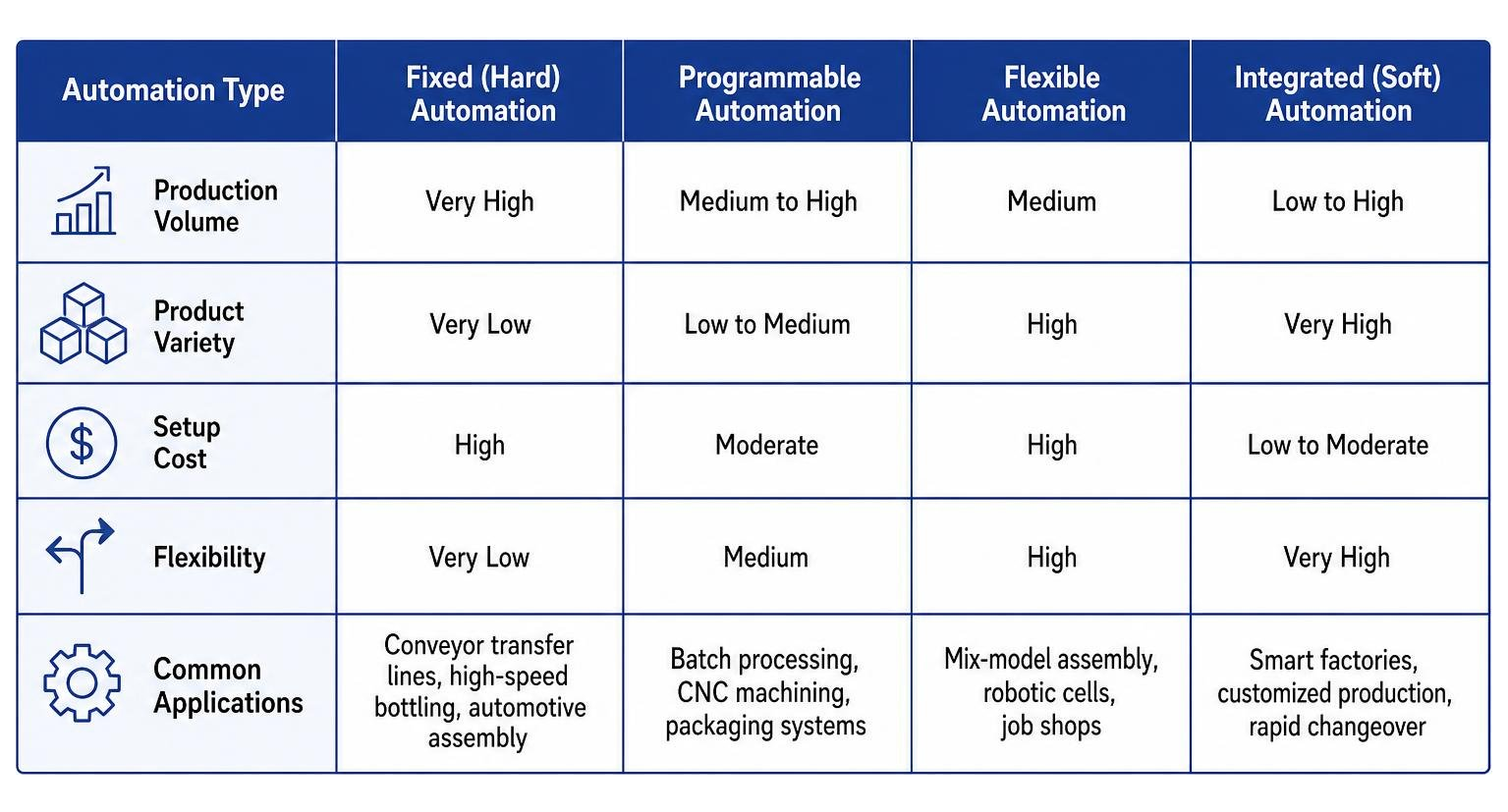
To help determine which approach makes sense for your operation, consider this comparison of the four primary automation types:
| Automation Type | Production or Order Volume | Product or SKU Variety | Setup Cost | Flexibility | Common Warehouse and Material Handling Applications |
|---|---|---|---|---|---|
| Fixed (Hard) Automation | Very High | Very Low | High | Very Low | High-speed conveyors, sortation lines, pallet handling, dedicated transfer lines |
| Programmable Automation | Medium to High | Low to Medium | Medium | Medium | Batch handling, repeatable palletizing, programmed conveyor routing, controlled process zones |
| Flexible (Soft) Automation | Medium | Medium to High | High | High | AMRs, robotic palletizing, goods-to-person workflows, configurable picking and routing |
| Integrated Automation | High | High | Very High | Very High | Coordinated distribution centers, connected WMS/WCS/WES, AS/RS, sortation, robotics, and controls |
Fixed Automation
Also known as hard automation, this system is designed to perform a single, repetitive task at high volume. The sequence of operations is largely fixed by the physical equipment configuration. In a warehouse, this may include dedicated conveyor transfer lines, high-speed sortation, or pallet handling lanes. While the initial capital barrier can be high, the cost per move may be favorable once the system is running. However, making changes to the process can require downtime and physical re-engineering.
Programmable Automation
This type is designed for repeatable workflows that can be reconfigured between runs or operational modes. When a new handling pattern, palletizing logic, or routing profile is needed, the equipment and controlling software can be adjusted to accommodate the new requirements. This is useful for facilities with recurring process variations, though changeovers still require careful planning and validation.
Flexible Automation
Often referred to as soft automation, flexible systems are an evolution of programmable automation. They use advanced software, PLCs, sensors, and electromechanical controls to adapt to different product sizes, packaging types, routing paths, and order priorities with limited downtime.
In distribution centers, flexible automation may include AMRs that reroute dynamically, robotic systems that handle varied cases or totes, or goods-to-person systems that adapt to changing order profiles. The value depends on whether the system can be integrated into the broader inventory, replenishment, picking, packing, and shipping workflow.
Integrated Automation
This represents the most coordinated approach to warehouse and material handling automation. Integrated automation connects equipment, controls, software, data, and operational processes under a unified design.
For a step-by-step framework on planning and executing these complex, facility-wide systems, refer to our comprehensive warehouse automation systems implementation guide.
When Industrial Automation May Not Be the First Step
Industrial automation is most effective when the underlying process is stable enough to support it. If inventory accuracy is poor, SKU dimensions are missing, receiving processes are inconsistent, replenishment rules are unclear, or WMS discipline is weak, automation may expose those problems faster instead of solving them.
In some facilities, the better first step is data cleanup, slotting improvement, workflow standardization, layout redesign, or WMS/WCS configuration before adding major equipment. A systems integrator can help determine whether the operation is ready for automation or whether process improvements should come first.
Industrial Automation Benefits for Warehouse Operations
Implementing an integrated automation strategy is not just about replacing manual labor; it is about upgrading operational capability around the facility’s actual constraints. When designed and executed correctly, the business value of these systems can span several key areas:
- Throughput and Productivity: Automated systems can help facilities maintain more consistent cycle times and increase daily capacity when the equipment, labor model, and order profile are aligned.
- Inventory Accuracy and Quality: Automated scanning, verification, and routing can reduce manual touches and help improve picking, sorting, and shipping accuracy.
- Storage Density: Automated systems, such as high-density storage racks and shuttles, can help operations make better use of their existing footprint and delay or reduce the need for building expansion.
- Workplace Safety and Ergonomics: Automation can move workers away from repetitive lifting, long travel paths, awkward reaches, and other physically demanding activities when the system is designed around safe operator flow.
- Scalability: Integrated systems can make it easier to handle growth, seasonal peaks, and changing order profiles because equipment, controls, and software are planned as one operating environment.
To identify which parts of your facility are best suited for these upgrades, you can review the fulfillment areas ripe for automation.
Navigating the Challenges, Workforce Impacts, and Risks of Industrial Automation
While the benefits are clear, implementing industrial automation is not without its hurdles. Understanding these risks upfront is critical to ensuring a successful deployment.
Addressing the High Capital Costs and Implementation Risks of Industrial Automation
The most immediate barrier to automation is the initial capital expenditure. These systems require a significant upfront investment in equipment, software, controls engineering, installation, testing, training, and facility prep work. Because of this, calculating a realistic return on investment is essential.
For LD Systems, ROI planning starts with facility-specific data rather than broad performance assumptions. Order volume, SKU velocity, storage profile, travel distance, labor model, uptime requirements, error rates, seasonal peaks, and software readiness all influence whether automation will deliver the expected result.
One factor many operations overlook during planning is the cost of integration. Buying individual pieces of equipment is relatively simple; getting them to function as a unified, reliable system is where projects often stall. Unplanned downtime, software conflicts, poor data quality, and disconnected controls can quickly erode the expected ROI.
As facilities connect more equipment, controls, and software, cybersecurity and operational technology risk should be reviewed with qualified IT, OT, and security stakeholders. NIST’s Cybersecurity Framework Manufacturing Profile is one useful reference for organizations evaluating risk management practices in connected industrial environments.
To navigate these complexities and reduce implementation risk, operations should establish clear project milestones, integration testing protocols, software responsibilities, operator training plans, and realistic go-live timelines.
Workforce and Change Management Considerations
Industrial automation changes how warehouse and manufacturing teams work. Instead of spending as much time walking, searching, lifting, or transporting materials, employees may shift toward operating workstations, managing exceptions, supporting replenishment, monitoring equipment, performing quality checks, and maintaining automated systems.
The transition should be planned early. Training, maintenance access, safety procedures, operator flow, and supervisor visibility all affect whether the system performs well after installation.
This is why change management should be part of the automation plan rather than an afterthought. Supervisors, operators, maintenance teams, IT stakeholders, and safety leaders all need to understand how the system will affect daily work before go-live.
Industrial Automation Case Studies from LD Systems
LD Systems case studies show how industrial automation can improve warehouse and distribution performance when equipment, controls, software, and facility flow are designed together.
- Rite Aid distribution facility case study: LD Systems supported a high-volume distribution operation that achieved a 300% throughput increase, a 40% productivity boost, and 99.93% order accuracy.
- HSN order cycle time case study: An automated garment-on-hanger system reduced order cycle time from 2 hours to 20 minutes, achieved 99.94% order accuracy, and delivered a 50% productivity boost.
- Neuco conveyor controls modernization case study: LD Systems replaced proprietary conveyor controls with an open PLC-based architecture, improved operational and historical data access through SQL databases, and established a scalable WCS architecture.
- ROi surgical kit manufacturing case study: LD Systems supported a healthcare manufacturing and distribution operation with 2,500 raw materials and 1,100 CPTs, helping achieve a 65% productivity increase and 99.96% kit assembly accuracy.
These results are project-specific, but they show why industrial automation should be evaluated as an integrated system rather than a collection of isolated equipment purchases.
Frequently Asked Questions About Industrial Automation
What is the difference between fixed and flexible automation?
Fixed automation is designed around a repeatable process or material flow with limited variation. In warehouse and distribution environments, this may include dedicated conveyor lines, sortation systems, or pallet handling paths designed for consistent movement patterns.
Flexible automation is designed to handle more variation in product size, packaging type, routing path, order priority, or SKU mix. Examples may include AMRs, goods-to-person systems, configurable routing logic, and robotic systems that can support changing workflows with less physical reconfiguration.
How does industrial automation impact workforce requirements?
Automation shifts some work away from repetitive walking, lifting, scanning, transporting, and sorting. Depending on the facility and system design, employees may spend more time operating workstations, managing exceptions, monitoring equipment, supporting replenishment, performing quality checks, and maintaining automated systems.
What is the typical ROI timeline for an industrial automation project?
There is no universal ROI timeline for an industrial automation project. Payback depends on labor model, order volume, SKU profile, storage constraints, facility layout, technology selection, software integration, implementation scope, and the operational problems being solved.
In certain applications, LD Systems has helped automation projects target measurable ROI in as little as 17 months. Actual results vary by facility and project design.
How LD Systems Supports Industrial Automation Projects
Industrial automation projects succeed when equipment, controls, software, layout, and operational workflows are designed around the facility’s actual requirements. That includes SKU profile, order volume, labor model, storage constraints, picking strategy, software environment, safety requirements, and future growth plans.
LD Systems helps warehouses, distribution centers, fulfillment operations, and manufacturing facilities evaluate automation opportunities, identify bottlenecks, select the right mix of technologies, and integrate material handling equipment, controls, and warehouse software into one coordinated system.
Choosing an automation equipment company or industrial automation product is not the same as designing an integrated system. A systems integrator evaluates how equipment, controls, software, layout, and workflows need to function together before recommending a technology mix.
As a technology-agnostic warehouse systems integrator, LD Systems does not manufacture individual equipment or force a single vendor approach. The team focuses on designing industrial automation solutions that fit the operation rather than forcing the operation around a product.
The result is an engineered automation strategy built around facility data, material flow, controls integration, software requirements, and long-term scalability.
Ready to evaluate industrial automation opportunities in your facility? Request a consultation with LD Systems to review your layout, material flow, software integration needs, and automation priorities.
