


Executive Summary: Warehouse automation systems combine software, equipment, robotics, and engineered workflows to improve throughput, inventory accuracy, labor efficiency, and scalability across warehouse and distribution operations.
In this guide, you’ll learn how warehouse automation systems work, the technologies involved, when automation makes sense, common implementation mistakes, and how to evaluate the right solution for your operation.
Warehouse automation systems combine software, controls, robotics, storage technologies, and material handling equipment to automate receiving, storage, picking, packing, and shipping—helping facilities improve throughput, reduce labor dependency, and increase inventory accuracy.
Today’s warehouse and distribution operations face greater pressure than ever to improve throughput, accuracy, labor efficiency, and scalability. E-commerce growth is pushing global retail sales toward $7.4 trillion. More than 40% of U.S. consumers now expect delivery within two to three days, and 27% want same-day fulfillment. Meanwhile, finding and keeping qualified warehouse workers gets harder every year; U.S. Bureau of Labor Statistics data for warehousing and storage employment trends helps show why labor planning remains a strategic issue for distribution operations.
Operations managers are being asked to do more — faster, with greater accuracy, and often with fewer people — inside the same four walls they had five years ago. In many facilities, the problem is not one broken process. It is that receiving, put-away, picking, replenishment, packing, and shipping are each slightly inefficient, and those inefficiencies compound across every shift.
Effective warehouse automation addresses these challenges through engineered systems rather than isolated pieces of equipment. The right system connects technology to the workflows that create the largest bottlenecks, whether that means reducing travel time, improving inventory accuracy, increasing storage density, or stabilizing throughput during peak demand.
A warehouse automation system is an integrated combination of equipment, controls, software, and workflow design that automates receiving, storage, picking, packing, sorting, replenishment, and shipping tasks.
Signs Your Warehouse May Be Ready for Automation
While every operation is different, several indicators consistently suggest that automation deserves serious consideration. If several of the signs below apply to your facility, it may be time to compare manual improvements against a more structured automation solution:
| Sign Automation May Be Worth Considering | What It Usually Indicates |
|---|---|
| Labor shortages are affecting productivity | Throughput depends too heavily on hard-to-fill roles |
| Order volumes continue to grow | Current workflows may not scale quickly enough |
| Picking accuracy is declining | Manual picking, sorting, or data entry is creating avoidable rework |
| Employees spend excessive time walking between locations | Travel time is consuming too much productive labor |
| Existing warehouse space is nearing capacity | The facility needs more storage density without relocating |
| Overtime has become routine | Capacity is being added through labor hours instead of process efficiency |
| Seasonal demand creates recurring bottlenecks | Manual workflows cannot flex quickly enough during peak demand |
| Customers expect faster fulfillment than current processes can support | Service-level expectations are outpacing existing processes |
This framework does not automatically mean a facility needs advanced robotics. In many cases, the right first step is basic warehousing automation such as conveyor upgrades, barcode scanning, pick-to-light, or better WMS-directed workflows. A common finding in our facility reviews is that the highest-ROI opportunity is not always the most advanced technology; it is often the process that removes the most walking, rehandling, or decision-making from daily work.
Wondering if your operation is ready?
LD Systems performs operational assessments that identify where automation can deliver the highest ROI—often before recommending any equipment.
Defining Warehouse Automation Systems: Levels of Technology Integration
When evaluating how to modernize your facility, a common misconception is that you must choose between a fully manual operation and a lights-out, fully robotic facility. In reality, warehouse automation is not an all-or-nothing proposition. It exists on a spectrum of technology integration.
To design a system that fits your operational profile, we look at material handling processes through the lens of digital and physical integration. Digital automation focuses on data capture and software orchestration, while physical automation introduces machinery to reduce manual touches. One pattern we frequently see during warehouse assessments is that companies initially focus on purchasing equipment when the larger issue is workflow design. In many projects, redesigning inventory flow delivers measurable improvements before the first conveyor or robot is installed. The sweet spot for most growing companies lies in finding the right balance between the two, which is where professional warehouse systems integration and broader material handling systems planning become critical.
To help operations leaders navigate their options, the industry generally categorizes automation into four distinct levels:
- Basic Automation: Primarily targets simple, repetitive tasks. It utilizes straightforward mechanical assistance and data collection tools to streamline localized workflows.
- System Automation: Driven by software platforms like warehouse management systems (WMS) to coordinate workflows, track inventory, and optimize pick paths without necessarily adding heavy physical machinery.
- Mechanized Automation: Introduces advanced physical equipment, such as robotic arms or automated vehicles, to assist human workers with heavy lifting, transport, and sorting.
- Advanced Automation: Combines sophisticated software, physical robotics, and artificial intelligence (AI) to create highly autonomous workflows that adapt to real-time operational shifts.

By understanding where your current facility sits on this spectrum, you can identify the logical next step for your operation without over-engineering your workflows.
Basic vs. Advanced Automation Levels
The leap from basic to advanced automation represents a shift from localized task improvement to facility-wide optimization.
At the basic level, operations rely on tools like traditional conveyor systems and handheld barcode scanners. These systems excel at moving goods from Point A to Point B and capturing data at key touchpoints. While highly reliable, basic automation still requires significant human intervention to make decisions, route materials, and perform the actual picking and packing tasks.
Advanced automation, by contrast, removes the physical and cognitive bottlenecks of manual material handling. It integrates physical machinery with a centralized software brain, including warehouse control systems that coordinate conveyors, AS/RS, robotics, and other equipment. Instead of a worker walking miles of aisles to scan barcodes and push carts, an advanced system uses intelligent routing, predictive algorithms, and dynamic machine control to deliver goods directly to the worker. This transition reduces physical strain, eliminates human decision errors, and dramatically increases throughput capacity.
Core Technologies Behind Warehouse Automation Systems
The landscape of modern distribution is shifting rapidly, driven by the need for extreme flexibility. Online retail sales of physical goods are expected to approach $1.4 trillion, forcing operations to handle smaller, more frequent, and more diverse orders. The annual MHI Industry Report reinforces this broader shift toward supply chain innovation, automation, robotics, and data-connected operations.
Rather than relying on rigid, bolted-down infrastructure that is difficult to modify, modern warehouse design prioritizes modularity. The goal is to implement systems that can be expanded, reconfigured, or relocated as business profiles change. Several key technology families are leading this shift, offering high-density storage, rapid transport, and precise picking assistance.

The Role of AS/RS within Warehouse Automation
AS/RS systems are the cornerstone of modern space optimization. These systems use cranes, shuttles, or vertical lift modules to automatically place and retrieve loads from high-density storage locations.
If you are unfamiliar with how these systems operate, we suggest starting with our introductory guides on what automated storage and retrieval systems are and automated storage and retrieval systems.
The primary operational advantage of AS/RS is its ability to utilize vertical warehouse space. By condensing storage footprints, companies can avoid the massive capital expenditure of building new facilities or moving to larger real estate. Additionally, because these systems are completely enclosed and software-controlled, they deliver near-perfect inventory control and eliminate the product damage often associated with manual forklift operations.
Integrating Mobile Robotics into Warehouse Automation
The market for mobile robots is expected to more than triple in value, growing from $4.5 billion in 2023 to more than $14 billion by 2027. This explosive growth is driven by two distinct classes of vehicles: Autonomous Mobile Robots (AMRs) and Automated Guided Vehicles (AGVs), both of which fall under broader warehouse robotics strategies.
To understand how these mobile platforms navigate your facility, it helps to compare their underlying guidance systems:
- Automated Guided Vehicles AGVs: These vehicles navigate along fixed paths using magnetic tape, embedded wires, or optical markers. They are highly efficient for repeatable, heavy-payload transport—such as moving pallets from receiving to storage—but require a structured environment and will stop if an obstacle blocks their path.
- Autonomous Mobile Robot AMR: These robots use onboard sensors, cameras, and LiDAR to build a digital map of the warehouse. They can navigate dynamically, meaning if a pallet or worker blocks their path, the AMR will calculate a safe route around the obstacle.
Integrating these mobile platforms into your material handling flow allows you to automate horizontal travel, keeping your human workforce focused on high-value tasks at stationary workstations.
Light-Directed and Voice-Assisted Picking Solutions
For operations where manual picking remains necessary due to product variety or delicate handling requirements, light-directed and voice-assisted technologies offer a highly effective middle ground.
A light-directed pick-to-light system uses digital displays mounted on rack faces or shelving units. When an order is active, the system illuminates a light at the correct storage location and displays the exact quantity to pick. Once the worker retrieves the items, they press a button to confirm the action, and the next location lights up.
Voice picking takes a similar hands-free approach, using speech-recognition software and mobile headsets to guide workers through their tasks. Both technologies eliminate the need for paper pick lists, reduce training time for seasonal staff, and raise picking accuracy to over 99%.
Warehouse Processes Ripe for Automation
Every touchpoint in a warehouse represents a cost, a potential delay, and an opportunity for error. During warehouse assessments, we look at the entire flow of goods to determine where automation will deliver the greatest operational impact.
The table below outlines how key processes shift when transitioning from manual methods to automated systems:
| Warehouse Process | Manual Approach | Automated Solution | Operational Impact |
|---|---|---|---|
| Receiving | Manual paper log, visual inspection, manual put-away | Conveyor scanning, RFID portals, automated WMS logging | Faster dock-to-stock times, eliminated data entry errors |
| Storage & Put-away | Forklifts driving aisles, manual slotting decisions | AS/RS, shuttle systems, software-directed slotting | Maximize vertical space, perfect inventory location tracking |
| Order Picking | Workers walking aisles with carts and paper lists | Goods-to-Person (GTP), AMRs, Pick-to-Light | Up to 3x increase in picking speed, reduced physical fatigue |
| Sorting | Manual hand-sorting by shipping zone or carrier | High-speed shoe sorters, robotic small item sorting | Rapid order consolidation, eliminated shipping errors |
| Inventory Control | Periodic manual cycle counts, physical audits | Continuous automated tracking, drone counts | Real-time stock visibility, eliminated shut-down audits |
Optimizing the Picking and Sorting Workflows
Picking and sorting are the most labor-intensive and cost-heavy zones of any fulfillment center. To streamline these areas, many operations transition to goods-to-person workflows.
If you are unfamiliar with the mechanics of this approach, we recommend reading our resource on goods-to-person technology. Instead of workers walking miles of aisles to find inventory, goods-to-person systems deliver the correct storage bins directly to a stationary workstation.
To further accelerate order consolidation, we often integrate robotic small item sorting systems. These robotic sorters can rapidly identify, scan, and route individual items into order-specific bins, allowing facilities to handle high-volume e-commerce orders with minimal manual intervention.
Streamlining Inventory Control and Replenishment
Inaccurate inventory tracking leads to stockouts, backorders, and wasted warehouse space. When manual processes fail to keep up with fast-moving stock, it is often a sign that your facility needs a structural change. You can explore these operational indicators in our guide on signs your warehouse needs a goods-to-person system.
By integrating automated storage with your warehouse management system (WMS), replenishment becomes a proactive, software-driven process. The system monitors inventory levels in real time, automatically triggers replenishment tasks when stock reaches pre-defined thresholds, and directs operators to the exact put-away locations. This continuous synchronization ensures that picking locations are always stocked, preventing fulfillment delays and maintaining high throughput.
Strategic Benefits: ROI, Safety, and Scalability
Investing in warehouse automation systems is a strategic decision that impacts your entire business. More than 90% of warehouse operators report that cost-cutting measures are critical to balancing the need for more space with the difficulty of hiring and retaining a qualified workforce. The annual MHI Industry Report, published with Deloitte, also reinforces why automation ROI should be evaluated as part of a broader supply chain modernization strategy rather than as a standalone equipment purchase.
While the upfront capital expenditure of automation can be significant, the long-term return on investment is driven by predictable operational costs, optimized space utilization, and improved safety performance.
Navigating Labor Shortages and Enhancing Safety
Labor availability is one of the most volatile challenges facing supply chain leaders today. For a deeper look at this challenge, read our analysis on navigating labor shortages with automation. By automating repetitive, physically demanding tasks, you can stabilize your throughput regardless of local labor market conditions.
Furthermore, automation directly addresses workplace safety. According to the Occupational Safety and Health Administration (OSHA), overexertion, falls, and being struck by objects remain leading causes of industrial injuries in warehousing. We outline how automated systems mitigate these hazards in our guide, warehouse safety starts with automation. By using robotics to handle heavy lifting and high-altitude retrieval, you remove workers from high-risk environments, lower your workers’ compensation claims, and build a more ergonomic, supportive workplace.
Maximizing Storage Density and Space Utilization
Commercial real estate is expensive, and expanding your physical footprint is often impractical. Automation allows you to grow your business within your existing walls by dramatically increasing storage density.
We dive deep into these space-saving mechanics in our guide to AS/RS as a smart solution for smoother warehouse operations. Traditional warehouses require wide aisles to accommodate forklifts and manual picking carts. Automated systems, however, can operate in highly condensed racking structures with narrow aisles and vertical reaches of up to 40 feet or more. This allows you to store up to 10 times more inventory in the same footprint, delaying or completely eliminating the need for costly facility relocation.

Implementation Roadmap
Most successful automation projects are introduced in phases rather than all at once.
Attempting to automate every process simultaneously often increases implementation risk without improving ROI. Facilities typically begin with an operational assessment, identify the largest bottlenecks, evaluate software and equipment compatibility, simulate proposed workflows, implement priority systems, and then optimize performance over time. This phased approach reduces risk while allowing operations to continue running during implementation.
A successful project is not just about purchasing high-tech equipment; it is about engineering a unified system where hardware and software work together seamlessly.
The diagram below outlines the key phases of a structured automation deployment, from initial data collection to final go-live:
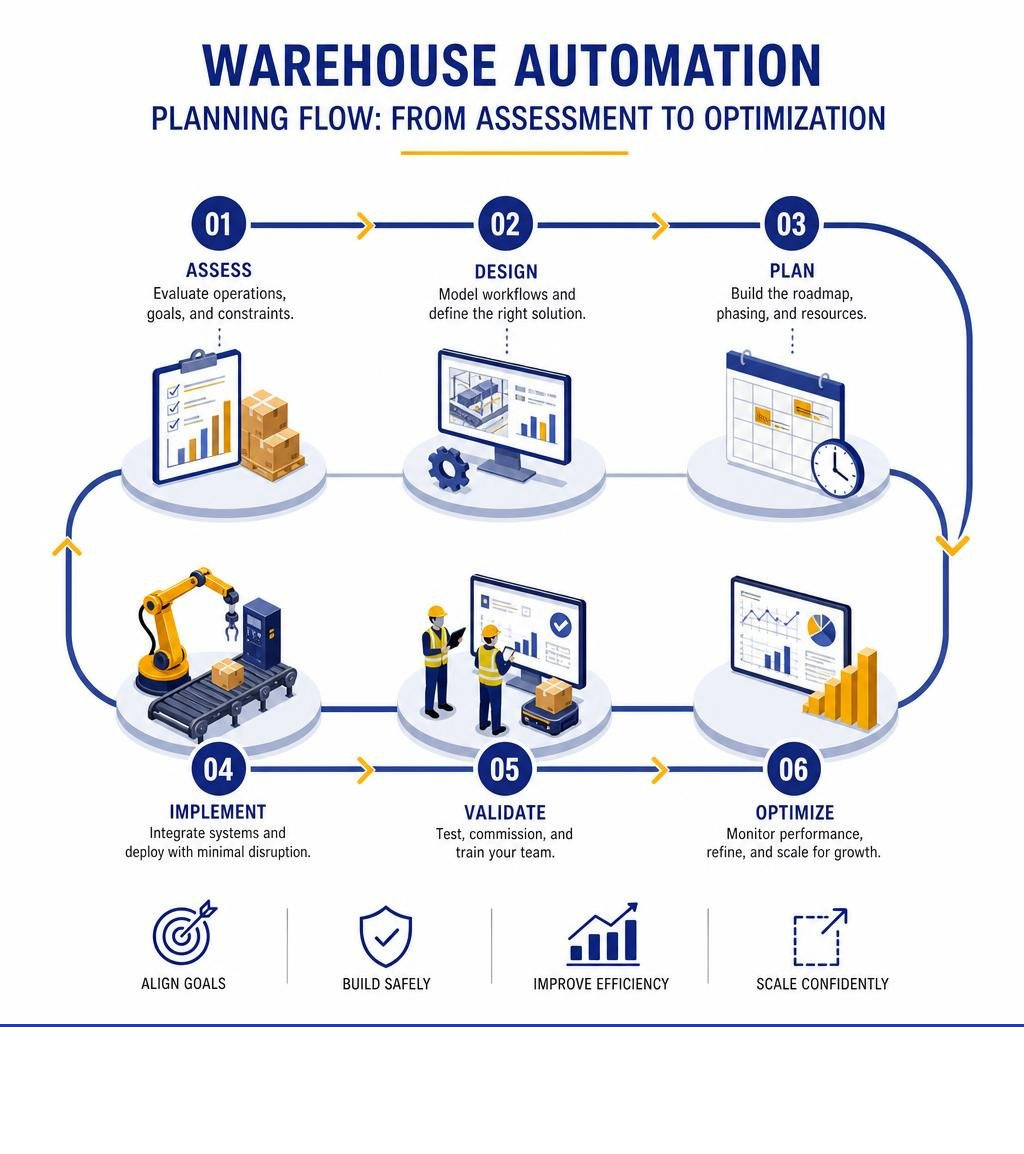
This systematic approach ensures that every integration risk is identified and mitigated before physical equipment arrives on your dock.
Warehouse Automation Planning Roadmap
A practical roadmap should move from operational evidence to engineered design, then into controlled deployment and continuous improvement. For an integrator, the planning sequence typically looks like this:
- Current State Assessment: Document the facility layout, order profiles, SKU velocity, labor model, equipment constraints, and current process bottlenecks.
- Operational Analysis: Quantify travel time, pick rates, storage density, error rates, replenishment delays, overtime patterns, and peak-season capacity gaps.
- Technology Selection: Compare conveyors, AS/RS, AMRs, AGVs, robotic picking, sortation, WMS, WES, and WCS options against the specific workflows they need to improve.
- Simulation and Validation: Model throughput, storage capacity, labor savings, and bottleneck risks before committing to equipment purchases.
- System Design: Engineer the physical layout, control logic, software integrations, safety zones, installation schedule, and phased deployment plan.
- Installation and Integration: Install the automation equipment, connect controls and software systems, and coordinate the new workflow with existing warehouse operations.
- Testing and Commissioning: Validate performance under real operating conditions, including edge cases such as rush orders, replenishment surges, and exception handling.
- Training and Change Management: Train supervisors, operators, maintenance teams, and IT stakeholders so the system becomes part of daily operations rather than a standalone technology project.
- Optimization: Monitor performance data after go-live and tune slotting, routing, labor planning, replenishment rules, and system settings over time.
At this stage, many operations discover that selecting equipment is only one part of the decision. Determining how conveyors, robotics, software, storage, controls, and facility workflows work together is the role of a warehouse systems integrator. For LD Systems, that means evaluating the full material handling environment before recommending technology, so the final solution is designed around throughput, safety, ROI, and long-term scalability rather than a disconnected equipment list.
This phased approach helps companies avoid overbuying technology before they understand the operational problem. In practice, we often see projects become more successful when the first design conversation centers on order profiles, SKU movement, labor flow, and exception handling rather than a specific machine. That early discovery work is what turns automated warehousing solutions into measurable operational improvements instead of disconnected equipment purchases.
Common Mistakes to Avoid
Even strong automation projects can underperform when companies treat technology as the strategy instead of the tool. The most common mistakes include:
- Automating inefficient processes: If a manual workflow is disorganized, automation can make the same errors happen faster and at greater cost.
- Buying equipment before designing workflows: Equipment should be selected after process mapping, throughput modeling, software requirements, and facility constraints are understood.
- Ignoring software integration: WMS, WES, WCS, ERP, conveyor controls, robotics platforms, and reporting tools must exchange accurate data in real time.
- Underestimating future growth: A system designed only for current order volume may become a bottleneck as SKU counts, order profiles, or service-level expectations change.
- Over-automating the operation: Complex robotics are not always the answer when a simple conveyor, software change, slotting improvement, or pilot project would deliver stronger ROI.
- Choosing equipment instead of choosing a systems integrator: The right partner evaluates the full operation, not just the machine list, and aligns warehouse automation technology with ROI, safety, scalability, and implementation risk.
To ensure long-term success, we recommend reviewing our guidelines on the successful integration of automation. It is critical to simplify and standardize your manual standard operating procedures (SOPs) before introducing technology. Finally, never overlook the human element. For automation to succeed, you must manage the transition carefully through comprehensive staff training and open communication, a concept we explore in optimizing warehouse operations with human-automation collaboration.
When Not to Automate
Automation is powerful, but it is not always the right answer. A balanced evaluation should consider whether the operation is stable enough, large enough, and repeatable enough to justify the investment.
Automation may not be appropriate if:
- Order volumes are consistently low and manual processes already meet service-level targets at an acceptable cost
- Layouts or workflows change weekly, making fixed equipment or complex integrations difficult to justify
- The operation is temporary or tied to a short-term contract, pop-up facility, or transitional business model
- Manual processes already outperform the likely automation ROI after labor, maintenance, software, downtime, training, and capital costs are considered
- The real problem is poor process discipline, inaccurate inventory data, or unclear SOPs rather than a lack of equipment
In these cases, the better first move may be process redesign, slotting improvements, labor planning, WMS optimization, or a smaller pilot project before investing in a larger automation warehouse deployment.
How We Evaluate Automation Projects
LD Systems evaluates automation projects by looking at the full operating environment, not just the equipment list. Before recommending a solution, we review SKU velocity, order profile, inventory turns, labor utilization, software systems, growth projections, and building constraints. That broader analysis helps determine whether the right answer is conveyors, AS/RS, robotics, WMS/WCS integration, process redesign, or a phased combination of technologies.
Should You Automate?
The right automation path depends on the operational constraint you are trying to solve. The table below offers a practical starting point for matching common warehouse challenges to likely solution categories:
| If your operation… | Consider… |
|---|---|
| Has labor shortages | AMRs, pick-to-light, or goods-to-person workflows |
| Is out of storage space | AS/RS, shuttle systems, or higher-density storage design |
| Ships thousands of orders per day | Sortation, conveyor automation, or robotic small item sorting |
| Has high picking errors | WMS-directed workflows, goods-to-person, or pick-to-light |
| Is growing rapidly | A systems integration assessment before selecting equipment |
This decision framework is not a substitute for facility analysis, but it helps clarify whether the conversation should start with labor efficiency, storage density, order throughput, accuracy, or long-term system design.
Choosing a Systems Integrator

Selecting the right systems integrator is often the difference between a warehouse automation project that delivers measurable ROI and one that becomes a collection of disconnected equipment. A qualified systems integrator should evaluate the full operation—including layout, SKU profile, labor model, software stack, safety requirements, throughput targets, and long-term growth plans—before recommending any automation technology.
A qualified warehouse systems integrator should help you:
- Translate operational bottlenecks into engineered system requirements
- Compare automation options without overbuilding the solution
- Integrate WMS, WES, WCS, ERP, conveyors, AS/RS, robotics, controls, and reporting tools
- Plan installation around live warehouse operations to reduce disruption
- Validate performance through testing, commissioning, training, and post-launch optimization
- Design for scalability so the system can grow as order volume, SKU mix, or fulfillment expectations change
The best integrators remain technology-agnostic, recommending the combination of software and equipment that best fits your operation rather than pushing a specific manufacturer’s products.

At LD Systems, warehouse systems integration begins with understanding operational constraints—not selling equipment. Every recommendation is based on throughput, storage density, labor utilization, software compatibility, long-term scalability, and measurable return on investment.
Future Trends
Warehouse automation technology will continue moving toward more flexible, data-connected, and modular systems. The next generation of automation warehouse projects will likely place less emphasis on one large fixed installation and more emphasis on systems that can be adjusted as demand, SKU profiles, and labor availability change.
Key trends to watch include:
- More modular robotics: AMR fleets, robotic sorters, and goods-to-person systems that can be expanded in phases instead of purchased all at once
- Greater AI-assisted orchestration: Software that dynamically balances labor, equipment, orders, replenishment, and carrier cutoffs in real time
- Higher-density storage: AS/RS and shuttle systems designed to make better use of vertical space and reduce the need for facility expansion
- Human-automation collaboration: Workflows that use automation to reduce walking, lifting, searching, and repetitive handling while keeping people focused on exception management and quality control
- More connected performance data: Dashboards that help managers track throughput, downtime, labor utilization, order accuracy, and ROI after go-live
Organizations that treat automation as a long-term operational strategy—not simply an equipment purchase—will be best positioned to adapt as customer expectations, labor markets, and fulfillment requirements continue evolving.
Frequently Asked Questions about Warehouse Automation
When should a company consider automating its warehouse?
A company should consider automation when manual processes repeatedly limit throughput, accuracy, labor availability, or space utilization. Common triggers include shipping errors, high turnover, seasonal volume spikes, long pick paths, crowded storage areas, and missed fulfillment windows.
What is the typical ROI timeline for warehouse automation?
Many operations target payback within 17 to 24 months, but ROI depends on system scale, labor savings, error reduction, space utilization, maintenance costs, and implementation complexity. A proper assessment should model savings before equipment is selected.
How do WMS, WES, and WCS software systems work together?
A WMS manages inventory and orders, a WES sequences work across people and automation, and a WCS controls physical equipment. Together, they connect business priorities to real-time machine movement inside the facility.
What is the difference between AMRs and AGVs?
AGVs follow fixed paths using markers, tape, wires, or defined routes. AMRs navigate dynamically with sensors and mapping software, allowing them to reroute around obstacles and adapt more easily to changing warehouse layouts.
Is full warehouse automation always the best option?
No. Many facilities get better ROI from phased automation, process redesign, WMS optimization, conveyors, pick-to-light, or goods-to-person systems. Full automation only makes sense when volume, workflow stability, and payback justify the investment.
Build a Warehouse Automation Strategy That Fits Your Operation
Warehouse automation is no longer reserved for the world’s largest distribution centers. Today, organizations of many sizes are using engineered automation systems to improve throughput, accuracy, labor efficiency, and long-term scalability.
At LD Systems, we provide comprehensive material handling systems integration for warehouses, distribution centers, and manufacturing facilities across Florida and the broader United States. With 50 years of combined experience, we design and implement tailored automation solutions that optimize your space, stabilize your labor requirements, and deliver measurable ROI in as little as 17 months.
Ready to transform your distribution or manufacturing workflows? Streamline Your Warehouse Processes with LD Systems today and take the first step toward an engineered, future-proof operation.
