

What Is a Distribution Network and How Does It Drive Supply Chain Efficiency?

A distribution network is the system of facilities, inventory flows, transportation connections, and operating processes that moves finished goods from production or receiving points to customers. For operations leaders evaluating warehouse automation, the most relevant part of that network is the facility infrastructure inside each node: distribution centers, regional DCs, fulfillment centers, last-mile sortation facilities, manufacturing warehouses, and high-volume shipping operations.
Here’s a quick-reference summary for operations leaders evaluating their distribution network:
| Key Question | Quick Answer |
|---|---|
| What is it? | A connected system of warehouses, DCs, fulfillment nodes, and transportation links that move goods after manufacturing or receiving |
| Why does it matter? | Each facility node affects throughput, inventory availability, order accuracy, labor efficiency, delivery speed, and customer experience |
| Where LD Systems fits | Warehouse automation, material handling systems, AS/RS, conveyor, sortation, robotics, controls, and WMS/WCS/WES coordination inside network facilities |
| Common facility nodes | Regional DCs, fulfillment centers, manufacturing warehouses, last-mile sorting facilities, and high-volume shipping operations |
| Biggest facility constraints | Layout, labor availability, SKU profile, storage density, picking process, dock capacity, software integration, and growth requirements |
| Who should read this? | Operations, supply chain, engineering, and logistics leaders improving facility performance within a broader supply chain network |
Getting your distribution network right is one of the highest-leverage decisions in operations management because the network is only as strong as the facilities that receive, store, pick, sort, stage, and ship inventory inside it. National carrier strategy, retail territory planning, and long-haul transportation modeling matter, but they are not the focus of this guide. This article focuses on how warehouse automation and systems integration help each node in a distribution network perform better.
For many companies, the problem is not simply where inventory should be located. It is whether each facility can handle the volume, SKU mix, labor model, order profile, and service expectations assigned to it. A regional DC cannot support faster delivery if its picking process, conveyor flow, dock layout, or software coordination cannot keep pace. A last-mile sortation facility cannot improve customer service if it lacks reliable induction, sortation, staging, and visibility.
At LD Systems, we work with operations and engineering leaders across warehousing, distribution, fulfillment, and manufacturing who are facing exactly this challenge: facilities that were designed for yesterday’s volume, speed, and cost expectations, now being asked to support a more demanding distribution network.
This guide breaks down how distribution networks work at the facility level, what performance trade-offs matter inside each node, which automation technologies can improve network execution, and how to build a smarter infrastructure strategy for where your business is going — not just where it’s been. For a neutral overview of how distribution choices affect cost and customer service, see this Northwestern University resource on designing the distribution network in a supply chain.
The Role of Facility Nodes in the Larger Supply Chain Network
A distribution network operates at the post-manufacturing stage of the supply chain. Once raw materials are transformed into finished goods, the manufacturing process ends, and the logistics of physical distribution begin.
Inside the larger supply chain network, each facility node has a specific job. A manufacturing warehouse may buffer finished goods before release. A regional distribution center may replenish downstream facilities or serve wholesale accounts. A fulfillment center may pick, pack, and ship ecommerce orders. A last-mile sorting facility may consolidate parcels by route, destination, or carrier handoff.
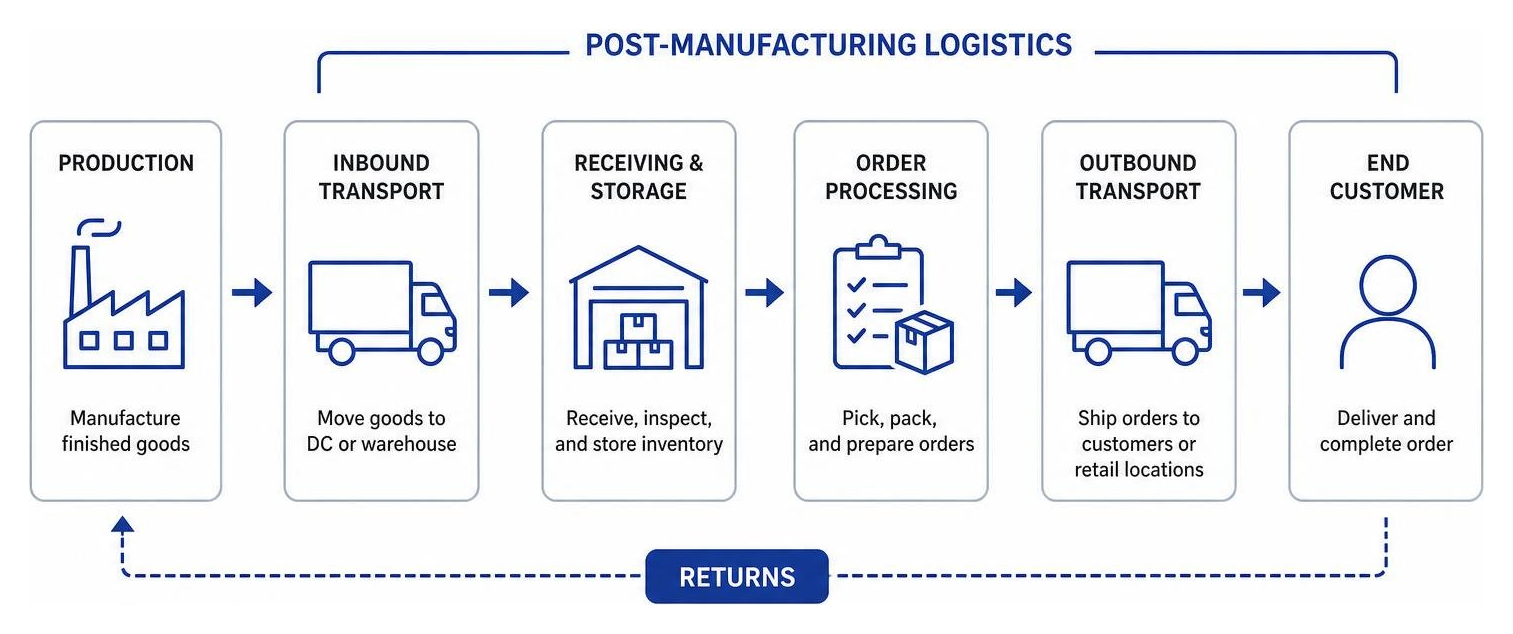
Without a highly structured facility flow, operations quickly break down. Inventory piles up in the wrong zones, travel time increases, dock congestion grows, and delivery promises become harder to meet. A well-designed facility supports the broader supply chain network by keeping inventory visible, moving, and ready for the next step in the supply chain.
Key Performance Metrics: Balancing Response Time, Variety, and Availability
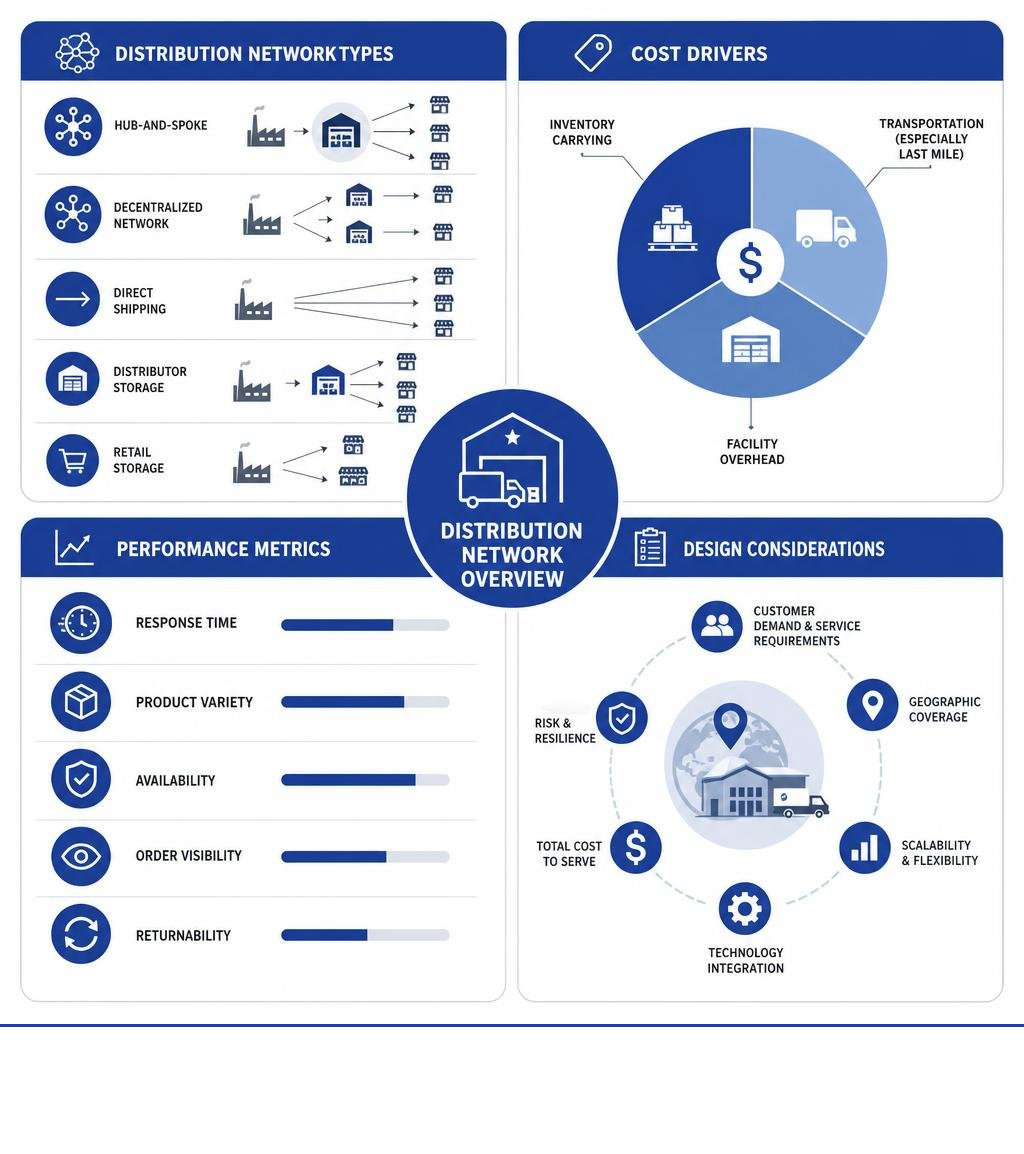
When supply chain leaders design or optimize a distribution network, they must balance several critical customer service metrics. Improving one metric almost always impacts another, creating a delicate balancing act:
- Response Time: How long does it take for a customer to receive an order? Faster response times often require inventory to be positioned closer to demand, but they also require each facility to process orders quickly and accurately.
- Product Variety: How many different SKUs can the customer order? Broader SKU variety increases storage, slotting, picking, replenishment, and software complexity inside the facility.
- Product Availability: What is the likelihood of a product being in stock when an order is placed? High availability depends on inventory planning, but it also depends on accurate receiving, putaway, cycle counting, replenishment, and order confirmation.
- Order Visibility: Can the customer and the operations team track the order in real time? This relies heavily on software integration across WMS, WCS, WES, ERP, controls, and automation systems.
- Returnability: How easy is it for customers to return items? Reverse logistics require dedicated space, specialized handling, inspection processes, and clear routing to prevent returned goods from clogging primary fulfillment channels.
During warehouse assessments, we find that many operations overlook how these performance metrics translate into physical infrastructure requirements. A business aiming for faster response times, higher SKU variety, and stronger availability may need better storage design, improved pick modules, conveyor and sortation capacity, dock planning, and software integration — not just a new transportation plan.
Distribution Network vs. Supply Chain Network
A distribution network is one part of the larger supply chain network. The supply chain includes sourcing, production, inventory planning, manufacturing, transportation, distribution, fulfillment, returns, and customer delivery. The distribution network focuses more specifically on how finished goods move through warehouses, distribution centers, fulfillment centers, sortation facilities, and shipping operations after production or receiving.
That distinction matters because many distribution problems are not only transportation problems. They are facility-performance problems. A network may look efficient on a map, but if the warehouse nodes inside it cannot receive, store, pick, sort, stage, and ship at the required pace, service levels still suffer.
| Term | What It Covers | LD Systems Relevance |
|---|---|---|
| Supply Chain Network | The full flow of materials, production, inventory, distribution, and delivery | Helps define where warehouse and distribution facilities fit into the broader operating model |
| Distribution Network | The movement of finished goods through DCs, fulfillment centers, sortation nodes, and shipping operations | Directly affects facility layout, automation scope, software integration, throughput, and labor requirements |
| Facility Node | A warehouse, DC, fulfillment center, last-mile sorting facility, or manufacturing warehouse inside the network | The point where LD Systems can improve material flow, storage, picking, sortation, controls, and system coordination |
A supply chain strategy can define where inventory should sit and how goods should flow. A distribution network strategy determines whether the physical facilities can actually execute that plan. For LD Systems customers, that execution layer is where warehouse automation, material handling systems, and software integration become critical.
How Distribution Network Design Affects Warehouse Requirements
Every distribution network design creates a different set of warehouse requirements. The number of facilities, the role of each node, customer service expectations, SKU profile, labor model, and transportation plan all influence what the warehouse must be able to do.
A regional distribution center may need high-density storage, pallet handling, replenishment flow, conveyor capacity, and outbound staging. A direct-to-consumer fulfillment center may need pick modules, goods-to-person systems, packing automation, carton flow, and parcel sortation. A manufacturing warehouse may need AS/RS, pallet movement, production buffering, and clear coordination between production and outbound distribution.
Facility requirements shaped by distribution strategy
| Distribution Network Decision | Warehouse Impact | Common Infrastructure Needs |
|---|---|---|
| More regional facilities | Inventory moves closer to customers, but each node must operate efficiently | Storage design, replenishment, labor planning, dock flow, WMS visibility |
| Faster delivery promises | Facilities must process orders with shorter cycle times | Picking efficiency, conveyor, sortation, staging, software coordination |
| Higher SKU variety | Storage, slotting, replenishment, and picking become more complex | Pick modules, goods-to-person systems, carton flow, WMS/WES rules |
| More parcel shipping | Outbound flow depends on carton movement and carrier handoff | Conveyor, manifesting, label verification, sortation, dock staging |
| Growth through existing buildings | Legacy layouts must support new volume without disrupting operations | Phased automation, controls upgrades, brownfield integration, layout redesign |
The strongest distribution network plans connect network modeling with facility design. If a company adds volume to a node without improving receiving, storage, picking, sortation, or software integration, the network may simply move bottlenecks from one location to another.
Centralized vs. Decentralized Distribution Networks
One of the most important distribution network decisions is whether to centralize inventory in fewer facilities or decentralize inventory across multiple regional nodes.
A centralized distribution network stores inventory in one or a small number of larger facilities. This can simplify inventory control and reduce duplicated facility overhead, but it may increase shipping distance, lengthen response times for distant customers, and place heavy throughput demands on the primary warehouse.
A decentralized distribution network places inventory closer to major customer regions through multiple DCs, fulfillment centers, or sortation nodes. This can support faster response times and shorter delivery distances, but it also increases facility complexity, inventory balancing requirements, labor needs, software coordination, and the risk of duplicating inefficiency across multiple sites.
| Model | Advantages | Facility Trade-Offs |
|---|---|---|
| Centralized | Consolidated inventory, fewer buildings, simpler network oversight | Primary facility needs strong storage density, picking capacity, outbound flow, and dock throughput |
| Decentralized | Inventory closer to demand, faster regional response, more flexible service coverage | Each node needs the right layout, labor model, automation, replenishment process, and system visibility |
| Hybrid | Combines national or regional DCs with selected fulfillment or sortation nodes | Requires careful coordination between upstream DCs, downstream facilities, WMS/WCS/WES logic, and transportation handoffs |
For many companies, the right answer is not purely centralized or decentralized. It is a hybrid model where each facility has a clearly defined role and the right material handling infrastructure to support that role.
How Last Mile Sorting and Distribution Centers Change Facility Design
Last mile sorting and distribution centers change facility design because they handle faster turns, smaller order units, tighter shipping windows, and more route- or carrier-specific staging than traditional bulk distribution operations. A last mile sorting and distribution center is less focused on long-term storage and more focused on rapid induction, scanning, sortation, staging, and carrier handoff.
A regional DC may focus on storage, replenishment, pallet movement, case handling, and downstream distribution. A last-mile sorting facility usually needs rapid induction, scanning, sortation, exception handling, staging, and visibility into carrier or route handoff. The building may need less long-term storage but more controlled outbound flow.
Key facility design considerations include:
- Induction capacity: How quickly parcels, cartons, totes, or cases enter the system.
- Scanning and identification: How reliably items are matched to route, carrier, destination, service level, or order status.
- Sortation logic: How the facility separates flow by lane, zone, destination, carrier, store, or customer promise.
- Staging space: How outbound loads are organized without creating dock congestion.
- Exception handling: How damaged, late, misrouted, or unscannable items are pulled out of the main flow.
- System visibility: How WMS, WCS, WES, carrier, and operational data stay synchronized.
The right technology depends on volume, order profile, parcel characteristics, available space, and growth expectations. Conveyor and sortation may be essential in one operation, while another may need phased automation, improved staging, better controls, or software integration before adding more equipment.
Warehouse Automation Technologies That Support Distribution Networks
Warehouse automation helps distribution networks perform when it is matched to the facility’s actual role. The goal is not to automate for its own sake. The goal is to improve flow through the node so the broader network can meet service, cost, accuracy, and growth requirements.
| Technology | How It Supports the Distribution Network | Best Fit |
|---|---|---|
| AS/RS and high-density storage | Improves storage density and controlled inventory movement | Space-constrained warehouses, manufacturing buffers, high-volume storage nodes |
| Conveyor systems | Moves cartons, totes, cases, or pallets through receiving, picking, packing, sortation, and shipping | Facilities with repeatable material flow and high movement volume |
| Sortation systems | Separates orders, cartons, parcels, or cases by destination, route, carrier, lane, or service level | Ecommerce, omnichannel, parcel-heavy, store replenishment, and last-mile operations |
| Goods-to-person systems | Brings inventory to operators instead of sending operators through long pick paths | High-SKU fulfillment, ecommerce, parts distribution, and labor-constrained facilities |
| Warehouse robotics | Supports flexible movement, picking support, transport, or sortation depending on application | Facilities with changing layouts, growth needs, or phased automation requirements |
| Controls and automation integration | Coordinates equipment logic, sensors, PLCs, conveyors, sorters, scanners, and operational signals | Any facility where multiple automation systems must work together reliably |
For example, a facility supporting high-volume parcel shipping may benefit from conveyor, manifesting, label verification, and sortation. A high-SKU fulfillment center may need goods-to-person automation, ergonomic workstations, carton flow, and replenishment logic. A manufacturing warehouse may need pallet handling, AS/RS, and tighter coordination between production, storage, and outbound staging.
By selecting technology around the role of the facility node, companies can improve throughput, reduce unnecessary handling, and support distribution network scalability without overbuilding.
Software Integration Across the Supply Chain Network
Software integration is what connects the distribution network plan to day-to-day facility execution. A WMS may manage inventory and transactions, a WCS may coordinate equipment control, a WES may sequence work across people and automation, and ERP or order systems may drive broader business rules.
The challenge is that these systems often evolve at different times. A facility may add conveyor, sortation, robotics, or AS/RS while still relying on older WMS logic, manual workarounds, or disconnected reporting. When systems do not communicate cleanly, operations can experience inventory delays, missed confirmations, poor visibility, stalled equipment, or inefficient work sequencing.
Modern distribution facilities may need integration across:
- WMS: Inventory, receiving, putaway, picking, replenishment, shipping, and transaction records.
- WCS: Equipment control for conveyors, sorters, scanners, sensors, and automated material handling systems.
- WES: Work release, task sequencing, order prioritization, exception handling, and labor/automation coordination.
- ERP and order systems: Customer orders, inventory planning, financial records, purchasing, and enterprise workflows.
- Carrier and parcel systems: Manifesting, label creation, service selection, tracking, and outbound confirmation.
Integration complexity depends on the existing software stack, data quality, transaction rules, automation scope, and operational requirements. APIs, middleware, WCS logic, custom interfaces, and phased testing may all be part of the solution.
For LD Systems, software integration is central to distribution network performance because physical automation only works well when inventory data, equipment logic, order priorities, and operator workflows stay aligned.
Distribution Network Planning Mistakes
Many distribution network problems begin when companies separate network strategy from facility reality. A model may recommend adding nodes, consolidating buildings, increasing delivery speed, or changing fulfillment paths, but the plan can fail if the facilities cannot support the required flow.
Common planning mistakes include:
- Designing the network without validating facility capacity. A location strategy must be tested against receiving capacity, storage density, pick rates, dock doors, labor availability, equipment constraints, and outbound staging.
- Adding facilities without fixing process inefficiency. Decentralizing an inefficient operation can multiply the same problems across more buildings.
- Choosing automation before defining the operational problem. Technology should be selected after understanding SKU profile, order mix, volume patterns, facility layout, labor model, and software requirements.
- Underestimating software integration. WMS, WCS, WES, ERP, controls, and carrier systems need clean transaction logic and testing before go-live.
- Ignoring future volume and SKU shifts. A facility designed only for today’s profile may become constrained as ecommerce, SKU variety, parcel volume, or service expectations change.
- Treating last-mile flow like standard warehousing. Sortation, staging, route logic, exception handling, and carrier handoffs often require different infrastructure than bulk storage.
- Overusing hard ROI assumptions. Automation results depend on facility design, labor conditions, order profile, technology scope, and integration quality.
A better approach is to connect distribution network planning with operational modeling, facility assessment, phased automation planning, and software integration strategy.
LD Systems Case Studies: Facility Performance Inside the Network
Documented LD Systems case studies show how facility-level improvements can strengthen a broader distribution network. In the Rite Aid distribution facility case study, LD Systems helped support a new distribution facility that achieved a 300% increase in throughput, a 40% productivity boost, and 99.93% order accuracy. In the WIX Filters distribution efficiency case study, LD Systems redesigned storage and order processing to increase product facings by 400%, improve productivity by 60%, and reduce order cycle time by two-thirds. In the Honeywell distribution network case study, LD Systems improved small-parts picking speed by 60%, improved space utilization by 50%, and structured 7,200 pick facings for better accessibility. These project-specific results show how distribution network performance depends on the efficiency of each facility node.
How LD Systems Supports Distribution Network Performance
A distribution network is only as strong as the facilities that receive, store, pick, sort, stage, and ship inventory inside it. LD Systems helps warehouses, distribution centers, fulfillment operations, and manufacturing facilities improve those nodes through warehouse automation, material handling systems, AS/RS, conveyor systems, sortation, robotics, storage solutions, controls, and WMS/WCS/WES coordination.
Rather than recommending equipment in isolation, LD Systems evaluates facility layout, SKU profile, order volume, labor constraints, software environment, throughput requirements, and growth plans to design integrated systems that support the broader distribution network.
From conveyor systems and high-density AS/RS to software integration and robotics, LD Systems supports the project lifecycle from initial concept through implementation and post-go-live support.
If you are ready to improve a critical node in your distribution network, contact LD Systems to discuss how warehouse systems integration, automation, storage, sortation, and software coordination can support your facility’s next stage of growth.
