

What Is Omni Channel Fulfillment?

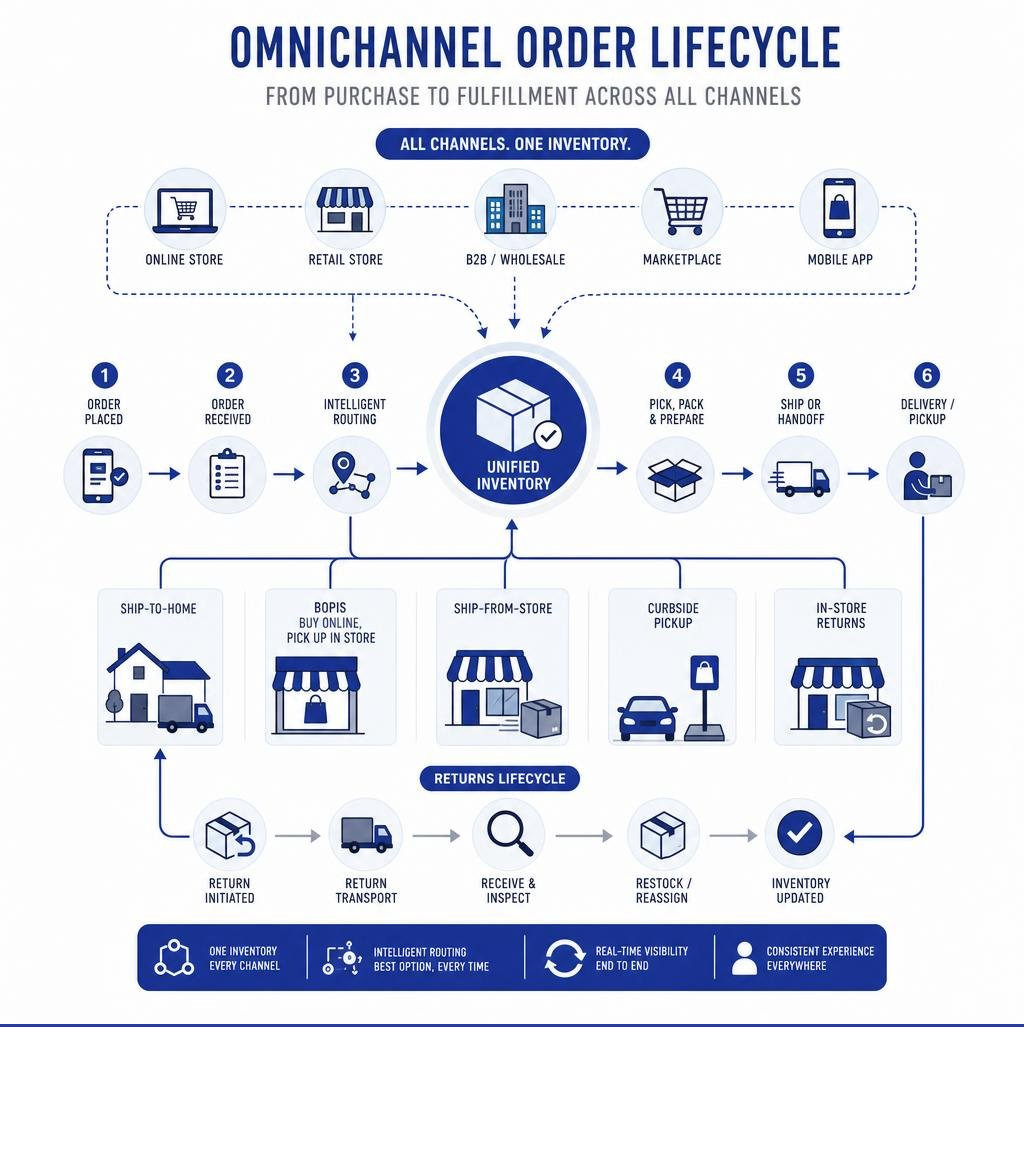
Omni channel fulfillment is the operational strategy of managing and executing customer orders across every sales channel — DTC, retail, wholesale, and marketplace — from a single, unified inventory pool. Instead of siloing stock by channel, every unit is available to every order, with intelligent routing deciding the best fulfillment path based on inventory availability, service level, cost, and customer location.
Also written as omni-channel fulfillment or omnichannel fulfillment, the strategy depends on accurate inventory visibility, coordinated software, and warehouse systems that can support multiple order paths at once.
Here’s the quick answer for operations leaders:
- What it is: One shared inventory pool serving all channels simultaneously — online, in-store, B2B, and marketplace
- How it differs from multichannel: Multichannel keeps separate inventory and workflows per channel; omnichannel unifies them into a single system
- Why it matters: Customers expect consistent experiences across channels and increasingly fast delivery or pickup options
- Core flow paths: Ship-to-home, BOPIS (buy online, pick up in store), ship-from-store, curbside pickup, and in-store returns
- Warehouse systems behind it: AS/RS, conveyors, sortation, robotics, storage, picking, packing, WMS/WCS/WES coordination, and material flow design
- Key operational challenge: Building the physical and digital infrastructure to move varied order types through the same network without bottlenecks, inventory errors, or missed service levels
If you already know the basics and want to dig into infrastructure design, automation, or software orchestration, the sections below go deep on how warehouse automation and systems integration support omnichannel fulfillment.
For teams still building the foundation, this becomes complicated quickly because selling on three or more channels is manageable — until the systems behind those channels stop scaling. One challenge we commonly see during warehouse assessments is that operations teams expand their channel presence faster than their warehouse systems can support. The Shopify store can’t see Amazon inventory. The retail partner runs a different system entirely. The warehouse team is manually updating stock levels in four different places.
The result? Overselling, missed SLAs, stockouts in the wrong locations, and a returns process that no one designed intentionally.
This guide covers the warehouse systems behind omnichannel fulfillment — from storage and automation to software orchestration, sortation, picking, packing, and material flow — so you can build or modernize an operation that supports multiple channels without creating disconnected workflows.
The Operational Reality of Omnichannel Fulfillment
Modern commerce has completely redrawn the lines of distribution. Consumers do not think in terms of “channels” — they simply expect to buy what they want, when they want it, and have it arrive on their doorstep or be ready for pickup quickly.
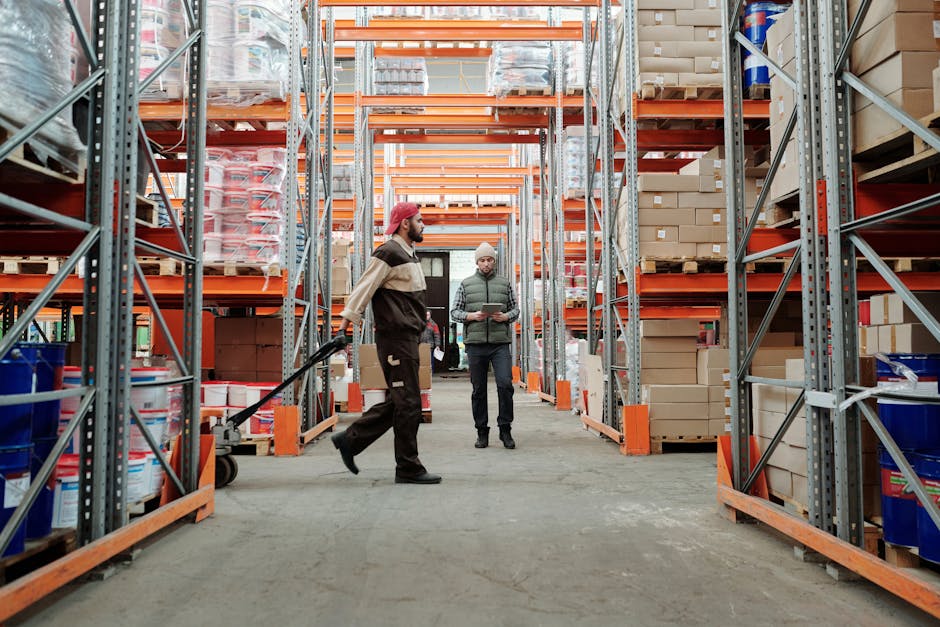
Managing this reality requires a complete departure from traditional, siloed warehousing. When operations attempt to scale without a unified inventory pool and coordinated warehouse systems, they immediately run into operational bottlenecks, capacity constraints, inventory errors, and rising labor costs.
Key pressures include:
- Customers expect consistent experiences across multiple channels.
- Online orders often carry aggressive delivery or pickup expectations.
- E-commerce and retail fulfillment commonly involve high SKU counts, varied packaging profiles, small-order picking, peak volatility, and tight service-level expectations.
Documented LD Systems case studies show how integrated automation can support high-volume ecommerce and omnichannel fulfillment. In the Chico’s ecommerce distribution case study, LD Systems helped reduce order cycle time from 3 hours to 30 minutes, tripled picking productivity, and reduced order errors. In the Thomson ecommerce case studies, LD Systems documented a 50% improvement in productivity, 99.93% order accuracy, and reduced order cycle time from 2 hours to 25 minutes through integrated storage, picking, conveyor, and sorter projects: dual-sided multi-lane narrow belt sorter for Thomson and storage and picking area conveyor and sorter for Thomson. These are project-specific examples, and results depend on order profile, SKU mix, layout, software integration, labor model, and automation scope.
Meeting these demands requires a sophisticated understanding of how inventory moves through the facility and across the network. For neutral context on fulfillment and delivery systems, operations leaders can review MHI’s fulfillment and delivery resources or the U.S. Census Bureau’s retail e-commerce data.
Transitioning from Multichannel to Omnichannel Fulfillment
The terms “multichannel” and “omnichannel” are frequently used interchangeably, but they represent entirely different operational philosophies.
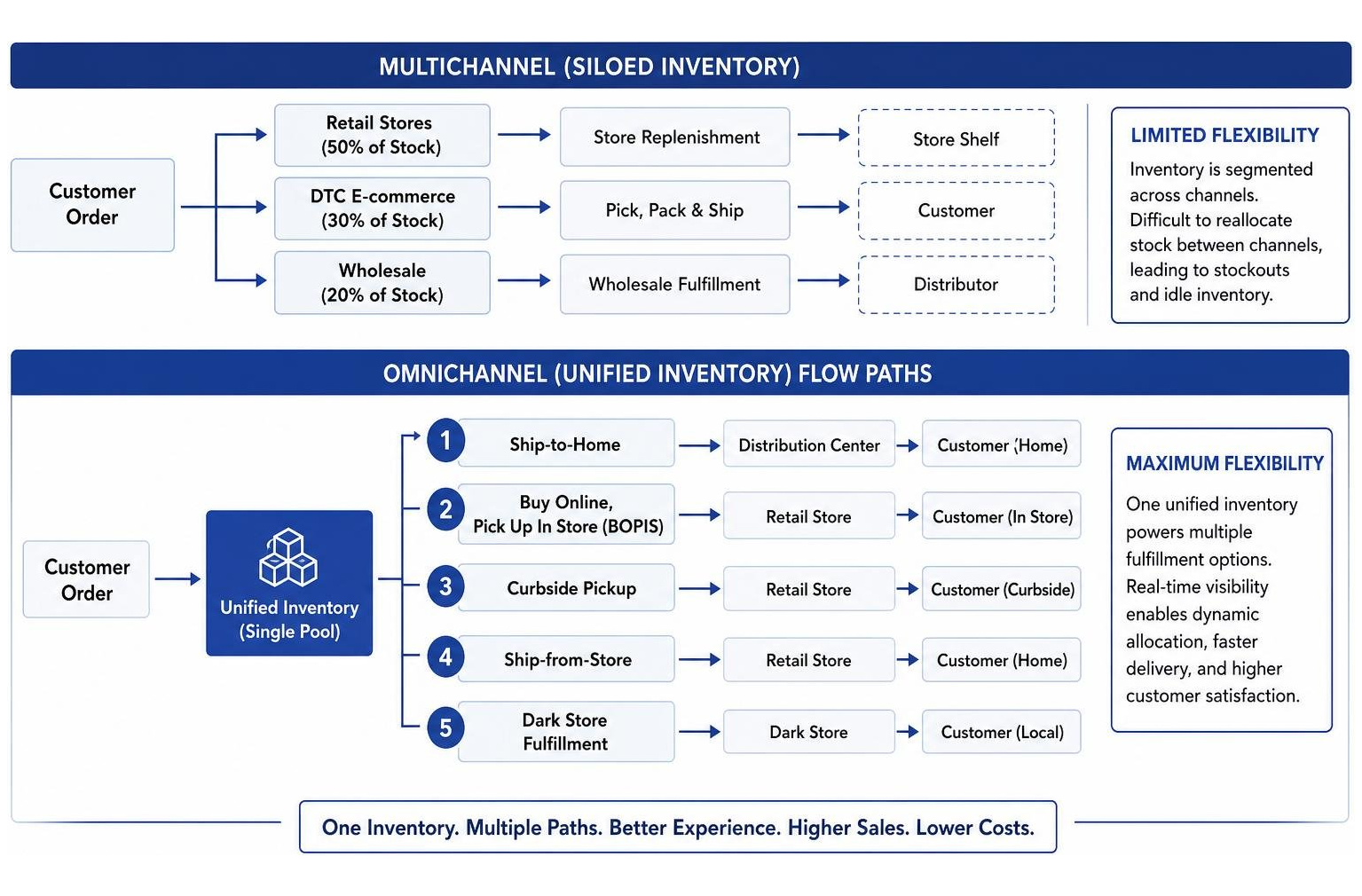
In a multichannel model, inventory is segregated. A business might allocate 50% of its stock to retail store replenishment, 30% to direct-to-consumer (DTC) e-commerce, and 20% to wholesale partners. These stock pools are typically housed in separate physical areas of a warehouse — or even in different facilities.
While this keeps workflows simple, it is highly inefficient. If the DTC channel experiences a sudden surge during a peak event while wholesale demand slows, the business cannot easily reallocate stock. The result is a dual crisis: stockouts and missed sales on one side, and idle, margin-killing inventory on the other.
An omnichannel model eliminates these artificial boundaries. All inventory sits in a single, unified pool. Whether an item is destined for an individual consumer’s doorstep, a physical store shelf, or a wholesale distributor, it is picked from the same shared inventory.
This transition represents a major growth inflection point. When an operation relies on manual spreadsheets and batch-processed updates to manage multiple channels, it faces immediate risks of overselling, delayed shipments, and missed service level agreements (SLAs).
Mapping the Core Omnichannel Flow Paths
To make a unified inventory pool work, facilities must support a variety of flexible fulfillment flow paths. These paths allow businesses to leverage their entire network — including distribution centers, dark stores, and physical retail locations — as active fulfillment nodes.
The most common flow paths include:
- Ship-to-Home: The traditional e-commerce route, where an order is picked, packed, and shipped directly from a distribution center to the customer.
- Buy Online, Pick Up In Store (BOPIS): Orders placed online are routed to the nearest retail store. Store associates pick the item from the retail shelf or backroom storage.
- Curbside Pickup: Similar to BOPIS, but designed for contactless convenience, requiring real-time communication tools for store staff.
- Ship-from-Store: Retail locations act as mini-fulfillment centers, shipping local e-commerce orders directly to nearby consumers to reduce last-mile shipping times and costs.
- Dark Store Fulfillment: Underperforming retail storefronts are converted into local micro-fulfillment centers closed to the public, optimized purely for rapid picking and local delivery.
These flexible paths do more than just speed up delivery; they directly affect facility design. Each flow path changes how inventory should be stored, picked, packed, staged, sorted, and confirmed in the warehouse system.
Designing a Resilient Omnichannel Fulfillment Infrastructure
To handle these diverse flow paths without causing chaos on the warehouse floor, operations must invest in a resilient physical and digital infrastructure. This is where warehouse systems integration becomes critical.
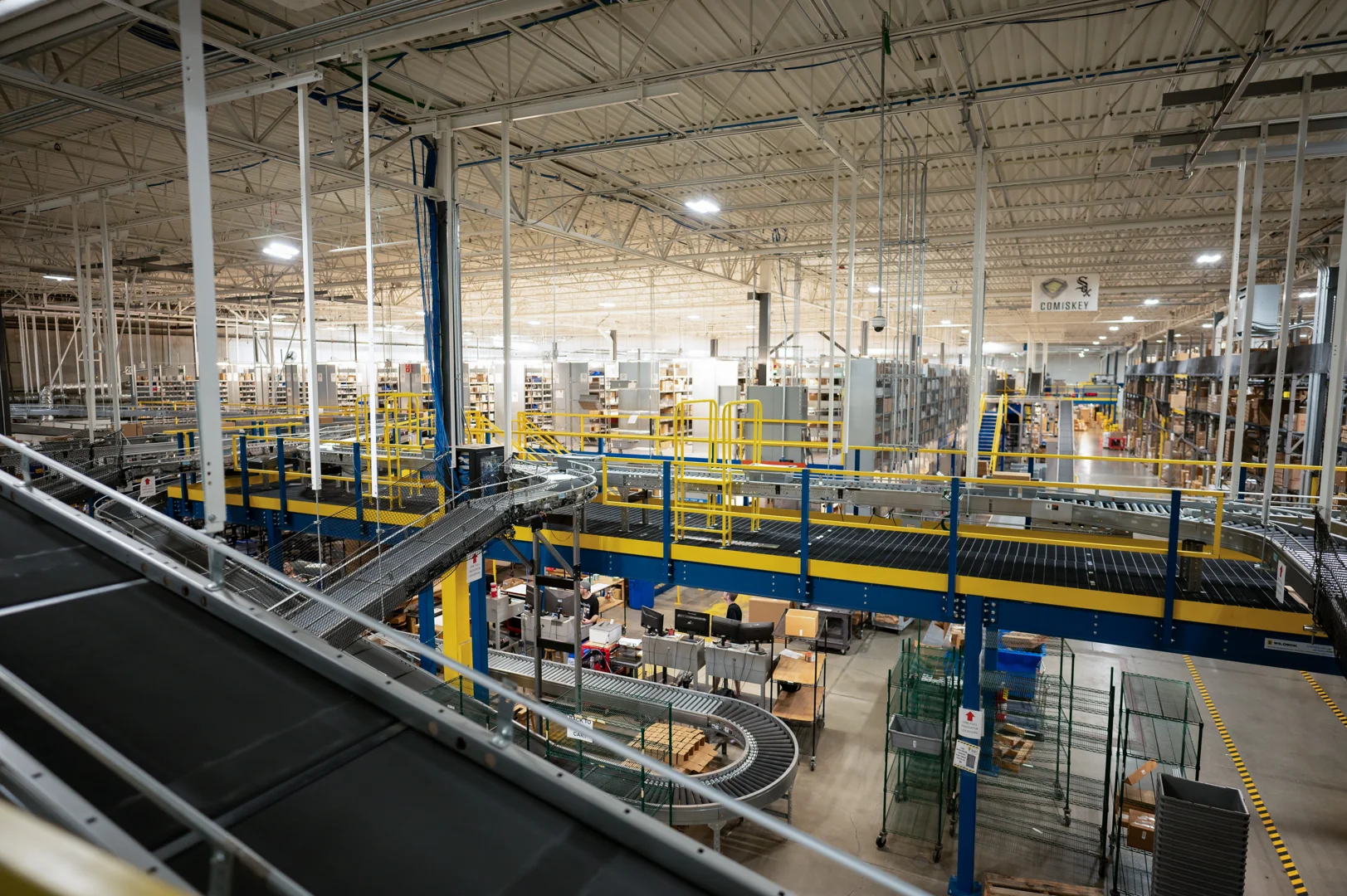
Designing a facility that can simultaneously process B2B pallets, retail cases, and DTC individual items requires a strategic blend of material handling systems, industrial storage solutions, and advanced software control. The goal is to maximize throughput speed, optimize storage density, and build long-term scalability.
Software Orchestration for Omnichannel Fulfillment
At the heart of any successful omnichannel operation is a tightly integrated software stack. Many businesses make the mistake of treating their software systems as standalone applications, leading to data delays and operational friction.
To orchestrate complex fulfillment networks, three software layers must work in harmony:
- Order Management System (OMS): The decision layer. The OMS aggregates orders from all sales channels and determines the optimal fulfillment node based on inventory availability, customer proximity, shipping costs, and SLAs. It calculates the critical available-to-promise (ATP) logic, ensuring that inventory counts are updated in real time across all channels to prevent overselling.
- Warehouse Management System (WMS): The execution layer. Once the OMS routes an order to a specific facility, the WMS directs the physical movement of that order inside the four walls. It manages bin locations, optimizes pick paths, and directs packing and shipping workflows.
- Warehouse Execution System (WES): The optimization layer. The WES sits between the WMS and physical automation equipment. It dynamically directs labor and automated systems in real time, balancing workloads across pick modules, conveyors, and sorters to prevent bottlenecks.
The key is not choosing software in isolation. It is building the integration logic, controls, data visibility, and material flow required for each channel to share inventory without creating conflicting work queues or fulfillment exceptions.
Automation and Robotics in Modern Distribution Centers
When order volumes grow, manual picking processes quickly hit a wall. Companies evaluating an omni channel fulfillment provider may also need to decide whether to outsource fulfillment or invest in their own warehouse automation infrastructure. For operations that keep fulfillment in-house or operate a hybrid network, automation can help scale throughput without exponentially increasing headcount.
Implementing automated storage and retrieval systems (AS/RS) can be one effective way to improve efficiency, especially where operations need denser storage, shorter pick paths, and more controlled item flow. High-density shuttle systems and robotic goods-to-person solutions may increase storage utilization and accelerate pick activity when the system is properly matched to SKU profile, order mix, facility layout, and software integration.
This type of space utilization is particularly valuable for urban micro-fulfillment centers, where real estate is at a premium but proximity to customers is essential for same-day delivery.
However, technology is only as good as its integration. A common misconception is that purchasing individual pieces of automated equipment will automatically solve throughput bottlenecks. True efficiency comes from the successful integration of automation into a cohesive, balanced system.
When preparing a facility for high-volume channels, engineering teams must evaluate whether their current infrastructure is truly ready. Leaders can assess their operational readiness by reviewing the checklist in Is Your Warehouse Ready for the E-commerce Surge?.
Managing Inventory Distribution and Hidden Operational Costs
Distributing inventory across multiple warehouses, retail stores, and third-party logistics (3PL) partners helps place products closer to demand centers. This strategic inventory placement can reduce shipping transit times and lower last-mile carrier costs. However, it also introduces significant complexity.
Operations must maintain precise safety stock buffers to prevent regional stockouts without over-purchasing inventory. Additionally, relying on a single parcel carrier is a major risk. Carrier diversification is essential for maintaining shipping consistency, especially during peak seasons when capacity is tight.
Another major challenge in omnichannel logistics is reverse logistics. Returns processing can create significant cost pressure when factoring in return shipping, multi-step inspection, restocking labor, and channel-specific repackaging compliance.
When evaluating how to manage these operational complexities, businesses should separate fulfillment-network decisions from warehouse-system decisions. A brand may use in-house fulfillment, a 3PL, or a hybrid network, but each model still depends on accurate inventory visibility, coordinated software, efficient storage, reliable picking and packing, and well-designed material flow.
| Fulfillment Model | Warehouse Systems Implications | Key Challenges | Best Suited For |
|---|---|---|---|
| In-House Fulfillment | Greater control over automation, storage, software integration, packing standards, and facility layout. | Higher capital planning requirements; greater responsibility for WMS/WCS/WES coordination, labor planning, and system maintenance. | Operations with established volume, complex workflows, or custom compliance needs. |
| 3PL Partner | External partner may manage daily fulfillment, but brands still need clean data, system integrations, inventory rules, and channel-specific requirements. | Less control over daily operations; possible integration friction; variable storage, pick, pack, and value-added service fees. | Growing DTC, retail, and wholesale brands that need flexible capacity or geographic reach. |
| Hybrid Network | Requires consistent inventory logic, routing rules, and exception handling across company-run facilities and external nodes. | More complex orchestration across systems, facilities, SLAs, and returns workflows. | Brands balancing control, speed, geographic coverage, and capital investment. |
For companies comparing in-house fulfillment, 3PL partnerships, and hybrid networks, the warehouse systems decision remains critical. Each model depends on accurate inventory visibility, coordinated software, efficient storage, reliable picking and packing, and well-designed material flow. LD Systems supports the warehouse infrastructure behind the fulfillment model: AS/RS, conveyors, sortation, robotics, storage, picking, packing, controls, and WMS/WCS/WES coordination.
Mitigating Labor Shortages and Scaling Throughput
The logistics industry continues to face persistent labor shortages. Relying solely on temporary warehouse labor to handle seasonal spikes is no longer a viable long-term strategy.
To maintain high throughput, operations must focus on improving labor efficiency, picking accuracy, and workplace safety. This is where ergonomics and targeted automation play a major role. By implementing goods-to-person systems, warehouses can reduce unproductive travel time, allowing pickers to remain at optimized, ergonomic workstations.
This shift can improve safety, reduce physical fatigue, and increase picking speed and accuracy when the system is properly designed around SKU profile, order mix, layout, and software integration. To explore strategies for managing labor constraints, supply chain leaders can read about navigating labor shortages with automation.
Streamlining E-commerce and Retail Sortation
To support a true omnichannel strategy, the physical outbound process must accommodate a wide variety of packaging types — from small polybags for DTC orders to heavy corrugated cases for retail replenishment.
Implementing advanced conveyor systems and automated sortation is critical for routing these varied profiles to their correct shipping lanes. For example, high-speed dual-sided multi-lane narrow belt sorters can accurately divert packages of different sizes and weights without damaging the product.
For a deeper understanding of how these material handling systems are designed and integrated, operations leaders can consult optimizing ecommerce solutions in warehouses.
To see these systems in action, real-world case studies offer valuable engineering insights. For instance, the Chico’s e-commerce distribution case study demonstrates how targeted system upgrades improve high-volume fulfillment.
Similarly, physical sorting and storage layouts, such as those detailed in the Thomson dual-sided multi-lane narrow belt sorter project and the Thomson storage, picking, conveyor, and sorter case study case studies, show how automated sortation and optimized pick modules can reduce physical bottlenecks.
Frequently Asked Questions About Omnichannel Logistics
What is the difference between an OMS and a WMS in omnichannel operations?
The Order Management System (OMS) serves as the “brain” or the decision layer of your fulfillment network. It operates above individual facilities, receiving orders from all sales channels, tracking global inventory levels, and determining which fulfillment node (a specific warehouse, dark store, or retail location) should fulfill the order based on proximity, cost, and SLAs.
The Warehouse Management System (WMS) is the “muscle” or the execution layer. It operates within the physical walls of a specific facility, directing warehouse associates or automated systems to pick, pack, and ship the order once the OMS has routed it to that location. Together, they require tight, real-time system integration to maintain accurate inventory counts.
When should a growing brand transition to a unified omnichannel model?
A brand should transition to a unified model when managing separate inventory silos for different channels begins to cause operational friction. Common warning signs include:
- High rates of overselling or inventory discrepancies.
- Frequent stockouts on one channel while identical inventory sits idle in another channel’s stock pool.
- Excessive manual effort spent reconciling inventory data across systems.
- Difficulty meeting delivery SLAs during peak order volumes.
How do automated storage and retrieval systems (AS/RS) improve omnichannel efficiency?
AS/RS can improve omnichannel efficiency by increasing storage density, reducing manual travel, and presenting inventory to operators or automation in a more controlled sequence. Actual performance depends on SKU profile, order volume, replenishment strategy, software integration, facility layout, and system design.
Support Omnichannel Fulfillment with Integrated Warehouse Automation
Successfully executing an omnichannel strategy requires more than choosing the right sales channels or fulfillment model. The operation also needs a cohesive warehouse system where software, controls, storage, picking, packing, sortation, conveyors, robotics, and material handling equipment work together.
As a technology-agnostic warehouse systems integrator, LD Systems supports omnichannel fulfillment by designing, engineering, and implementing the warehouse infrastructure that makes multi-channel order flow possible. The team evaluates throughput bottlenecks, inventory profiles, SKU characteristics, facility layouts, labor constraints, and growth plans to integrate the right blend of AS/RS, conveyor systems, sortation, warehouse robotics, storage solutions, packing workflows, controls, and WMS/WCS/WES coordination.
In certain applications, LD Systems has helped automation projects target measurable ROI in as little as 17 months. Actual results depend on facility layout, order volume, labor model, technology selection, software integration, and implementation scope.
If you are ready to strengthen the warehouse infrastructure behind your omnichannel strategy and reduce operational bottlenecks, contact the engineering team at LD Systems to discuss warehouse systems integration services.
