

What Is an Omnichannel Supply Chain?

For many operations serving customers across ecommerce, stores, wholesale, marketplaces, and other channels, building an omnichannel supply chain is becoming a baseline expectation.
What is an omnichannel supply chain? An omnichannel supply chain integrates sales and fulfillment channels — physical stores, ecommerce, mobile, wholesale, and more — into a coordinated network where inventory data, orders, and customer information can move between systems. The goal is to create a consistent customer experience regardless of where or how someone shops.
| Omnichannel Supply Chain Element | Warehouse-Side Requirement |
|---|---|
| Shared inventory visibility | Accurate WMS data, ATP logic, scanning, and inventory status updates |
| Multiple fulfillment paths | Storage, picking, packing, sortation, staging, and shipping workflows that support ecommerce, retail, wholesale, and transfers |
| Omnichannel distribution | Facility flow designed for mixed order profiles, returns, replenishment, and outbound dock capacity |
| Omnichannel delivery | Warehouse processes that prepare orders accurately before carrier handoff |
| Systems integration | Coordination between OMS, WMS, WCS, WES, controls, and material handling equipment |
For LD Systems’ audience, the most important question is not how to design an entire retail network or last-mile strategy. It is how the warehouse, distribution center, fulfillment operation, or manufacturing facility must be engineered so it can support omnichannel fulfillment reliably.
Here’s what that means inside the operation:
- Inventory must be visible and available across the systems that promise, allocate, pick, pack, and ship orders
- Facilities may need to support both bulk replenishment and high-velocity direct-to-consumer fulfillment
- Orders may require different paths through storage, picking, packing, sortation, staging, and shipping workflows
- Returns and exceptions need processes that can reintroduce inventory accurately without disrupting outbound flow
A 2026 survey of 647 supply chain leaders found continued ecommerce growth and increasing adoption or planning of omnichannel distribution strategies. That broader shift creates a practical warehouse challenge: how do you design the physical automation, software coordination, controls, and material flow needed to support multiple fulfillment channels without creating unnecessary complexity?
That’s exactly what this guide addresses — from the structural differences between omnichannel and multichannel models, to the warehouse technology stack, automation strategies, and implementation approach that help operations support omnichannel fulfillment at scale.
Omnichannel vs. Multichannel Supply Chain
Retail, ecommerce, wholesale, and distribution channels have become more connected over time. Many businesses once operated under a single-channel model: a physical store, catalog, or distributor relationship handled most customer demand. When ecommerce emerged, many organizations added a website as a separate operation, creating a multichannel model.
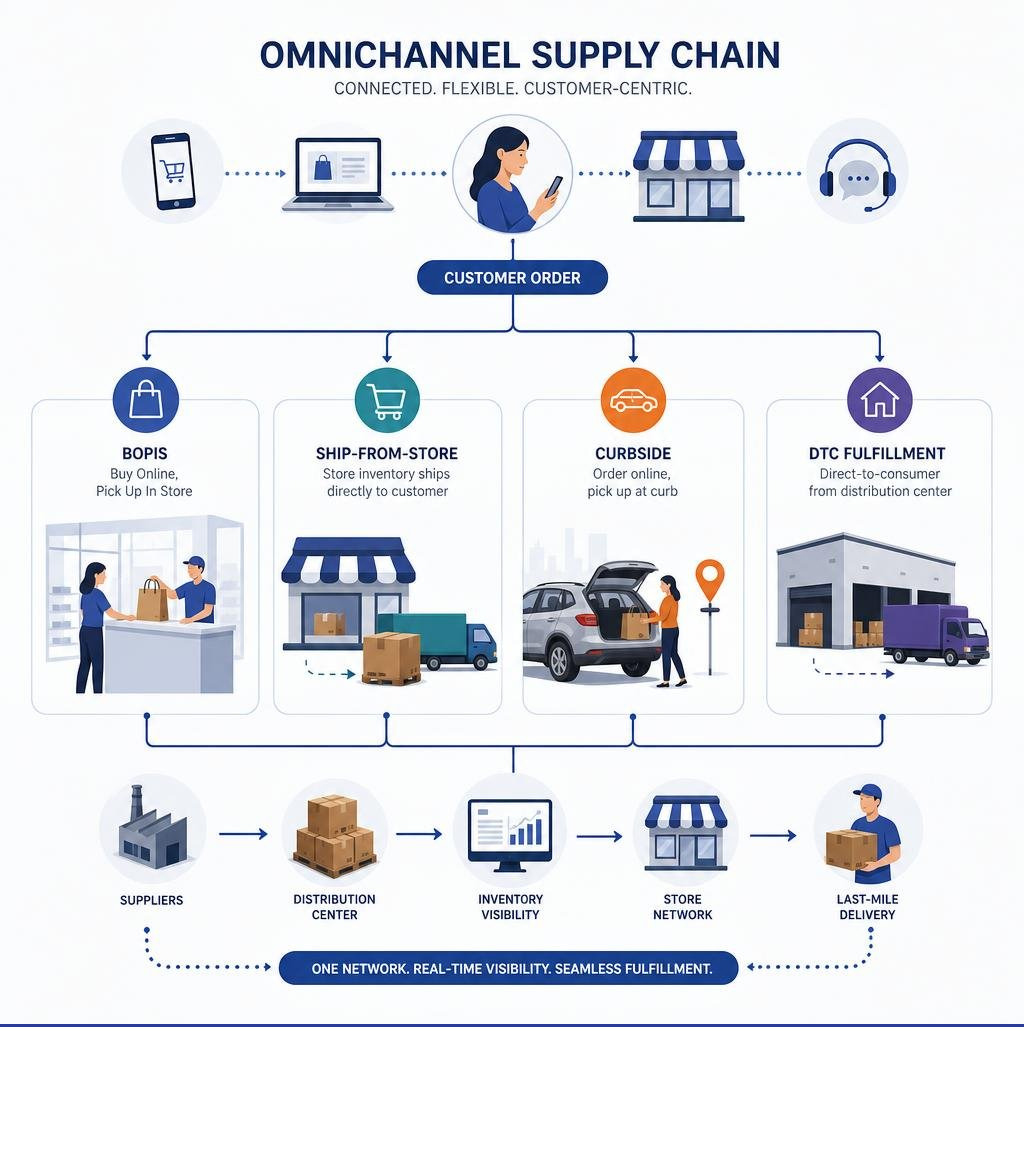
Today, that siloed approach creates operational risk. A customer might research on a mobile device, buy online, pick up locally, return through a different channel, or expect a replacement shipment from the nearest available node. Behind the scenes, that experience depends on inventory accuracy, order routing, warehouse execution, and physical material flow.
For businesses in the United States and Canada, managing this complexity requires moving away from fragmented warehouse and fulfillment processes toward better-connected operations. For LD Systems, the focus is facility-side execution: the automation, controls, software coordination, and physical handling systems that help warehouses and distribution centers support omnichannel fulfillment.
How Omnichannel Supply Chains Work
At its core, an omnichannel supply chain is a fully integrated, customer-centric model where sales channels can draw from coordinated inventory and fulfillment data. Rather than treating physical stores, wholesale partners, and ecommerce websites as completely independent business units, this approach treats them as different front-end access points to a more unified operating network.
In this model, information flows bi-directionally as close to real time as the systems and process design allow. If a customer buys the last unit of a specific SKU from a retail shelf in Daytona Beach, Florida, that unit should be reflected in the available-to-promise inventory displayed on the company’s digital channels. This level of synchronization helps reduce overselling, supports better allocation, and allows businesses to keep more accurate customer promises.
Industry research on omnichannel supply chain design reinforces the same point: channel strategy has to be supported by execution systems, automation, and facility design that can handle mixed order profiles.
Omnichannel vs. Multichannel Supply Chain: The Structural Shift
The difference between multichannel and omnichannel supply chains is not just semantic; it is structural. During warehouse assessments, operations leaders often realize that their inefficiencies stem from trying to run an omnichannel business with a multichannel backend.
In a multichannel system, channels operate in silos. The ecommerce team may have its own inventory, warehouse space, and software. The retail replenishment team may have separate logistics and allocation rules. This can lead to inventory fragmentation, where a business appears stocked out for online shoppers while usable inventory remains elsewhere in the network.
| Feature | Multichannel Supply Chain | Omnichannel Supply Chain |
|---|---|---|
| Focus | Channel-centric (optimized per channel) | Customer-centric (unified journey) |
| Inventory Pool | Fragmented (siloed by channel) | Coordinated or shared inventory visibility |
| Data Integration | Low or batch-processed | Real-time or near-real-time system coordination |
| Fulfillment Paths | Rigid (online orders from ecommerce DC only) | Flexible (BOPIS, ship-from-store, curbside, DC, or 3PL depending on the network) |
| Returns | Often tied to the purchase channel | Designed to support more flexible return paths |
| Operational Silos | High (separate teams, software, and goals) | Lower when systems, workflows, and KPIs are aligned |
For LD Systems’ work, the important takeaway is that a more unified customer promise requires warehouse-side execution that can keep up with it.
Omnichannel Distribution: Designing Warehouse Flow for Multiple Channels
Transitioning to an integrated model can improve customer experience and inventory utilization, but it also introduces significant operational friction. An omnichannel distribution center may need to support ecommerce parcel orders, retail replenishment, wholesale shipments, store transfers, returns processing, and mixed order profiles from the same facility footprint.
That creates different requirements for labor, space, storage, picking, packing, sortation, staging, and dock flow. A retail replenishment order may move by pallet or case to a store destination, while an ecommerce order may require piece picking, cartonization, parcel labeling, and carrier sortation. Wholesale orders may involve larger order quantities, different documentation, or separate staging rules. Returns are especially important in omnichannel distribution because returned inventory may need inspection, disposition, relabeling, restocking, repair, or quarantine before it can be made available to another channel. Returns need a process for inspection, disposition, restocking, repair, or exception handling without disrupting outbound fulfillment.
To make this model profitable, businesses must balance high customer expectations with disciplined cost control. In the warehouse, that balance depends less on broad retail strategy and more on practical execution: reliable inventory capture, efficient pick paths, consistent replenishment, scalable packing workflows, and disciplined exception handling.
Driving Customer Experience and Operational Efficiency
When designed correctly, an integrated fulfillment network can turn warehouse execution into a brand advantage. Flexible fulfillment paths — such as buy online, pick up in-store (BOPIS), curbside pickup, ship-from-store, and direct-to-consumer parcel fulfillment — depend on the ability to move inventory accurately through different workflows.
For a warehouse or distribution center, this often means supporting both bulk pallet picking for retail replenishment and high-velocity piece picking for ecommerce orders. The facility may need different storage media, pick modules, conveyor zones, sortation logic, packing workflows, dock staging processes, and system rules depending on the order profile.
To support these complex, multi-path fulfillment strategies, warehouses must be optimized for the actual mix of orders moving through the building. Understanding how to design these dual-purpose environments is critical, as discussed in detail within our guide on optimizing ecommerce solutions in warehouses.
Overcoming the Complexity of Distributed Inventory
While the benefits are clear, the operational challenges are substantial. The biggest pain point is often inventory visibility. Without reliable system data and disciplined warehouse processes, businesses face a double-edged sword:
- Stockouts and Lost Sales: If inventory data is delayed or inaccurate, a customer might order an item online that is not actually available, leading to canceled orders and damaged brand loyalty.
- Dead Stock and High Holding Costs: To compensate for poor visibility, operations may over-order or hold excess safety stock, tying up capital and consuming valuable space.
Labor availability, training, travel time, and process consistency can also limit omnichannel performance. When manual processes are used to manage distributed inventory and mixed order profiles, labor costs can rise while throughput slows. Many operations are turning to targeted automation to reduce unnecessary travel, improve picking accuracy, and create more consistent material flow, a strategy covered in our resource on navigating labor shortages with automation.
Omnichannel Logistics Starts with Inventory Visibility
An omnichannel supply chain cannot function without a robust, integrated technology stack. It is impossible to manually coordinate orders, inventory, labor, returns, and fulfillment commitments across multiple physical locations in real time. Value does not come from buying isolated pieces of equipment; it comes from unifying automation, material flow, and software into a single, cohesive system.
Omnichannel logistics starts with knowing what inventory is available, where it sits, what has already been committed, and which node can fulfill the order without creating downstream problems. That requires coordination between the systems that promise inventory, allocate orders, direct warehouse execution, and control material flow.
To build a reliable digital foundation, operations must integrate their back-end systems so that data flows reliably between physical material handling equipment and high-level enterprise software. This integration process is outlined step-by-step in our guide to systems integration 101.
The Software Decision Layer: ERP, OMS, WMS, WCS, and WES Coordination
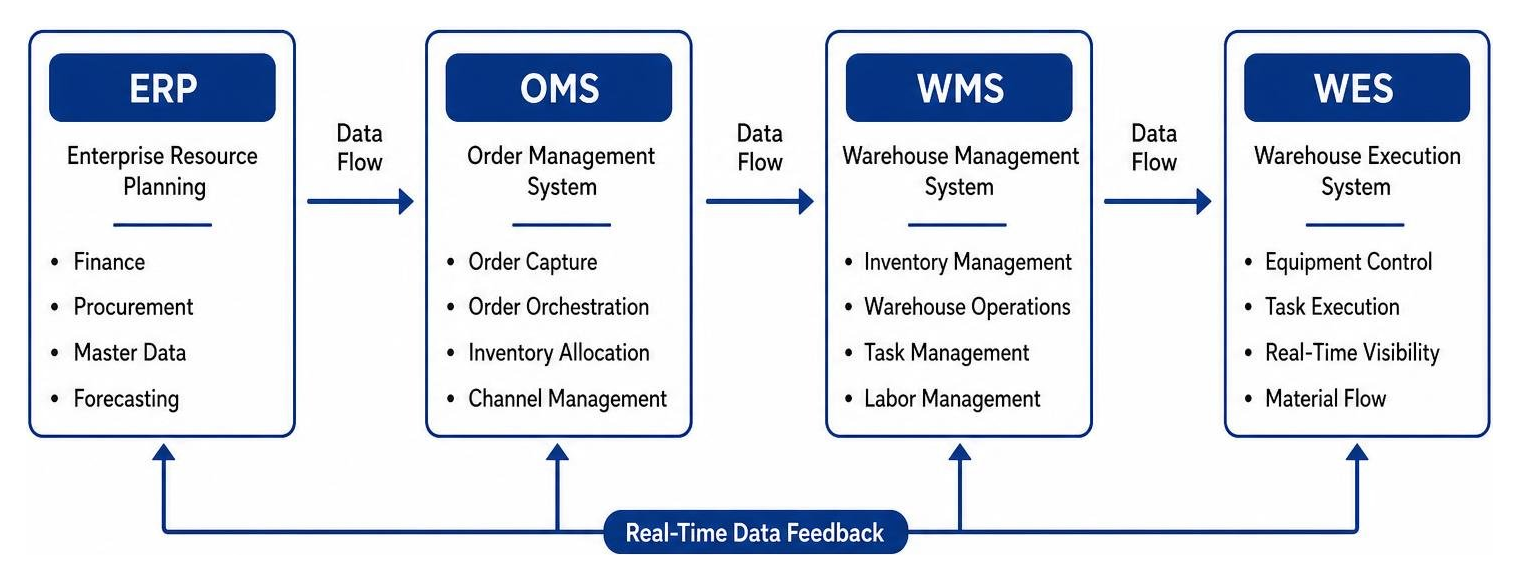
The software stack of a modern fulfillment network acts as its central nervous system. It consists of several layers that must work in close coordination:
- Enterprise Resource Planning (ERP): The overarching system of record for financial data, procurement, and high-level business planning.
- Order Management System (OMS): The decision layer. The OMS pools orders from sales channels and applies routing rules to determine which physical node — such as a warehouse, retail store, or 3PL — should fulfill each order based on inventory availability, service commitments, proximity, and cost considerations.
- Warehouse Management System (WMS): The execution layer inside the four walls. Once the OMS routes an order to a warehouse, the WMS directs inventory movement, bin locations, picking paths, packing tasks, replenishment, and shipping workflows.
- Warehouse Control System (WCS): The automation control layer that coordinates equipment such as conveyor, sorters, scanners, and other material handling systems.
- Warehouse Execution System (WES): The orchestration layer that can balance labor, automation, order waves, replenishment, and real-time workflow priorities across the facility.
A common mistake is treating these systems as standalone applications. For example, if the OMS does not have a tight, bi-directional sync with the WMS, the online store may display inaccurate available-to-promise inventory, leading to overselling, canceled orders, or unnecessary split shipments.
ATP logic, returns processing, inventory allocation, and node-level visibility all depend on reliable data capture inside the facility. Returned inventory must be inspected and updated correctly before it can be made available again. Inventory allocated to one order should not be promised to another channel. Store transfer, ecommerce, wholesale, and replenishment orders all need clear status updates so managers can see where inventory is located and whether it is ready to ship, stage, replenish, or hold.
To prevent these friction points, operations must design clear boundaries between the decision layer and the execution layer. Managing the flow of material on the warehouse floor also requires linking the WMS with execution software, a topic we cover in our breakdown of WCS, WMS, and WES systems.
How Warehouse Automation Supports Omnichannel Delivery
LD Systems does not act as a delivery carrier or last-mile delivery provider. However, warehouse automation plays a direct role in whether omnichannel delivery promises can be met before the shipment ever leaves the facility.
Omnichannel delivery depends on what happens before the carrier handoff. If inventory is inaccurate, orders are delayed in picking, cartons are misrouted, or staging areas are poorly organized, delivery promises break down before the shipment leaves the facility. Warehouse automation supports omnichannel delivery by improving inventory visibility, pick accuracy, packing flow, sortation, dock staging, and carrier handoff readiness.
On the physical warehouse floor, automation is the engine that drives throughput and accuracy. To handle the variability of omnichannel order profiles — ranging from single-item ecommerce orders to multi-pallet retail shipments — warehouses require flexible material handling systems. Key technologies include:
- Automated Storage and Retrieval Systems (AS/RS): These systems maximize storage density and automate the storage and retrieval of parts, totes, or pallets, reducing travel and improving access to high-velocity inventory.
- Warehouse Robotics & Autonomous Mobile Robots (AMRs): AMRs can transport goods between picking zones, consolidation points, and packing stations, reducing unproductive travel time for workers.
- Goods-to-Person (G2P) Solutions: Rather than having workers walk long pick paths, G2P systems deliver inventory to ergonomic picking workstations, supporting higher throughput and better picking accuracy.
- High-Speed Conveyor & Sortation Systems: These systems route picked items to packing stations and sort finished cartons or parcels by carrier, shipping zone, store destination, or outbound dock.
Implementing these technologies requires careful planning, as detailed in our comprehensive warehouse automation systems implementation guide.
As omnichannel operations mature, automation decisions should be tied to clear warehouse constraints: SKU velocity, order profile, labor model, pick density, replenishment frequency, packing requirements, returns volume, carrier cutoff times, dock capacity, and future scalability.
Designing a Flexible Omnichannel Supply Chain: Implementation Best Practices
Designing a successful fulfillment network is not about achieving perfect optimization on day one; it is about building a system that can adapt to volatile market conditions. Traditional quantitative modeling approaches—which rely on months of historical data to build static networks—are often too slow for modern retail. Instead, operations must build agility directly into their physical layouts and software systems.
This requires a collaborative approach to engineering. When integrating physical equipment and software, working with an experienced systems integrator can mitigate implementation risks, ensure all components communicate correctly, and deliver measurable ROI. This collaborative approach is discussed in our guide on the successful integration of automation.

Transitioning to Unified Inventory Visibility and Allocation Logic
The most important operational shift is not always physically consolidating all inventory into one facility or treating every unit as interchangeable. In omnichannel distribution, the goal is to create unified inventory visibility and allocation logic so the business can decide which node should fulfill each order based on availability, cost, service level, labor, capacity, and downstream constraints.
That may still involve shared inventory pools in some facilities, but the real value comes from coordinated decision-making across warehouses, stores, in-transit inventory, and third-party fulfillment nodes. With accurate visibility and clear allocation rules, operations can:
- Reduce unnecessary safety stock: Better visibility can reduce the need to overbuffer inventory in every channel or location.
- Improve fulfillment decisions: Orders can be routed to the node that best balances inventory availability, shipping cost, labor capacity, cutoff times, and customer service commitments.
- Use space and labor more effectively: Facilities can be designed around the actual role each node plays, whether that means ecommerce fulfillment, store replenishment, wholesale orders, returns processing, or a mixed omnichannel profile.
These principles of network design are outlined by industry experts in Supply chain of the future: Key principles in building an omnichannel distribution network, which emphasizes that connected inventory enables retailers to fulfill orders from the most logical, cost-effective node without holding redundant stock.
Phased Automation and Scalability Planning
Trying to automate every warehouse process all at once is a high-risk strategy that often leads to budget overruns and operational disruption. A more reliable approach is a phased “crawl, walk, run” strategy.
- Crawl (The Basics): Focus on getting your data clean. Implement a robust WMS, establish standardized warehouse receiving processes, and ensure real-time inventory visibility across your existing manual operations.
- Walk (Targeted Automation): Identify the most severe bottlenecks in your facility. This often involves implementing conveyor systems to connect picking and packing areas, or deploying AMRs to reduce worker travel time.
- Run (Full Integration): Integrate high-density AS/RS, goods-to-person workstations, and advanced robotic picking systems, fully orchestrated by a unified Warehouse Execution System (WES).
By designing scalability into your initial layout, you can add modular automation components as your throughput requirements grow. This phased approach to warehouse design and technology selection is detailed in our guide on navigating the automation landscape.
Frequently Asked Questions about Omnichannel Logistics
What is the difference between an OMS and a WMS in omnichannel operations?
An Order Management System (OMS) and a Warehouse Management System (WMS) handle two distinct layers of the fulfillment process:
- OMS (The Decision Layer): Operates at the enterprise level. It collects orders from sales channels and determines where an order should be fulfilled based on inventory availability, routing rules, service commitments, and cost considerations.
- WMS (The Execution Layer): Operates inside the four walls of a specific warehouse. Once an order is assigned to a facility, the WMS directs how that order is physically picked, packed, staged, and shipped — managing bin locations, worker tasks, and inventory accuracy at the SKU level.
LD Systems focuses on the warehouse-side systems that help OMS and WMS decisions translate into accurate physical execution. Its role is to help warehouse and distribution operations coordinate the physical automation, controls, WMS/WCS/WES integration points, storage systems, picking workflows, conveyor, sortation, and material flow that allow facility execution to support omnichannel promises.
How does warehouse automation support omnichannel delivery?
Warehouse automation supports omnichannel delivery by improving the facility-side processes that happen before carrier handoff. Accurate inventory capture, efficient picking, consistent replenishment, carton flow, sortation, packing, staging, and shipping workflows all help orders move through the warehouse with fewer delays and exceptions.
For omnichannel fulfillment, automation may include conveyor, sortation, goods-to-person systems, AMRs, AS/RS, scanning, labeling, controls, and WMS/WCS/WES coordination. The right mix depends on order profile, SKU velocity, labor model, facility layout, returns volume, carrier cutoffs, and the balance between ecommerce, retail replenishment, wholesale, and store-transfer workflows.
What is available-to-promise (ATP) inventory?
Available-to-promise (ATP) is the quantity of a specific product that a business can commit to new customer orders. Unlike “on-hand” inventory — which simply counts every physical unit in the building — ATP calculations may subtract existing order commitments, pending returns, and safety stock buffers. Accurate ATP logic is essential in omnichannel retail to help prevent overselling across multiple digital channels.
LD Systems Examples for Omnichannel Fulfillment and Distribution
Documented LD Systems case studies show how integrated warehouse automation can support the same execution challenges that appear in omnichannel fulfillment: faster order cycles, more accurate picking, coordinated sortation, and reliable high-volume distribution.
- Chico’s e-commerce distribution case study: LD Systems helped reduce order cycle time from 3 hours to 30 minutes, tripled picking productivity, and reduced order errors. For omnichannel operations, this is a strong example of how ecommerce fulfillment performance depends on coordinated picking, packing, and distribution workflows.
- Thomson e-commerce distribution case study: LD Systems documented a 50% productivity improvement, 99.93% order accuracy, and a reduction in order cycle time from 2 hours to 25 minutes through an integrated storage, picking, conveyor, and sorter project. This example is especially relevant for facilities that need ecommerce distribution and sortation to work together at scale.
- HSN order cycle time case study: In a high-volume fulfillment environment, LD Systems’ work with HSN shows how automation and systems integration can support order accuracy and cycle-time improvement when operations must process large order volumes consistently.
These examples reinforce the central warehouse-side requirement of an omnichannel supply chain: customer promises depend on facility systems that can move inventory accurately, route orders efficiently, and keep fulfillment workflows synchronized before the shipment ever reaches the customer.
How LD Systems Supports Omnichannel Warehouse Operations
Omnichannel supply chain performance depends on more than sales channels and delivery promises. The warehouse must be able to receive, store, pick, replenish, pack, sort, stage, and ship orders across multiple fulfillment paths without losing inventory accuracy or creating bottlenecks.
LD Systems helps warehouses, distribution centers, fulfillment operations, and manufacturing facilities connect material handling equipment, AS/RS, conveyors, robotics, controls, WMS/WCS/WES coordination, and warehouse systems integration into a scalable fulfillment operation.
LD Systems is a technology-agnostic warehouse systems integrator. Rather than manufacturing individual pieces of hardware or acting as a full supply chain strategy firm, OMS vendor, last-mile delivery provider, or retail network consultant, we design, engineer, integrate, install, and support complete automation systems tailored to facility-level operational goals. Our expertise spans:
- High-density AS/RS and goods-to-person solutions
- Custom conveyor and high-speed sortation systems
- Advanced warehouse robotics and AMR integration
- Coordinated WMS, WCS, and WES software integration
- Turnkey controls engineering and project management
We work closely with midsize and large organizations to evaluate operational bottlenecks, develop customized automation strategies, and implement scalable systems that support measurable ROI. In certain applications, LD Systems has helped automation projects target measurable ROI in as little as 17 months, but results depend on facility layout, order volume, labor model, technology selection, software integration, and implementation scope.
Whether you are modernizing an existing facility in Florida or designing a highly automated distribution center, LD Systems can help evaluate the warehouse-side systems needed to support omnichannel fulfillment. To improve inventory visibility, fulfillment flow, sortation, staging, and delivery readiness, request a professional warehouse systems integration consultation with LD Systems.
