

What Are Automated Guided Robots?

“Automated guided robots” is a broad search phrase often used to compare automated guided vehicles, autonomous mobile robots, and other mobile robotic systems used for warehouse transport. In practice, operations teams are usually evaluating two related categories: AGVs (automated guided vehicles) and AMRs (autonomous mobile robots).
If you’re evaluating whether these systems belong in your operation, here’s a quick orientation:
What are automated guided robots?
- AGVs (Automated Guided Vehicles): Driverless vehicles that follow predefined paths using magnetic tape, inductive wire, laser reflectors, or natural feature navigation to transport materials without a human operator.
- AMRs (Autonomous Mobile Robots): A more advanced class of mobile robot that uses onboard sensors, cameras, and AI-based mapping (SLAM) to navigate dynamically, replanning routes around obstacles in real time.
- The key difference: AGVs follow fixed or semi-fixed routes and stop when blocked. AMRs calculate alternate paths on the fly. Both reduce manual transport labor, but they suit different operational profiles.
For a neutral industry overview of how AGVs fit into modern material handling, the MHI guide to automated guided vehicles provides a useful starting point.
Why operations leaders are investing now:
- Persistent labor shortages are making manual material transport increasingly unsustainable.
- Throughput demands — driven by e-commerce growth and tighter delivery windows — require more consistent, predictable internal material flow.
- Some SLAM-based systems can reduce infrastructure requirements and shorten deployment timelines compared with systems that require physical guidepaths.
- Safety and scalability needs are pushing facilities toward repeatable, software-directed transport instead of relying only on manual moves.
The navigation approach your operation uses — track-guided, laser reflector, SLAM, or hybrid — determines how flexible, accurate, and costly your system will be over its lifetime. That decision deserves a clear-eyed technical comparison before any capital is committed.
This guide breaks down every major navigation method, compares AGVs and AMRs across real operational variables, and helps you build a business case grounded in your facility’s actual constraints.
AGV vs. AMR: What’s the Difference?
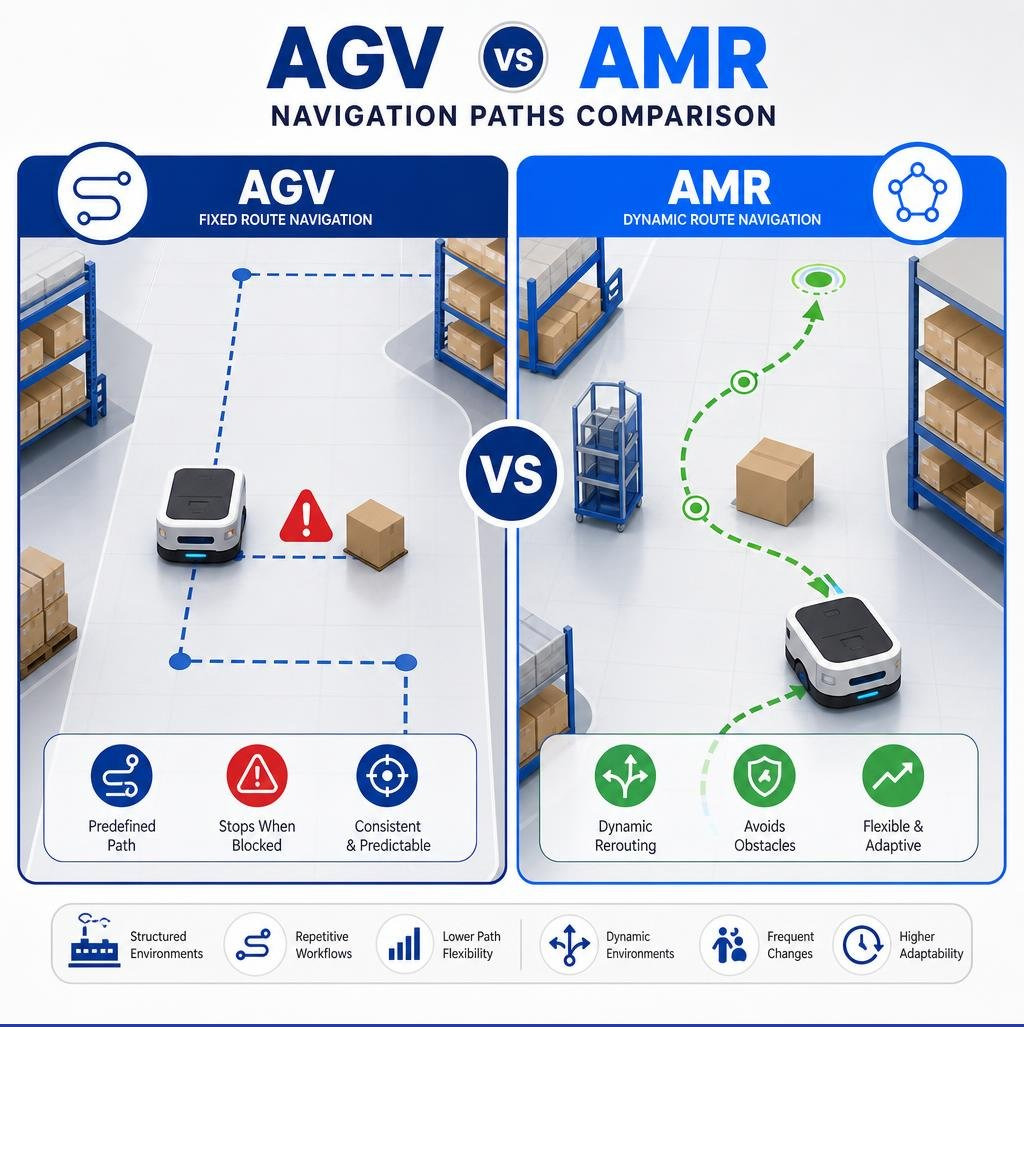
AGVs and AMRs are both automated guided robots used to move materials through warehouses, distribution centers, and manufacturing facilities, but they are not interchangeable. The biggest distinction is how each system navigates: AGVs are designed around fixed or semi-fixed routes, while AMRs use dynamic path planning to adjust movement as conditions change.
| Factor | AGV | AMR |
|---|---|---|
| Navigation | Fixed or semi-fixed routes | Dynamic path planning |
| Best fit | Repetitive, predictable moves | Flexible workflows |
| Obstacle response | Stops when blocked | Reroutes when possible |
| Infrastructure | May require tape, wires, reflectors, or markers | Often uses SLAM/natural feature navigation |
| Integration need | Fleet manager, WMS/WES/WCS coordination | Fleet manager, WMS/WES/WCS coordination |
| Best use cases | Pallet transport, tugging, repeat routes | Goods movement, replenishment, zone transport, flexible fulfillment |
For LD Systems customers, the decision is less about choosing the newest robot category and more about matching the right mobile automation approach to the facility’s routes, load profiles, safety requirements, and software environment. A repetitive pallet move from production to staging may favor an AGV-style system, while a fulfillment operation with changing pick paths or replenishment needs may benefit from AMR flexibility.
Core Navigation Technologies for Automated Guided Robots
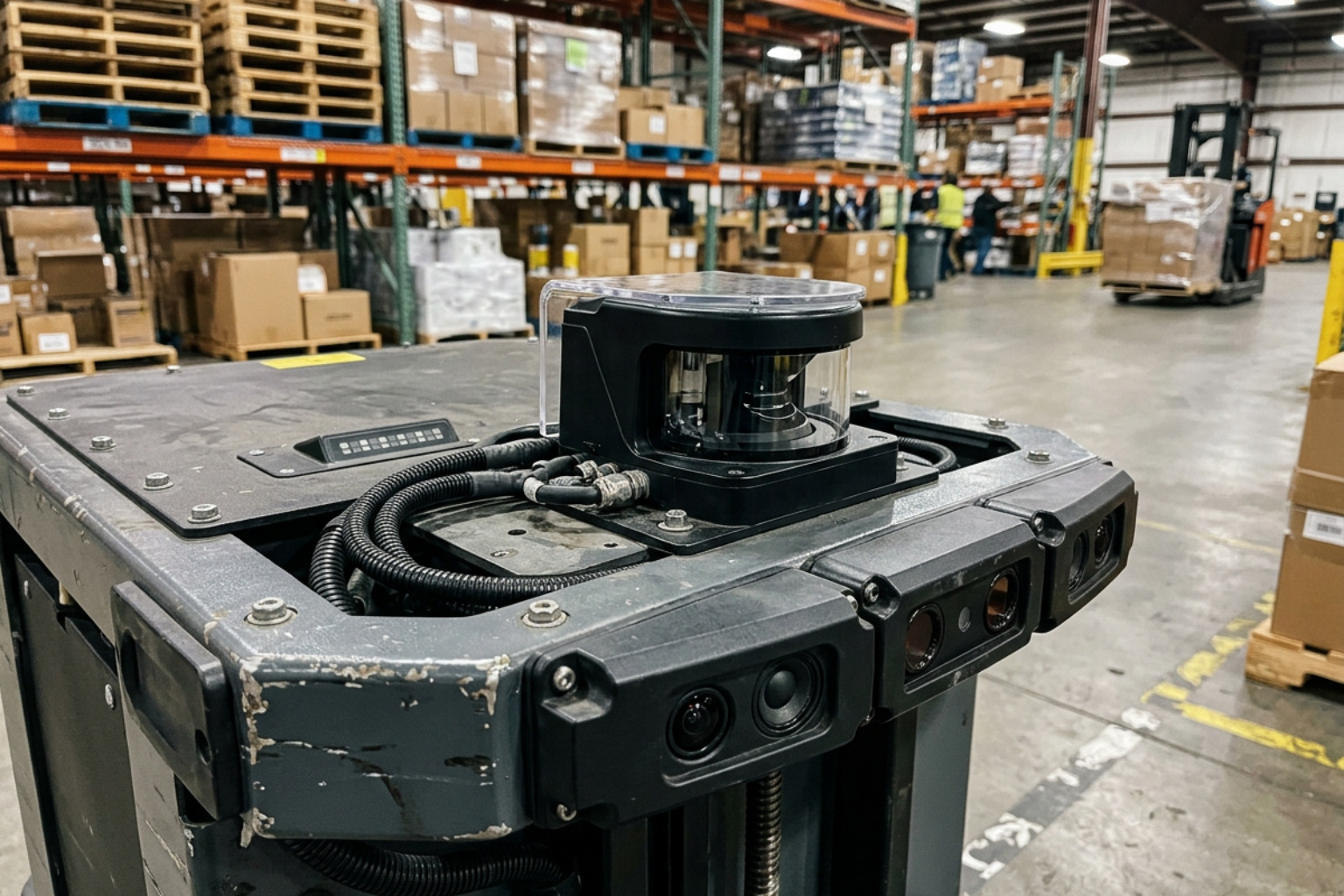
Selecting the right guidance system requires understanding how these vehicles establish their position and determine their path. From the early days of simple wire guidance to modern spatial AI, each technology offers a distinct balance of installation complexity, path flexibility, and positioning accuracy.
Operations leaders can also build context with LD Systems’ robotic warehouse systems, which explains how robotics fit into a broader warehouse automation plan.
Track-Guided and Marker-Based Navigation
Track-guided and marker-based systems represent the traditional foundation of automated guided vehicle navigation. These systems rely on physical markers installed directly in or on the facility floor to define the vehicle’s travel paths.
- Magnetic Tape and Inductive Wire: Magnetic tape is adhered directly to the floor surface, while inductive wires are buried in shallow trenches cut into the concrete. The vehicle uses magnetic or inductive sensors to detect the path, maintaining a centered position directly over the line.
- Optical Guidepaths and QR Codes: Optical systems use painted lines or UV markers that are visible only to specialized cameras. More modern iterations of marker-based navigation use a grid of QR codes placed on the floor. The robot utilizes a downward-facing camera to read these codes, allowing it to determine its exact coordinates and orient itself within the grid.
While these methods offer exceptionally high repeatability and simple control logic, they require rigid paths. Any changes to the material flow require physical floor modifications, line repainting, or tape re-application, which can disrupt active operations.
Laser Target and Reflector Navigation
Laser target navigation, often referred to as laser guidance or laser triangulation, eliminates the need for continuous floor markers. Instead, it relies on elevated reflective targets placed on walls, columns, or permanent machinery throughout the facility.
The vehicle is equipped with a rotating laser scanner, typically mounted on top of the chassis. As the scanner rotates, it projects laser beams that bounce off the reflective targets. By measuring the return angles of these beams, the onboard system uses triangulation to calculate the vehicle’s position relative to the facility map.
This approach is often suited for heavy-duty or highly repeatable transport applications where predictable routing and precise positioning matter. It allows operations to move away from physical tape while maintaining the controlled material flow required for heavy pallet transport AGVs.
Natural Feature and SLAM Navigation for Automated Guided Robots
Natural feature navigation and Simultaneous Localization and Mapping (SLAM) represent the cutting edge of mobile robot guidance. Instead of relying on physical floor tape or reflective targets, these systems use the existing environment—such as walls, structural columns, and permanent racking—to navigate.
Using 2D or 3D LiDAR sensors alongside optical cameras, the vehicle maps its surroundings in real time. The SLAM algorithm compares the real-time sensor data with a stored digital map of the facility, allowing the robot to calculate its position dynamically.
- Infrastructure-Free Deployment: Because no tape, wires, or reflectors are required, SLAM-enabled systems can be deployed without altering the physical building.
- Dynamic Mapping: If a new pallet rack is added or a wall is moved, the system can update its digital map without physical intervention.
- Tight-Space Maneuverability: Advanced AMR platforms can support omnidirectional or highly maneuverable movement patterns in applications where rigid paths are impractical.
This infrastructure-free approach is the standard for modern autonomous mobile robot systems, providing the agility needed to adjust workflows on the fly.
Operational Trade-offs: AGVs vs. AMRs and Traditional Material Handling
When designing a material handling system, operations leaders must evaluate mobile robots against traditional alternatives like fixed conveyors or manual forklifts. Each technology has distinct operational trade-offs regarding flexibility, space utilization, throughput, and capital expenditure.
| Feature / Variable | Automated Guided Vehicles (AGVs) | Autonomous Mobile Robots (AMRs) | Fixed Conveyor Systems | Manual Forklifts |
|---|---|---|---|---|
| Path Flexibility | Low to Medium (tied to markers/reflectors) | Very High (dynamic path planning) | Very Low (rigid, bolted to floor) | High, operator-dependent |
| Upfront Capital (CapEx) | Medium to High | Medium | High to Very High | Low to Medium |
| Facility Footprint | Medium (requires clear travel lanes) | Compact (can navigate tighter aisles) | High (permanently occupies floor space) | High (requires wide turning radii) |
| Scalability | Medium (requires path expansion planning) | High (add robots to fleet easily) | Low (requires physical redesign) | High (rent or purchase more units) |
| Integration Complexity | Medium (requires fleet manager & WMS) | High (requires advanced fleet software) | Low to Medium (PLC-driven) | None (completely manual) |
Comparing Flexibility, Cost, and Space Requirements
During warehouse assessments, operations leaders often find that space is their most constrained resource. Traditional material handling systems like conveyors provide high throughput but create physical barriers that bisect a facility. Once installed, they cannot be easily moved.
Mobile robots, on the other hand, share aisle space with manual equipment and personnel. However, the space requirements differ between AGVs and AMRs:
- Aisle Widths: Traditional forklift-style AGVs often require wider, standardized travel lanes to ensure safety sensors are not triggered by nearby racking. AMRs may be better suited for more flexible routing, but aisle requirements still depend on load size, safety zones, turning radius, traffic patterns, and facility layout.
- Scalability: With comprehensive robotic warehouse systems, scaling throughput does not require tearing up the floor. Operations can scale up by adding additional vehicles to the existing fleet during peak seasons and scaling down when demand normalizes.
Integrating Automated Guided Robots with Existing Systems
A mobile robot is only as effective as the software orchestrating its tasks. Coordinated integration with existing software systems is critical to preventing bottlenecks and maintaining inventory accuracy.
Most deployments require a multi-tiered software architecture:
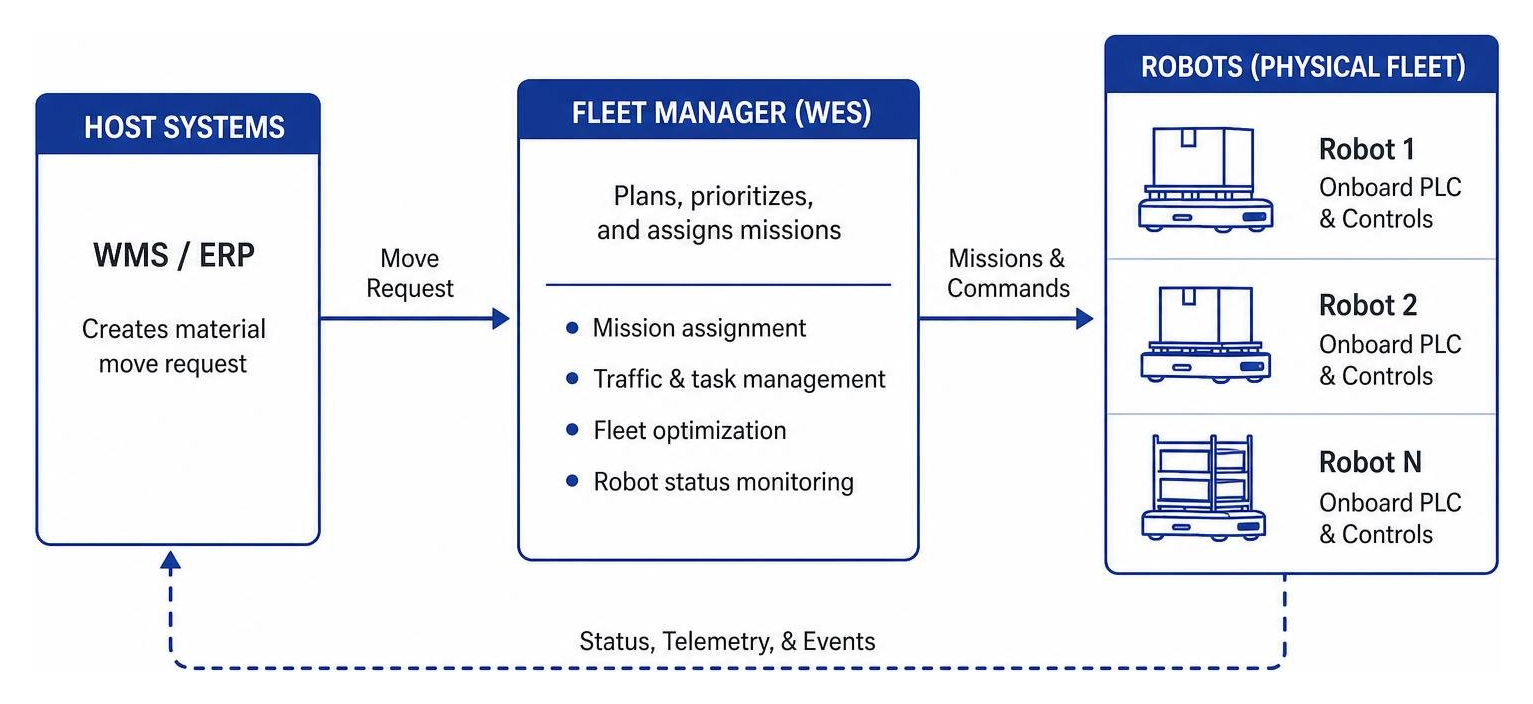
- Host Systems (WMS/ERP): The Warehouse Management System or Enterprise Resource Planning system identifies the need for a material move (e.g., a pallet needs to go from receiving to putaway).
- Warehouse Execution System (WES) / Fleet Manager: The WES or specialized fleet management software translates the move request into a specific mission, assigning it to the optimal robot based on location, battery status, and availability.
- Onboard PLC and Controls: The vehicle’s internal programmable logic controller (PLC) executes the physical movement, receiving coordinates from the fleet manager and utilizing onboard sensors to navigate safely.
This digital thread is especially critical when coordinating mobile robots with robotic storage and retrieval systems, ensuring that goods-to-person systems and horizontal transport fleets work in coordinated execution.
LD Systems Material Flow Automation Examples
LD Systems case studies provide useful proof points for the integration work behind automated material flow, even when the projects are not specifically described as AGV or AMR deployments. The lesson for automated guided robot planning is that vehicle selection is only one part of the system; controls architecture, data visibility, routing logic, picking workflows, and downstream fulfillment processes also determine whether automation improves flow.
In the Neuco conveyor control system modernization case study, LD Systems replaced proprietary conveyor controls with an open PLC-based architecture, improved access to operational and historical data through SQL databases, enabled routing adjustments, and established a scalable WCS architecture for future automation expansion. That type of controls foundation is directly relevant when facilities are evaluating how mobile robots, conveyors, WMS/WES platforms, and fleet software will coordinate work.
LD Systems’ American Honda parts picking case study also illustrates how automation planning can support parts movement and workflow improvement without overstating the project as a mobile robot case study. For high-volume fulfillment, the HSN order cycle time case study shows how integrated automation can support order flow, accuracy, and cycle-time improvement across a complex distribution environment.
Safety Standards, Fleet Management, and Environmental Considerations
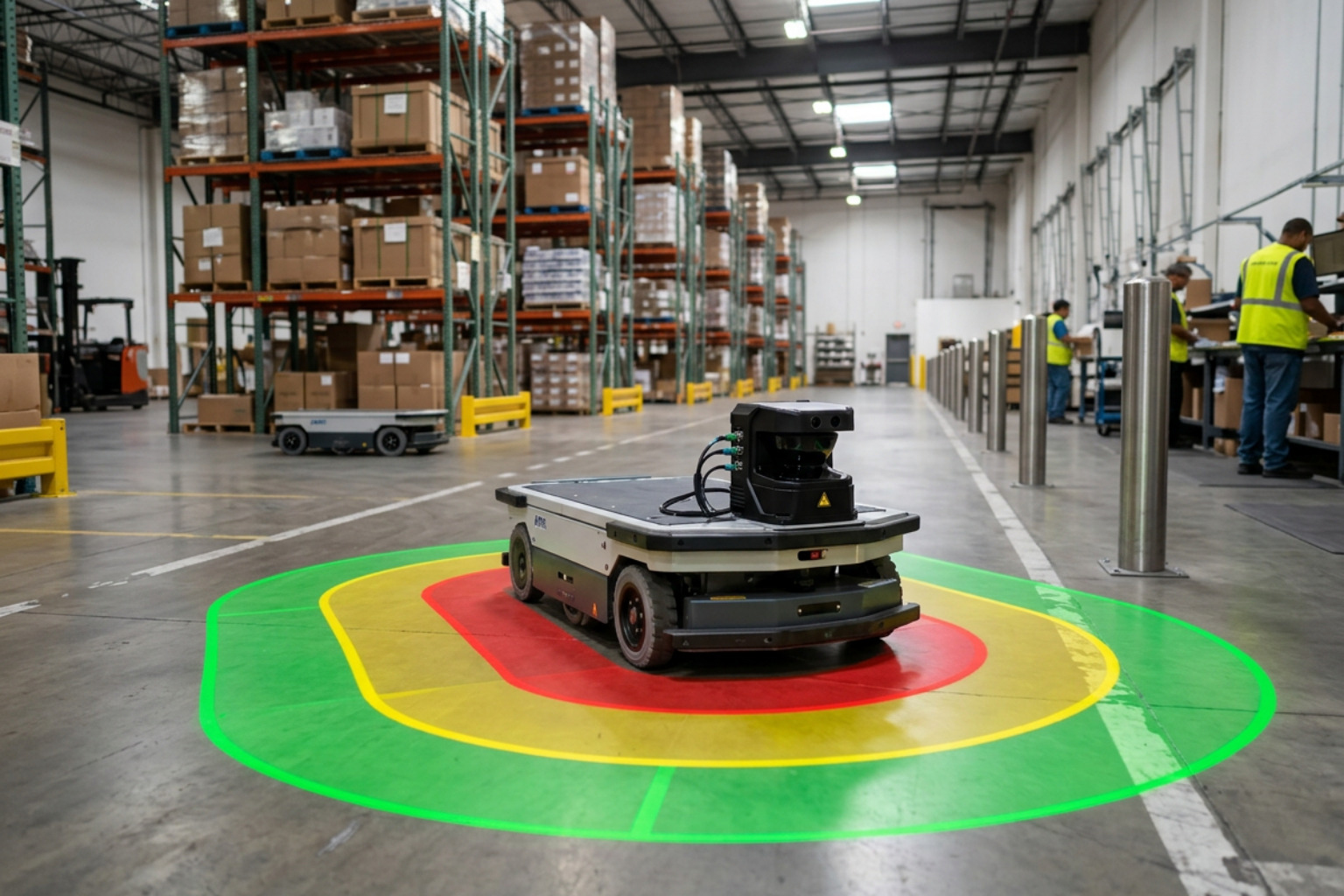
Deploying autonomous machinery into active facilities requires rigorous safety engineering. Unlike manual forklifts, which rely entirely on operator awareness, automated systems use layered safety technologies, traffic rules, and site-specific controls to reduce risk in shared workspaces.
ISO 3691-4 Compliance and Obstacle Detection
The primary international safety standard governing mobile robots is ISO 3691-4 (Driverless industrial trucks and their systems). This standard defines safety requirements for vehicle design, operational zones, and the integration of safety-related control systems. For additional safety context, A3’s overview of the R15.08 industrial mobile robot standard explains how U.S. guidance addresses industrial mobile robot systems.
Mobile robot safety depends on the robot design, load profile, travel speed, stopping distance, traffic patterns, pedestrian interaction, facility layout, and site-specific risk assessment. Safety-rated scanners and stop zones are important, but the full system must be evaluated in context rather than assumed compliant because a robot includes detection hardware.
Mobile robot systems are commonly designed with safety-rated scanners, warning zones, stop zones, emergency stops, and traffic rules to support safe operation in shared environments:
- Warning Zone: As the robot detects an object or person at a distance, it slows down and may emit an audible warning or flashing light.
- Stop Zone: If an obstacle enters the immediate path, the robot executes a controlled stop before contact is made.
- Emergency Stops and Traffic Rules: Physical emergency stop devices, speed limits, intersection controls, right-of-way rules, and restricted zones help align robot behavior with the facility’s actual workflows and pedestrian movement.
These safeguards should be configured around the vehicle’s speed, load weight, stopping distance, route geometry, and pedestrian exposure. By automating repetitive, heavy transport tasks thoughtfully, companies can reduce worker exposure to high-risk manual transport work.
Fleet Orchestration and Interoperability (VDA 5050)
As operations grow, they often deploy different types of mobile robots from various manufacturers—such as towing vehicles for raw materials, pallet stackers for warehousing, and small AMRs for bin picking. Historically, coordinating a mixed-vendor fleet was an integration challenge, as each manufacturer used proprietary fleet management software.
To solve this, the industry has moved toward the VDA 5050 standard. This protocol defines a standardized interface for communication between mobile robots and a central control software.
- Manufacturer-Independent Control: VDA 5050 allows a single, overarching fleet manager to assign tasks, manage traffic, and monitor battery levels across a heterogeneous fleet.
- Traffic Management: The central system uses real-time location data to prevent gridlock at intersections, coordinate charging schedules, and optimize travel paths across the entire facility.
For operations evaluating multi-vehicle systems, fleet orchestration should be considered alongside safety planning, software integration, and long-term warehouse system design.
Building the Business Case: Costs, ROI, and Implementation Strategy
Investing in mobile automation requires a clear understanding of the financial and operational variables that drive return on investment. While the initial capital expenditure can be significant, the long-term savings in labor, operational efficiency, and reduced product damage often justify the transition.
To understand why these financial metrics are driving widespread adoption, it is helpful to look at why robotic automation is becoming the global standard.
Capital Investment and Payback Timelines
The total cost of ownership for a mobile robot system extends beyond the purchase price of the physical vehicles. A realistic budget must account for several key factors:
- Procurement Costs: The physical robot, battery charging stations, and onboard sensors.
- Software and Integration: Fleet management licenses, WMS/ERP integration, and custom PLC programming.
- Commissioning and Mapping: The engineering labor required to map the facility, establish travel paths, and test safety zones.
Payback depends on fleet size, labor model, number of shifts, travel distance, route consistency, software integration, equipment cost, utilization rate, and implementation scope.
In certain applications, LD Systems has helped automation projects target measurable ROI in as little as 17 months, but results depend on facility layout, order volume, labor model, technology selection, software integration, and implementation scope.
Phased Automation and Risk Mitigation
One factor many operations overlook is the disruption of a “big bang” implementation. To mitigate risk, experienced systems integrators recommend a phased automation strategy:
- Facility Assessment: Evaluate existing workflows, identify bottlenecks, and select the navigation technology that matches the physical floor conditions and throughput requirements.
- Single-Route Pilot: Implement a single vehicle on a highly repetitive, low-complexity route (e.g., moving finished pallets from a stretch wrapper to a staging area). This allows the team to adapt to the technology and refine safety zones.
- Fleet Scaling: Once the pilot proves successful, scale the fleet by adding vehicles and integrating the fleet manager directly with the WMS for automated task dispatching.
This phased approach minimizes upfront risk, allows for continuous learning, and ensures that the facility’s workforce is actively engaged in the change management process.
Frequently Asked Questions about Automated Guided Robots
What is the main difference between an AGV and an AMR?
The fundamental difference lies in path planning and obstacle avoidance. An AGV relies on predefined paths (defined by tape, reflectors, or fixed maps) and will stop completely if an obstacle blocks its path, waiting for it to be cleared. An AMR uses onboard intelligence, sensors, and SLAM algorithms to detect an obstacle, calculate an alternate route around it, and continue its mission without human intervention.
How do automated guided robots handle mixed operations with human workers?
Mobile robots are engineered to work safely alongside humans. They utilize safety-rated LiDAR scanners, 3D cameras, and emergency stop buttons to detect human presence. If a worker walks in front of a robot, the vehicle will slow down or stop completely based on its configured safety zones. Additionally, fleet software manages traffic at shared intersections to prevent collisions with manual equipment like forklifts.
What infrastructure modifications are required for laser or SLAM navigation?
Laser target navigation requires the installation of reflective targets on permanent structures such as walls or columns at a height visible to the robot’s rotating scanner. SLAM natural feature navigation often requires less fixed infrastructure than tape, wire, or reflector-based systems, but it still requires mapping, environmental consistency, traffic planning, and a suitable floor condition.
Partnering with a Systems Integrator for Automated Guided Robots
Selecting the right mobile robot is only half the battle; the real value comes from how those vehicles are integrated into your broader material flow. As a technology-agnostic systems integrator, LD Systems does not manufacture individual robots. Instead, we design, engineer, and implement complete, unified automation systems tailored to your specific operational goals.
With more than 50 years of combined engineering experience, our team evaluates your facility’s bottlenecks, designs the optimal material flow, and connects the physical equipment, controls, and software systems. Whether you are looking to automate a single transport route or orchestrate a multi-vendor fleet of mobile robots alongside conveyors and automated storage systems, LD Systems helps align equipment selection, controls, software, and facility workflow through a warehouse systems integration approach.
To evaluate your facility’s automation potential and discuss which navigation approach makes sense for your operation, request a warehouse automation consultation with LD Systems.
