

What Are Automated Mobile Robots?

Automated mobile robots, often referred to as autonomous mobile robots or AMRs, are self-navigating robots that move materials through warehouses, distribution centers, and manufacturing facilities. While “automated mobile robots” is a common search phrase, “autonomous mobile robots” is the more precise industry term.
At a glance — what you need to know about automated mobile robots:
| Question | Quick Answer |
|---|---|
| What are they? | Robots that navigate using sensors, mapping software, and onboard controls |
| How do they differ from AGVs? | AMRs generally support more dynamic routing, while AGVs are typically used for more predefined travel paths |
| Where are they used? | Warehouses, fulfillment centers, distribution centers, and manufacturing facilities |
| What do they move? | Totes, pallets, carts, components, and other materials within defined payload limits |
| Key benefit? | Flexible material movement that can reduce travel and improve flow when matched to the right workflow |
| ROI? | ROI depends on labor savings, travel reduction, throughput gains, software integration, facility layout, fleet size, and implementation scope |
For operations leaders, the shift matters because the underlying constraint hasn’t changed: moving materials through a facility is still labor-intensive, error-prone, and difficult to scale. What has changed is the technology available to address it.
A decade ago, automating internal transport often meant committing to conveyors, fixed-route AGVs, or infrastructure-heavy systems that could limit layout flexibility. Today, AMRs can be considered alongside conveyors, AS/RS, sortation, pallet handling systems, and other automation technologies as part of a broader facility strategy.
That distinction matters. AMRs are not automatically the best answer for every warehouse or manufacturing operation. They are one possible technology selected based on facility layout, SKU profile, order volume, payload requirements, traffic patterns, software integration, safety requirements, and ROI. For operations, distribution, and supply chain leaders evaluating where automation fits their facility, understanding how AMRs actually work — and where they genuinely deliver value — is the right place to start.
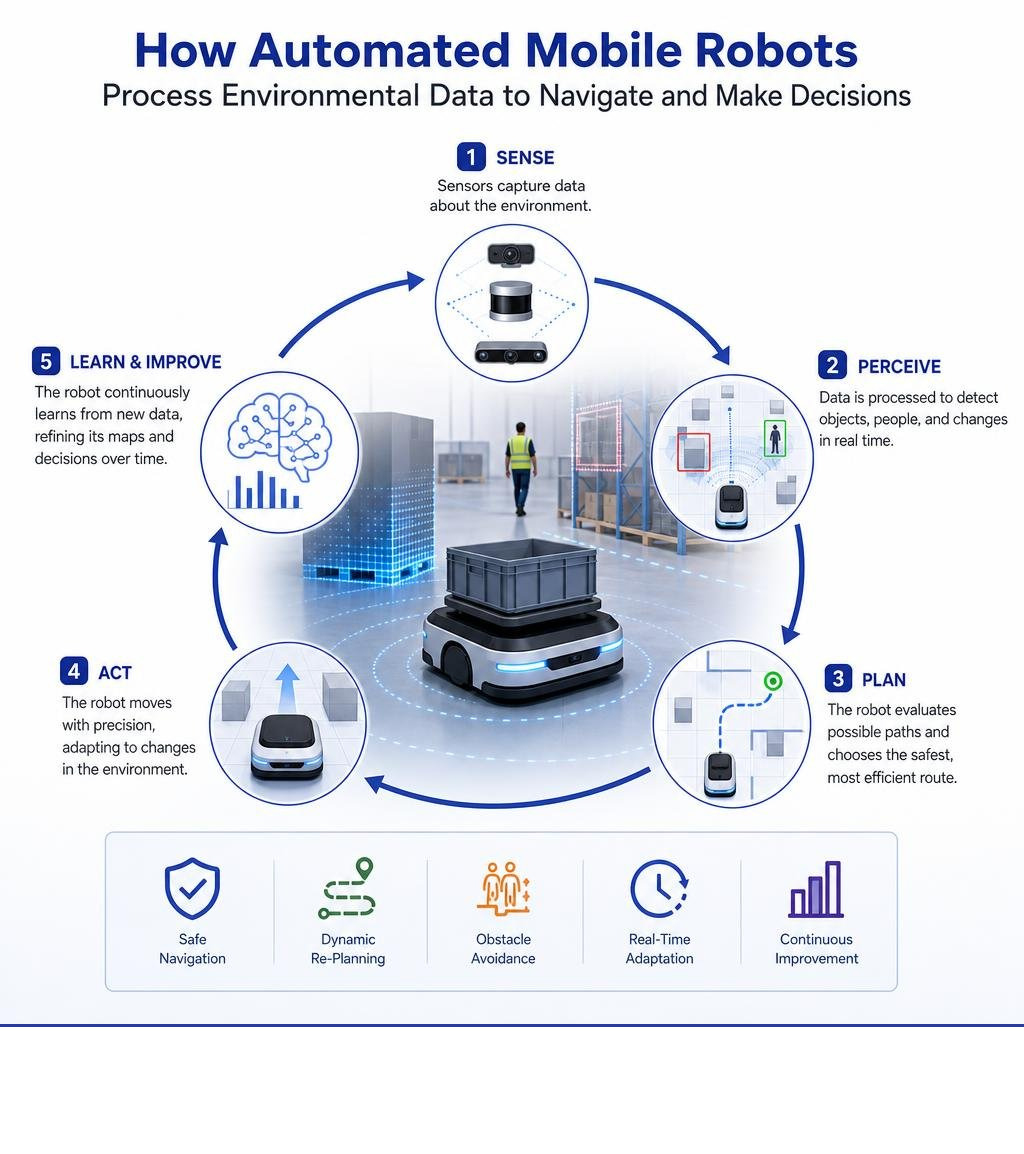
Modern industrial facilities are dynamic environments where material flow directly affects throughput. Traditional manual transport often relies on forklifts and manual carts, which can introduce safety risks, operational bottlenecks, and labor constraints. Automated mobile robots can reduce repetitive horizontal travel and support more flexible material movement when they are properly matched to the facility’s layout, payload requirements, traffic patterns, software environment, and operational goals.

During warehouse assessments, engineering teams often find that operators spend meaningful time walking, driving, or moving between work areas rather than performing value-added tasks. By introducing autonomous navigation into the right workflows, operations can reduce unnecessary travel and allow workers to focus more time on picking, packing, replenishment, quality control, and exception handling.
AGVs vs. AMRs: Understanding the Core Differences in Material Flow
When evaluating transport automation, operations leaders frequently ask about the practical differences between Automated Guided Vehicles (AGVs) and Autonomous Mobile Robots (AMRs). While both technologies move materials from point A to point B, their navigation methods, infrastructure needs, and operational fit can differ significantly.
| Feature | Automated Guided Vehicles (AGVs) | Autonomous Mobile Robots (AMRs) |
|---|---|---|
| Navigation Method | Commonly use predefined paths, magnetic tape, wire, optical lines, QR codes, or other guidance methods | Commonly use dynamic mapping, SLAM, LiDAR, 3D vision, or hybrid navigation methods |
| Obstacle Handling | Often stop, slow, or wait when a path is blocked, depending on system design | Can often reroute around obstacles within approved operating rules |
| Facility Infrastructure | May require floor markings, wires, beacons, or defined guide paths | Often requires less fixed route infrastructure, though charging, traffic rules, docking points, and software integration still require planning |
| Layout Flexibility | Route changes may require physical or controls updates | Routing changes are often software-based, subject to safety validation and workflow constraints |
| Scalability | Expansion depends on guide-path design, controls, traffic flow, and facility constraints | Expansion depends on fleet management, traffic patterns, charging, software integration, and operational fit |
| Typical Use Case | Repetitive, stable routes, assembly lines, or predictable transport tasks | Dynamic warehouses, e-commerce picking support, flexible manufacturing, and workflows with changing travel paths |
AGVs are often associated with predefined travel paths. If an AGV encounters a misplaced pallet, a box, or a human worker in its path, system behavior depends on the AGV design, guidance method, and controls logic; many systems will slow, stop, or wait until the route is clear. To understand how these traditional systems operate, you can learn more about automated guided vehicles (AGVs) and their specific industrial applications.
In contrast, AMRs possess onboard intelligence that can enable active path planning and obstacle avoidance. When an AMR detects an obstruction, its navigation software may calculate an alternative route in real time, bypassing the obstacle without stopping the entire workflow when that route is safe and permitted by the facility’s operating rules. This flexible movement makes AMRs highly adaptable in the right environments, but they still require careful planning around traffic flow, safety zones, charging, docking, payloads, and software integration. To explore the foundational technology behind these self-directing units, you can discover the fundamentals of autonomous mobile robots (AMRs) and how they support lean operations.
Navigation Technologies Powering Automated Mobile Robots
The intelligence of an AMR relies on a sophisticated sensor suite and advanced software algorithms. The core technology enabling this independence is SLAM (Simultaneous Localization and Mapping).
- LiDAR (Light Detection and Ranging): Laser scanners emit light pulses to measure distances to surrounding walls, columns, and equipment, creating a highly accurate 2D or 3D map of the environment.
- SLAM Algorithms: Onboard software processes LiDAR data in real time, allowing the robot to determine its location within the facility map while updating the map as environmental features change.
- 3D Cameras: These sensors provide depth perception, allowing the robot to detect low-profile obstacles, such as forklift tines, or high-hanging obstructions that laser scanners might miss.
- Hybrid Navigation: For environments requiring higher docking precision, AMRs may combine SLAM with localized markers, QR codes, or other reference points at workstations, conveyors, or drop-off locations.
Because these systems interact directly with human workers, lift trucks, conveyors, dock traffic, and traditional machinery, safety and performance planning must be treated as part of the full warehouse environment. Operations leaders can review A3 industrial mobile robot safety standards for mobile robot requirements and OSHA warehousing safety guidance for broader workplace hazard considerations in distribution and storage operations.
Types of Automated Mobile Robots and Where They Fit
Automated mobile robots are not a one-size-fits-all solution. They are engineered in various form factors to handle specific material profiles, weights, and operational tasks.
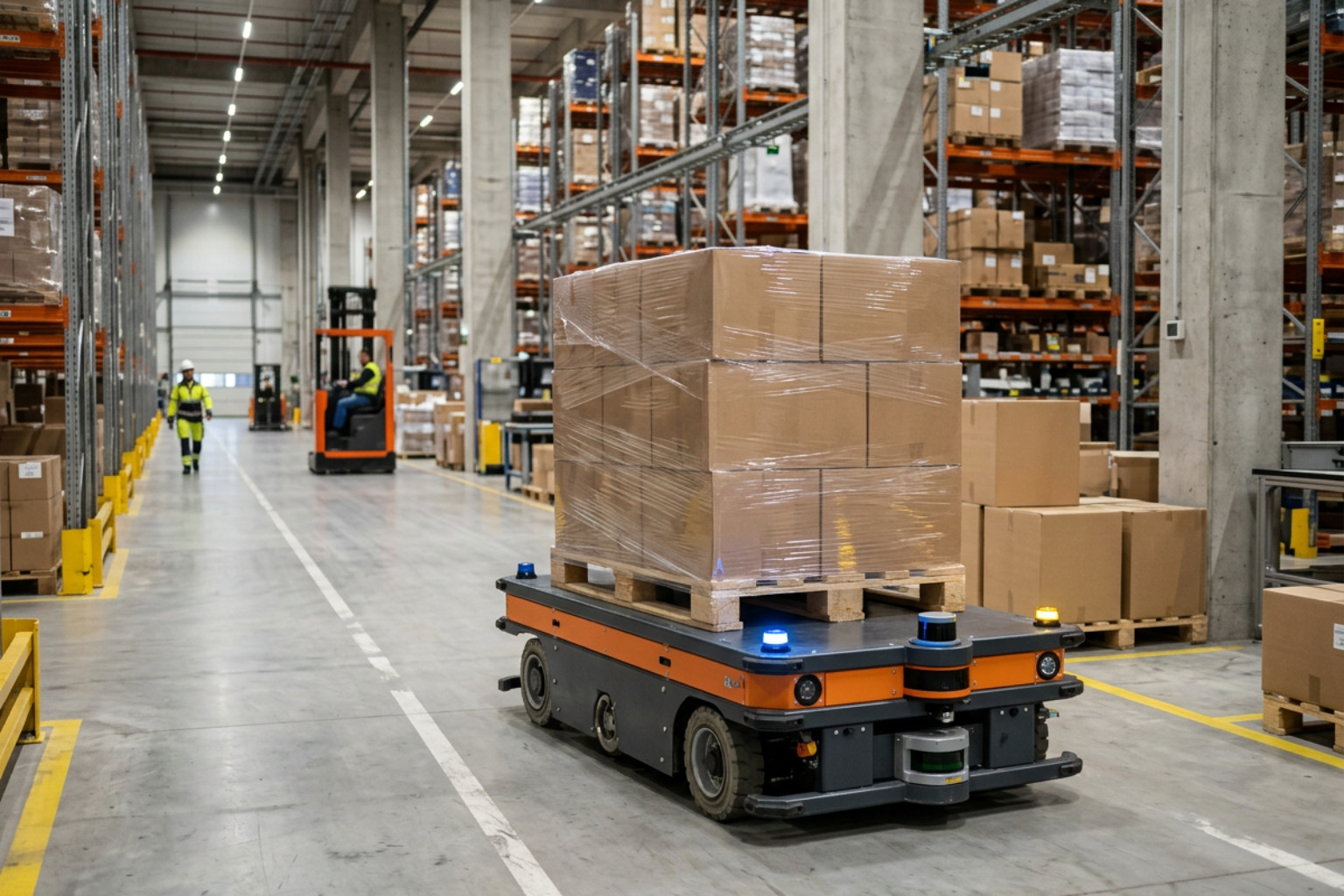
- Platform Robots: These low-profile units are designed to tunnel underneath transport racks, carts, or pallets, lift them slightly off the ground, and transport them across the facility. They are highly effective for moving work-in-progress (WIP) materials between manufacturing cells when rack design, floor conditions, payload, and traffic flow are properly planned.
- Mobile Manipulators: By mounting a collaborative robotic arm (cobot) onto a mobile platform, these systems can travel to a workstation, perform a pick-and-place task, and move to the next station, combining transport with physical manipulation in applications where reach, payload, tooling, and safety requirements align.
- Autonomous Forklifts: Engineered to support pallet movement, these heavy-duty AMRs use advanced sensors to identify, lift, and move pallets in receiving, storage, replenishment, and staging workflows. Their fit depends on pallet quality, aisle width, rack design, lift height, floor conditions, and integration with warehouse software.
To see how these different configurations fit into a broader facility plan, operations leaders can read our guide on the diverse types of robots used in logistics to match specific inventory profiles with the right robotic architecture.
How Automated Mobile Robots Optimize Goods-to-Person Workflows
In traditional order fulfillment, pickers often spend a significant portion of their shift traveling between aisles to locate items. Goods-to-person (GTP) workflows flip this dynamic by using AMRs to bring inventory directly to stationary operators.
When an order is received, an AMR navigates to the storage area, retrieves the specific shelf, bin, or tote containing the required SKU, and transports it to an ergonomic picking station. Once the operator picks the item, the AMR returns the inventory to storage. This process can reduce operator travel, improve ergonomics, and support more consistent picking performance when the system is properly matched to SKU velocity, order profile, storage strategy, replenishment flow, and software logic. To understand how these workflows transform daily operations, you can understand how robotic technology empowers warehouse teams by improving ergonomics and reducing repetitive physical strain.
Integrating AMRs with WMS, ERP, and Existing Automation Ecosystems
A common point of failure in automation projects is isolated technology. An AMR fleet is only as effective as its integration with the broader facility ecosystem. Successful deployment requires coordinated data exchange between three primary software layers:
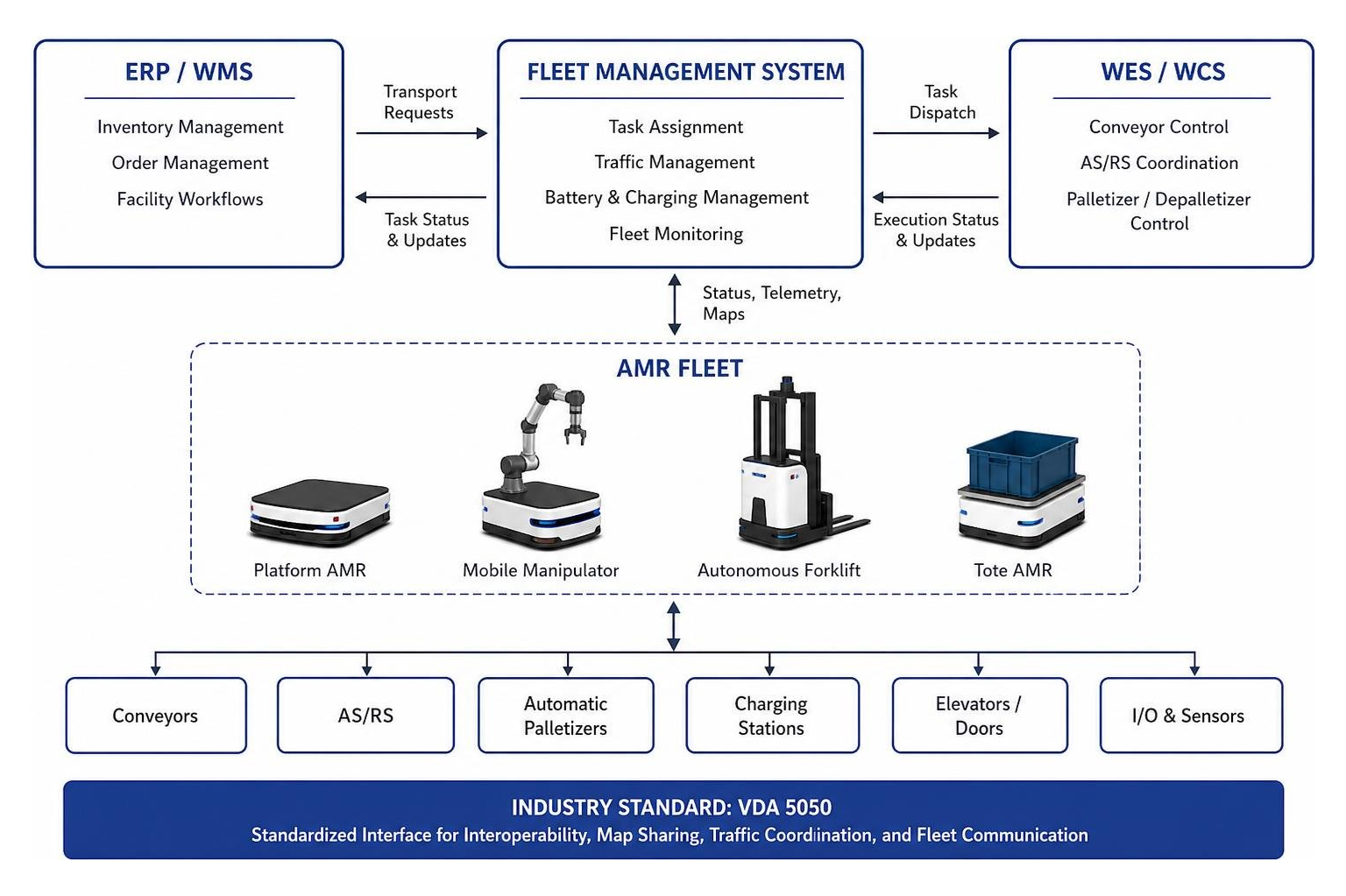
- Enterprise Resource Planning (ERP) & Warehouse Management Systems (WMS): These systems manage inventory levels, customer orders, and overall facility workflows. They send transport requests (e.g., “move pallet X from receiving to aisle 4”) to the robot control system.
- Fleet Management Software: This middle layer acts as the air traffic controller for the robots. It assigns specific tasks to individual AMRs based on proximity and battery levels, manages traffic flow in narrow aisles, and coordinates charging schedules.
- Warehouse Execution Systems (WES) & Warehouse Control Systems (WCS): These systems coordinate the AMRs with physical automation, such as conveyors, automated storage and retrieval systems (AS/RS), and automatic palletizers.
Some multi-vendor AMR environments may use interface standards such as VDA 5050 to support communication between robot fleets and control systems. Operations leaders can read our introduction to autonomous robotics to learn more about coordinating software, controls, and physical machinery.
The Role of Artificial Intelligence and Machine Vision
Some AMR systems use machine vision, sensors, and onboard processing to improve navigation, obstacle detection, traffic management, and fleet coordination. The level of intelligence varies by platform, application, and integration scope.
Onboard AI may help robots classify the objects they encounter. Instead of simply stopping for an obstacle, some AMRs can distinguish between a static structural column, a temporary pallet drop, and a walking human worker. This distinction can help the robot adjust its speed and trajectory within the limits of its software, sensors, and approved operating rules. Additionally, edge computing can allow some calculations to occur on the machine, reducing reliance on network bandwidth for certain tasks. You can explore AI in material handling to see how machine learning can support path planning, slotting, and fleet coordination efficiency.
Evaluating the Business Case: Safety, ROI, and Implementation Planning
Implementing an AMR fleet requires a rigorous evaluation of safety standards, operational metrics, integration requirements, and long-term business value.
Safety is a primary concern in collaborative environments where robots work alongside humans. Modern AMRs are designed around recognized safety standards, such as ISO 3691-4, which addresses driverless industrial trucks in dynamic spaces. Depending on the application, safety planning may include multiple layers, such as:
- Certified Laser Scanners: Creating protective fields around the vehicle that trigger controlled deceleration or emergency stops if breached.
- Acoustic and Visual Signals: Utilizing blue spotlights, turn signals, and audible alarms to alert nearby workers of the robot’s approach and intended path.
- Physical Bumpers: Serving as a redundant mechanical stop in the event of a sensor failure or unexpected contact.
From a financial perspective, AMRs can offer a compelling business case compared to some fixed automation options, but ROI is application-specific. The strongest opportunities usually involve repetitive travel, clear transport lanes, predictable payloads, measurable labor constraints, and software workflows that can reliably trigger and prioritize robot tasks. Payback depends on labor savings, travel reduction, throughput gains, software integration, facility layout, fleet size, charging strategy, safety validation, and implementation scope.
Documented LD Systems case studies show why mobile robotics should be evaluated as part of the broader material handling system, not as isolated equipment. While not every example involves AMRs specifically, these projects show how robotics, storage, picking, conveyor, and software coordination can improve facility performance when the full system is engineered together. In the Honeywell distribution network case study, LD Systems improved small-parts picking speed by 60%, improved space utilization by 50%, and structured 7,200 pick facings for better accessibility. In the Thomson storage, picking, conveyor, and sorter case study, LD Systems documented a 50% productivity improvement, 99.93% order accuracy, and reduced order cycle time from 2 hours to 25 minutes. In the Chico’s ecommerce fulfillment case study, LD Systems tripled picking productivity and reduced order cycle time from 3 hours to 30 minutes. In the Tucson Electric Power parts retrieval project, LD Systems documented a 75% retrieval time reduction, 99.7% accuracy, and a 50% productivity boost. These project-specific results reinforce why AMRs should be evaluated within the full material handling system, not as a standalone equipment purchase.
AMRs can reduce travel, improve material flow, and support more flexible routing when they are properly matched to the facility’s layout, payload requirements, traffic patterns, software environment, and operational goals. In other environments, conveyors, AS/RS, sortation, pallet handling equipment, voice-directed workflows, or process redesign may deliver a better operational fit.
When Automated Mobile Robots May Not Be the Best First Step
AMRs are often a strong option for facilities with clear movement problems, but they should not be treated as a shortcut around process discipline, data quality, or basic infrastructure readiness. In some operations, the better first step is improving slotting, inventory accuracy, traffic flow, replenishment logic, dock staging, or software rules before introducing a mobile robot fleet.
| AMRs may be a strong fit when… | Process or infrastructure improvements may come first when… |
|---|---|
| Travel time is limiting throughput | Facility traffic patterns are disorganized |
| Routes change often | WMS data or inventory accuracy is unreliable |
| Labor availability is constraining movement | The main bottleneck is packing, replenishment, or dock flow |
| The facility needs phased automation | Floor conditions, aisle widths, or charging locations are not ready |
| Loads are consistent and well defined | Payloads, handling requirements, or exception rates vary too widely |
This distinction improves the automation business case. If the facility is not ready for AMRs, forcing robots into an unstable process can increase exceptions, create traffic conflicts, and reduce operator trust. If the facility is ready, a phased AMR deployment can support measurable improvements without requiring every workflow to be rebuilt at once.
To minimize implementation risk, engineering teams recommend starting with a thorough facility layout analysis, detailed fleet sizing calculations, traffic simulation, safety review, software integration planning, and a clear understanding of payload requirements. Operations leaders looking to build a robust business case can learn about preventing risk with robotics and see how robotic automation is becoming the global standard for resilient supply chain operations.
Frequently Asked Questions about Mobile Robotics
What is the difference between an AMR and an AGV?
The primary difference is navigation flexibility and operating model. AGVs are commonly designed around predefined paths or guide methods, while AMRs use onboard sensors, mapping, and software to support more dynamic routing. The best choice depends on route stability, traffic patterns, payloads, safety requirements, integration needs, and the overall automation strategy.
What are AMR robots?
AMR robots, more accurately called autonomous mobile robots, are mobile robots that use sensors, mapping, and software to navigate through a facility without fixed guide paths. The phrase “AMR robots” is redundant, but it is commonly used when teams are researching mobile robot automation.
How do AMRs ensure safety when working alongside humans?
AMRs use multi-layered safety systems that may include certified LiDAR scanners, 3D depth cameras, acoustic alarms, optical warning lights, controlled speed zones, and emergency stop functions. These components are planned around recognized safety standards and the specific facility environment, including aisle width, pedestrian traffic, intersections, load handling, and docking areas.
What is the typical ROI timeline for an AMR deployment?
There is no universal ROI timeline for AMR deployment. Payback depends on labor savings, travel reduction, throughput gains, software integration, facility layout, fleet size, payload requirements, charging strategy, safety validation, and implementation scope. AMRs are most compelling when they solve a clearly defined material-flow problem and integrate cleanly with the operation’s warehouse software and physical processes.
Partnering with LD Systems for Automated Mobile Robots and Integrated Automation
Deploying automated mobile robots is not merely a matter of purchasing equipment; it requires a comprehensive systems integration strategy. Without precise planning, software coordination, and physical layout optimization, even the most advanced robots can underperform.
LD Systems is a technology-agnostic warehouse systems integrator specializing in material handling, warehouse automation, and industrial automation solutions. Rather than manufacturing individual pieces of equipment, LD Systems designs, engineers, integrates, installs, and supports complete automation systems tailored to each customer’s specific operational goals.
With more than 50 years of combined experience, our engineering team helps midsize and large organizations evaluate operational bottlenecks, develop customized automation strategies, and implement scalable warehouse systems. In certain applications, LD Systems has helped automation projects target measurable ROI in as little as 17 months. Actual results depend on facility layout, order volume, labor model, technology selection, software integration, and implementation scope. From our office in Daytona Beach, Florida, we support operations across the United States and Canada, connecting equipment, software, and controls into a unified, high-performing material flow.
If you are ready to evaluate whether automated mobile robots can improve throughput, labor efficiency, or material flow in your facility, request a consultation with our engineering team to begin your automation journey.
