


What Is an Automated Warehouse Picking System?
An automated warehouse picking system uses software, robotics, and material handling equipment to retrieve, present, sort, or confirm inventory for order fulfillment. Depending on the application, it may replace manual travel, assist human pickers, or combine automated storage with operator workstations to improve fulfillment speed, accuracy, ergonomics, and labor efficiency.
| Automated Warehouse Picking Systems at a Glance | Details |
|---|---|
| Purpose | Improve order picking speed, accuracy, ergonomics, and labor efficiency |
| Common technologies | Goods-to-person systems, AS/RS, AMRs, robotic picking, pick-to-light, and voice picking |
| Best for | Warehouses, fulfillment centers, distribution centers, e-commerce operations, and parts picking |
| Key consideration | The right system depends on SKU profile, order volume, pick strategy, software integration, and ROI goals |
Automated picking matters because order fulfillment performance is often constrained by picker travel, inventory visibility, training time, ergonomics, and error control. When the right system is matched to the right workflow, automation can help reduce repetitive movement, present inventory more consistently, and give operations teams better control over throughput and accuracy.
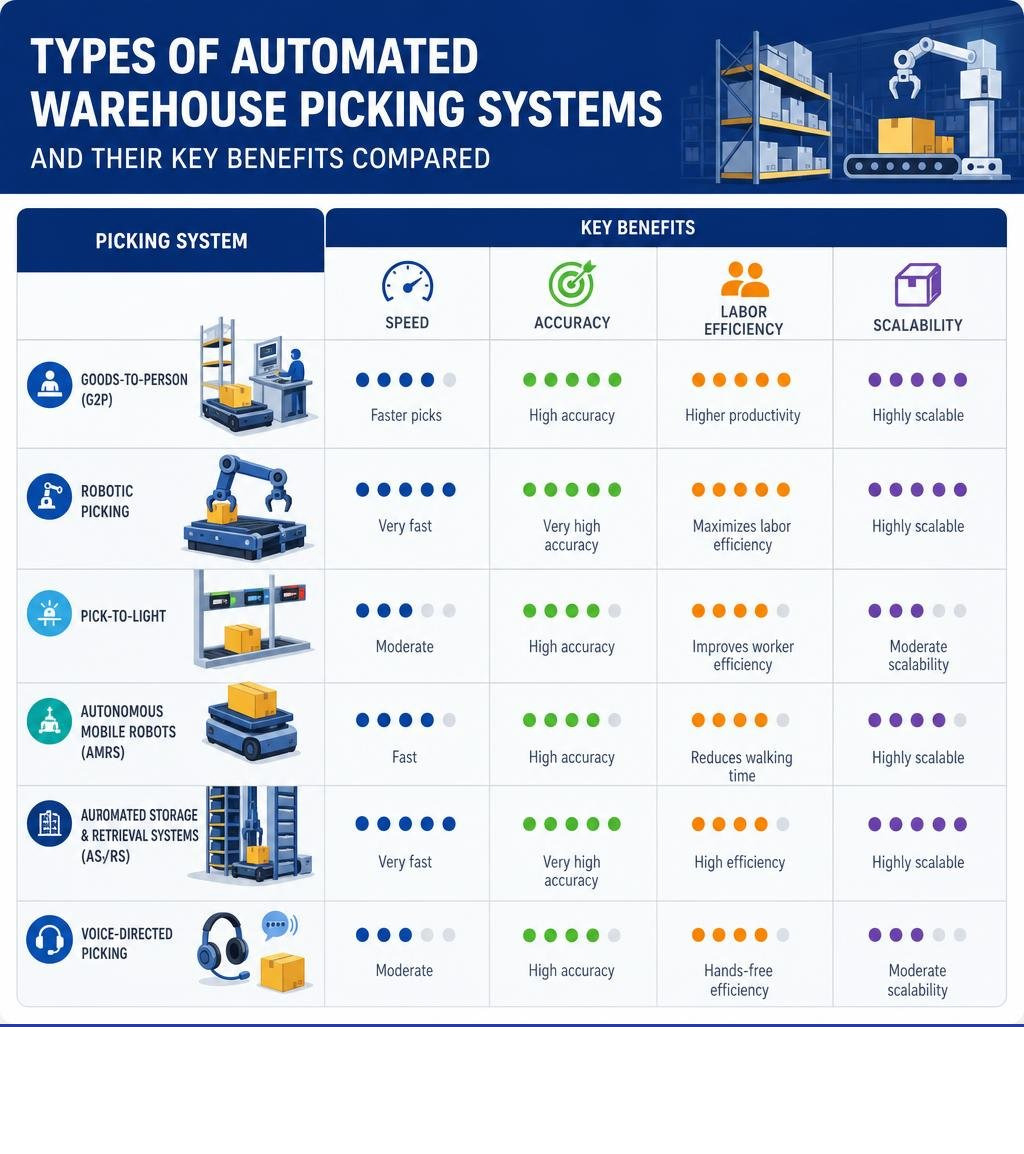
The most common types include:
- Goods-to-Person (G2P) — automated storage delivers inventory to a stationary worker or robot
- Robotic picking — robotic arms with computer vision pick individual items autonomously within defined SKU and handling limits
- Pick-to-light — light displays guide workers to the correct bin, reducing errors
- Autonomous Mobile Robots (AMRs) — mobile robots navigate aisles and bring goods to workers or reduce walking in selected workflows
- Automated Storage and Retrieval Systems (AS/RS) — high-density automated storage with mechanical retrieval
- Voice-directed picking — audio instructions guide workers hands-free through picks
If your facility is struggling with rising labor costs, growing order volumes, or inventory accuracy problems, you are not alone. Order picking can be a major operational cost driver in distribution and fulfillment because it affects labor planning, travel time, accuracy, ergonomics, and throughput.
Many warehouses still rely heavily on manual picking processes. As order profiles become more complex and customer expectations for faster fulfillment increase, the gap between manual workflows and well-designed automation can become more noticeable.
The challenge most operations leaders face is not simply whether to automate. It is which system to choose, when to invest, and how to integrate automation into an existing facility without disrupting current operations.
This guide is designed to help you answer exactly that.
The Operational Cost of Manual Picking and the Case for Automation
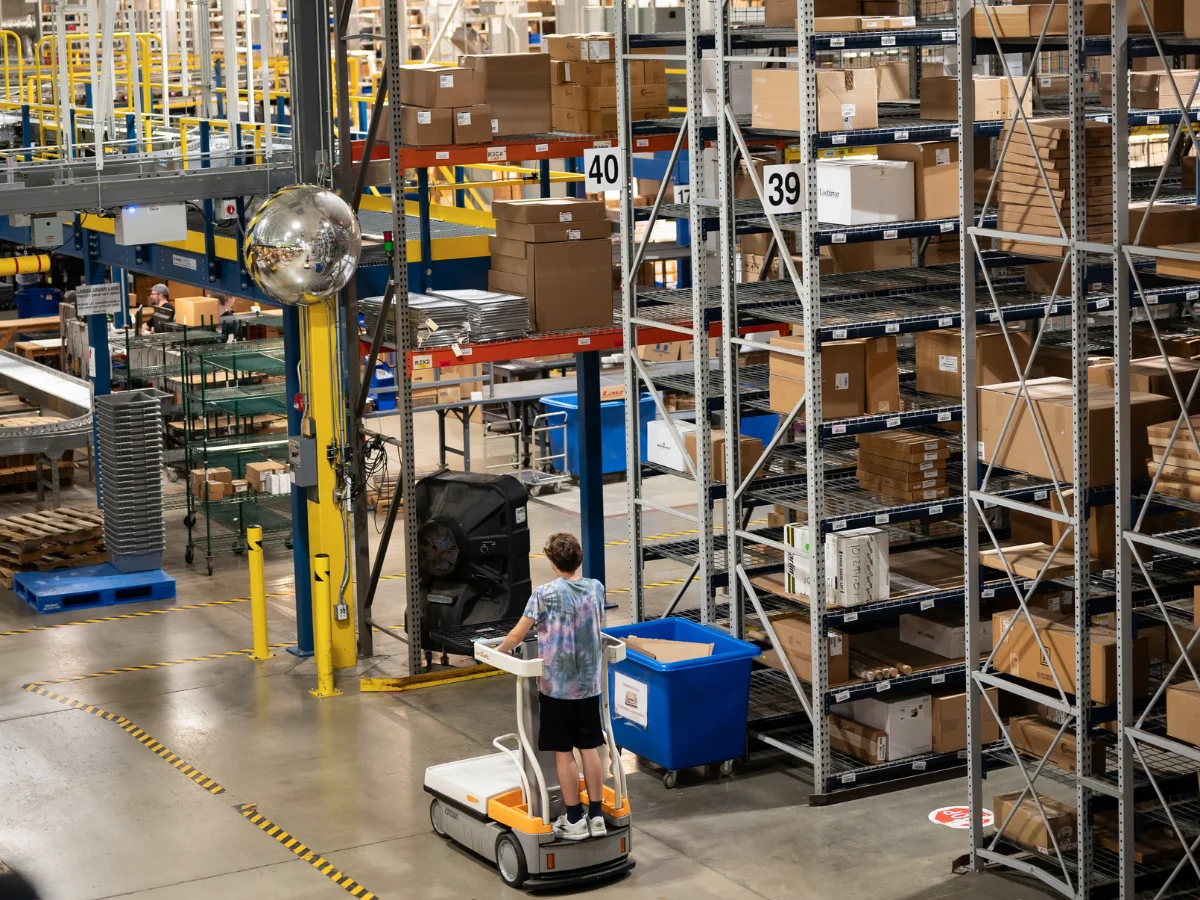
When we conduct warehouse assessments, we find that the true cost of manual picking is rarely confined to a single line item on a spreadsheet. Instead, it often appears as a mix of travel time, searching, handling delays, training requirements, ergonomic strain, and inconsistent execution under pressure. In many manual environments, operators spend a meaningful portion of each shift walking between locations, confirming rack positions, climbing stairs, pushing carts, or waiting for the next task.

Manual picking also depends heavily on human accuracy in fast-moving conditions. As order volume rises, mispicks, miscounts, and shipping errors can become more common if slotting, labeling, WMS discipline, and quality controls are not strong. Even small errors can create downstream costs through returns, customer service time, inventory reconciliation, repackaging, and customer experience issues.
Training time and labor volatility add another layer of complexity. During peak seasons, operations managers may need to onboard temporary staff quickly, even though new workers often need time to learn product locations, scanning processes, safety procedures, and exception handling. When the work also involves repetitive lifting, bending, reaching, and walking, employee fatigue and turnover can become persistent challenges.
Transitioning to automated order picking can mitigate these issues by shifting selected travel, retrieval, confirmation, or sorting tasks from manual labor to software-directed equipment. The right system can help stabilize labor requirements, reduce unnecessary movement, improve ergonomic presentation, and scale daily output more predictably as demand fluctuates.
| Manual Picking Cost Driver | Why It Matters |
|---|---|
| Picker travel | Reduces productive picking time |
| Search time | Slows order completion and creates inconsistency |
| Mispicks | Increases returns, rework, and customer service costs |
| Training time | Makes seasonal labor harder to scale |
| Ergonomic strain | Contributes to fatigue and turnover |
| Replenishment delays | Creates bottlenecks before picking even begins |
How Automated Warehouse Picking Systems Work
To understand how an automated warehouse picking system transforms fulfillment, it is helpful to contrast it with traditional methodologies. In a standard manual setup, the warehouse management system (WMS) generates a paper pick list or sends digital instructions to a handheld RF scanner. The operator must then navigate the physical layout of the facility to locate each item.
An automated picking system, by contrast, relies on a coordinated ecosystem of software, material handling machinery, and robotics to streamline or entirely eliminate this travel time. The system receives orders directly from the host software, determines the most efficient retrieval sequence, and orchestrates physical machinery to bring the inventory directly to the operator or package the order autonomously.
At the heart of this process is improved inventory visibility. When integrated well, automated picking systems can track inventory movement in real time, helping the operation maintain more accurate location, quantity, and status data for each SKU. This level of control is central to modern automated storage and retrieval systems, including the AS/RS technologies defined by MHI.
With the right automated picking system design, warehouses can transition from reactive, labor-intensive environments to more predictable, software-driven fulfillment operations.
Key Technologies Powering Modern Picking Automation
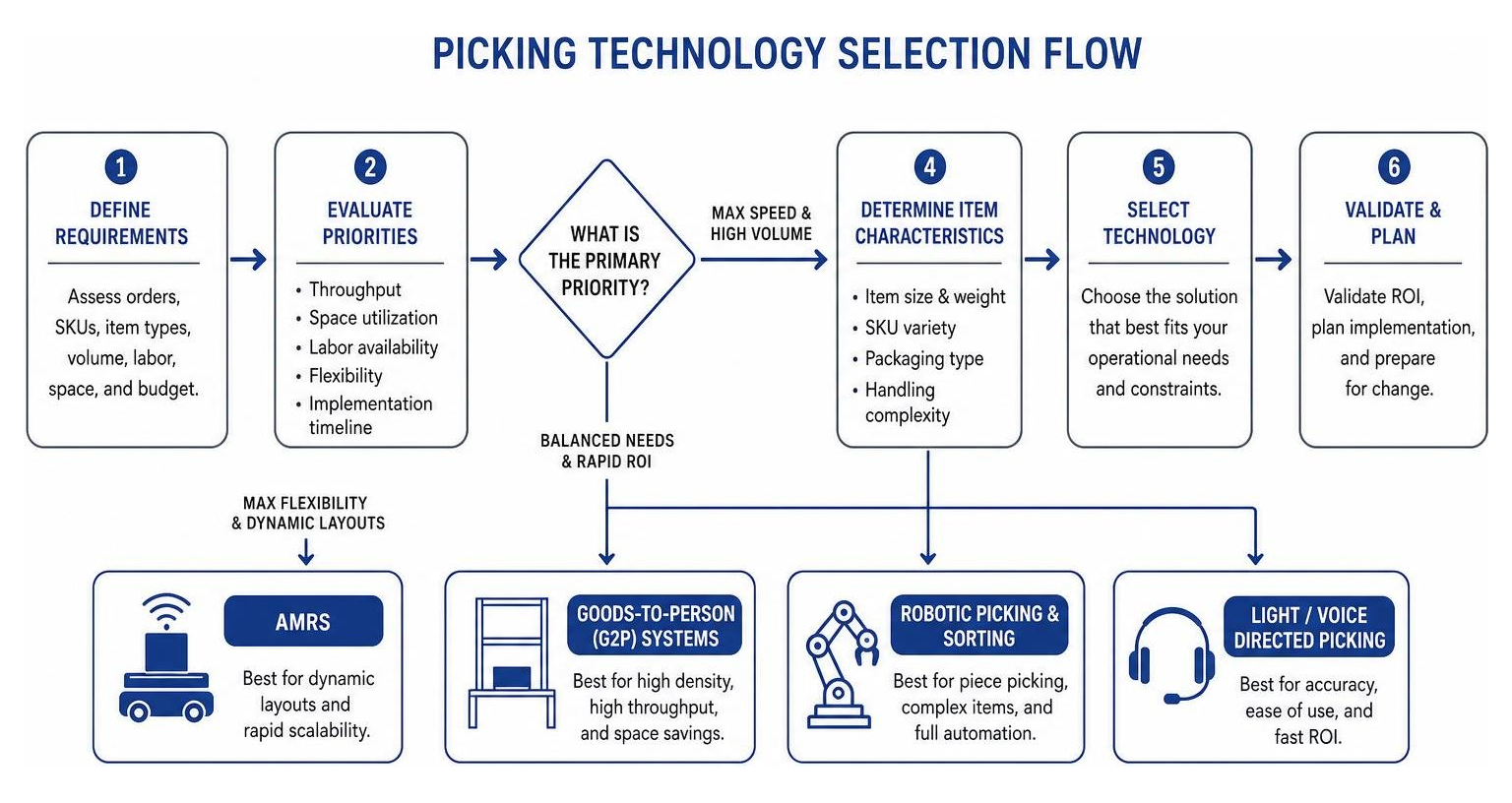
Choosing the right automated picking system requires an understanding of the different technologies available and where they perform best. No single technology is a silver bullet; rather, the optimal solution often combines multiple methodologies tailored to your specific inventory and order profiles.
| Technology Type | Best Suited For | Key Operational Benefit | Relative Footprint |
|---|---|---|---|
| Goods-to-Person (G2P) | High-velocity, small-to-medium SKUs | Reduces or eliminates picker travel within selected workflows | Extremely compact |
| Robotic Piece Picking | Consistent, small, structured items | Supports extended operation with less manual handling | Compact |
| Pick-to-Light | High-density, fast-moving parts | Improves accuracy through visual confirmation and WMS integration | Moderate |
| Voice-Directed Picking | Bulkier, variable, or case-pack items | Safe, hands-free and eyes-free picking | Uses existing shelving |
| AS/RS (Shuttles/Cranes) | High-density pallet or tote storage | Improves vertical cube utilization and reduces manual retrieval | Maximizes vertical space |
| AMRs (Autonomous Mobile Robots) | Flexible, dynamic layouts | Rapid deployment and easy scalability | Highly flexible |
Goods-to-Person (G2P) as an Automated Warehouse Picking System
Goods-to-person technology completely flips the traditional picking model on its head. Instead of operators walking to the product, the product is delivered directly to the operator at a stationary, ergonomically designed workstation. This is achieved using advanced storage systems such as shuttle-based AS/RS, vertical carousels, or mobile robots that retrieve totes or shelves and deliver them in a precise sequence.
If you are wondering whether your facility is ready for this shift, reviewing the signs your warehouse needs goods-to-person automation can help identify the key operational pain points—such as severe space constraints or high labor dependency—that G2P systems are engineered to solve.
A primary driver for G2P adoption is the improvement in storage density and throughput. Because these systems can use narrow aisles, vertical structures, and workstation-based picking, they may help facilities reclaim floor space and increase order-line productivity. Actual results depend on SKU profile, workstation design, replenishment strategy, software integration, and overall system scope.
Furthermore, G2P systems can improve safety and ergonomics. By presenting items at a more ergonomic height and angle, they can reduce bending, reaching, lifting, and unnecessary walking. To explore how these systems protect your most valuable assets, consult our guide on goods-to-person worker safety.
Understanding what goods-to-person technology is is the first step toward designing a high-throughput, space-efficient fulfillment operation that protects your workforce while maximizing output.
Robotic Picking and Sorting in the Modern Warehouse
For facilities considering higher levels of automation, robotic piece-picking systems can be useful in the right application. Robotic piece-picking systems typically combine robotic arms, vision systems, grippers or vacuum tools, and software that helps identify, pick, and place items within a defined operating range. Performance depends heavily on SKU shape, packaging, weight, fragility, presentation method, and exception rate, which is why robotic picking is often evaluated alongside goods-to-person workstations, sortation, and exception-handling processes rather than treated as a universal replacement for human picking.
Implementing robotic storage, retrieval, and pick systems can help operations support longer production windows and reduce repetitive manual handling. This technology is particularly effective when paired with robotic small item sorting systems, which route picked items to their exact packing stations with pinpoint accuracy.
Light and Voice Directed Picking Systems
Not every warehouse requires fully autonomous robotics to achieve high efficiency. In many cases, semi-automated technologies offer an exceptional balance of performance, ease of implementation, and rapid return on investment.
Pick-to-light systems use numeric LED displays and colored buttons mounted directly to storage racks or picking carts. The system illuminates the exact bin the operator needs to pick from and displays the required quantity. Once the pick is complete, the operator presses the button to confirm, instantly updating the WMS.
These systems are intuitive and can reduce training time for new employees. Because they rely on clear visual cues rather than paper lists, pick-to-light systems can improve accuracy when they are properly integrated with inventory data, slotting rules, replenishment processes, and quality controls. For a deeper dive into how this technology can transform your picking accuracy, read about the benefits of light-directed picking.
For operations that handle larger, heavier, or variable-sized items, voice-directed picking offers a hands-free, eyes-free alternative. Operators wear a lightweight headset and receive verbal instructions from the system, confirming their actions using simple spoken commands. This keeps the operator’s hands free to handle products safely and keeps their eyes focused on their surroundings, improving both speed and workplace safety.
By implementing voice-directed picking systems, facilities can reduce dependence on handheld RF scanners and improve picking speed and inventory accuracy when the system is properly integrated and operators are trained well.
Evaluating Your Facility and Calculating ROI
A common mistake we see during automation planning is choosing a technology simply because it looks impressive in a video. Every warehouse has a unique DNA defined by its order volume, SKU complexity, and physical constraints. Implementing the wrong system can create new bottlenecks instead of solving existing ones.
To avoid this, a thorough facility assessment is essential. You must analyze your historical order data to understand your peak throughput requirements, average items per order, and seasonal fluctuations. This data-driven approach is key to finding the right balance between capital expenditure (CapEx) and operational efficiency.
Before diving into complex robotics, it is always wise to optimize your existing workflows. Simple adjustments to slotting strategies, batching rules, and traffic patterns can yield significant improvements. Our guide on ways to optimize your picking processes outlines practical steps to streamline your operations. Once your baseline processes are optimized, you can target the fulfillment areas that are ready for automation to ensure your capital is deployed where it will have the greatest impact.
Aligning Your Inventory Profile with an Automated Warehouse Picking System
To select the ideal automated picking system, you must carefully match the technology to your inventory profile. A system designed for high-density, slow-moving parts will look vastly different from one engineered for fast-moving, high-volume e-commerce orders.
Consider the following factors during your evaluation:
- SKU Velocity (ABC Analysis): Fast-moving items (A-items) may benefit from high-throughput systems like pick-to-light or dedicated G2P lanes, while slow-moving items (C-items) are better suited for high-density vertical storage systems.
- Product Dimensions and Weight: Fragile, heavy, or oddly shaped items require specialized end-effectors if handled by robots, or may be better suited for voice-directed human picking.
- Storage Density Requirements: If your facility is running out of physical footprint, a high-density vertical AS/RS can help expand usable storage capacity by taking advantage of vertical cube and denser storage layouts.
- Scalability and Flexibility: If your business is growing rapidly or experiences extreme seasonal peaks, look for modular systems—such as AMRs—that can be added in phases without requiring a full facility shutdown.
By aligning your specific operational parameters with the right technology, you can design a system that maximizes both throughput and storage density. To explore these methodologies in detail, read about LD Systems picking methodologies.
When Automated Picking May Not Be the Right First Investment
Automated picking is not always the first improvement a warehouse should make. In some facilities, process cleanup, slotting, WMS discipline, workstation redesign, or basic conveyor improvements may deliver a better short-term return before robotics or goods-to-person automation is justified.
| Automated picking may be a strong fit when… | Process improvements may come first when… |
|---|---|
| Order volume or SKU complexity is growing quickly | SKU data, dimensions, or inventory accuracy are unreliable |
| Picker travel is limiting throughput | Picking errors come from poor labeling or weak WMS discipline |
| Labor availability is constraining fulfillment capacity | Order volume is too low to justify automation investment |
| Accuracy and sequencing requirements are increasing | Packing, shipping, or replenishment is the real bottleneck |
| The facility needs scalable throughput without expanding footprint | The operation may relocate before a system can reach payback |
Real-World Success in Automated Fulfillment
To see the power of automated picking in action, we can look to real-world applications where targeted integration solved complex distribution challenges.
For example, in the automotive sector, parts kitting and distribution require precision. Any delay or error in picking can affect assembly lines or delay critical repairs. By implementing a customized parts picking solution, a major manufacturer improved parts picking efficiency. You can read the complete project details in the case study on parts picking improvements for American Honda.
Similarly, high-volume e-commerce fulfillment presents unique challenges, including massive SKU counts, rapid order turnarounds, and unpredictable order spikes. In the apparel sector, where returns are high and order profiles change daily, integrating flexible automation is key to maintaining fast delivery times.
By designing an integrated fulfillment system that combined advanced software with optimized physical handling, a leading fashion retailer was able to support higher daily throughput and lower labor dependency. Discover how this was achieved in the Chico’s e-commerce distribution case study.
Frequently Asked Questions About Picking Automation
What is the average ROI for an automated picking system?
There is no universal ROI timeline for an automated picking system. Payback depends on labor savings, throughput gains, space recovery, accuracy improvements, order volume, and system scope. LD Systems has helped automation projects target measurable ROI in as little as 17 months in certain applications, but each project should be evaluated using facility-specific data.
ROI is typically influenced by:
- Reduced direct picking labor and travel time
- Space savings that may delay or reduce the need for facility expansion
- Fewer picking errors and lower return-handling costs
- Shorter employee onboarding and training times
How does automated picking integrate with existing WMS software?
Modern automated picking systems can integrate with WMS, WES, ERP, and WCS environments, but the complexity depends on the existing software stack, transaction rules, data quality, and automation scope. Integration may involve APIs, middleware, WCS logic, or custom interfaces.
Software integration can support:
- Order files are transmitted to the automation equipment in real-time
- Inventory counts are updated as pick confirmations are processed
- Picking routes, work queues, and equipment movements can be sequenced based on real-time priorities and system feedback
Can automated picking systems handle fragile or mixed-size SKUs?
Yes, but the right approach depends heavily on the SKU profile. One of the most common misconceptions is that automation only works for uniform, rigid boxes. Thanks to advancements in computer vision, robotic gripper design, goods-to-person workstations, and hybrid human-robot workflows, modern systems can support more diverse inventory profiles than earlier generations of automation.
Advanced robotic arms may use soft grippers, vacuum tools, or other specialized end-effectors to handle fragile polybags, deformed packages, and unpackaged items. For highly complex or mixed-size inventories, a hybrid approach—where robots handle standard items and human operators handle exceptions at integrated G2P stations—can broaden SKU coverage while preserving accuracy and throughput.
Partnering with LD Systems for Tailored Warehouse Integration
Implementing an automated warehouse picking system is not about choosing the most advanced technology first. It is about understanding the facility’s order profile, SKU mix, labor model, software environment, and material flow before selecting the right combination of automation tools.
This is where working with a warehouse systems integrator like LD Systems can help. LD Systems evaluates operational bottlenecks, facility constraints, software requirements, and ROI goals before recommending a specific automation approach.
With more than 50 years of combined experience, the engineering team at LD Systems helps organizations throughout the United States and Canada evaluate operational bottlenecks, develop customized automation strategies, and implement scalable warehouse systems that deliver measurable, long-term value. From conveyor systems and high-density AS/RS to advanced warehouse robotics and WMS/WCS/WES integration, every solution is engineered to improve throughput, accuracy, and return on investment.
If you are ready to eliminate operational bottlenecks and design a future-ready fulfillment operation, explore our robotic warehouse systems and automation solutions page or contact our team of automation specialists today for a detailed facility analysis.
