

What Is an Ecommerce Order Management System?

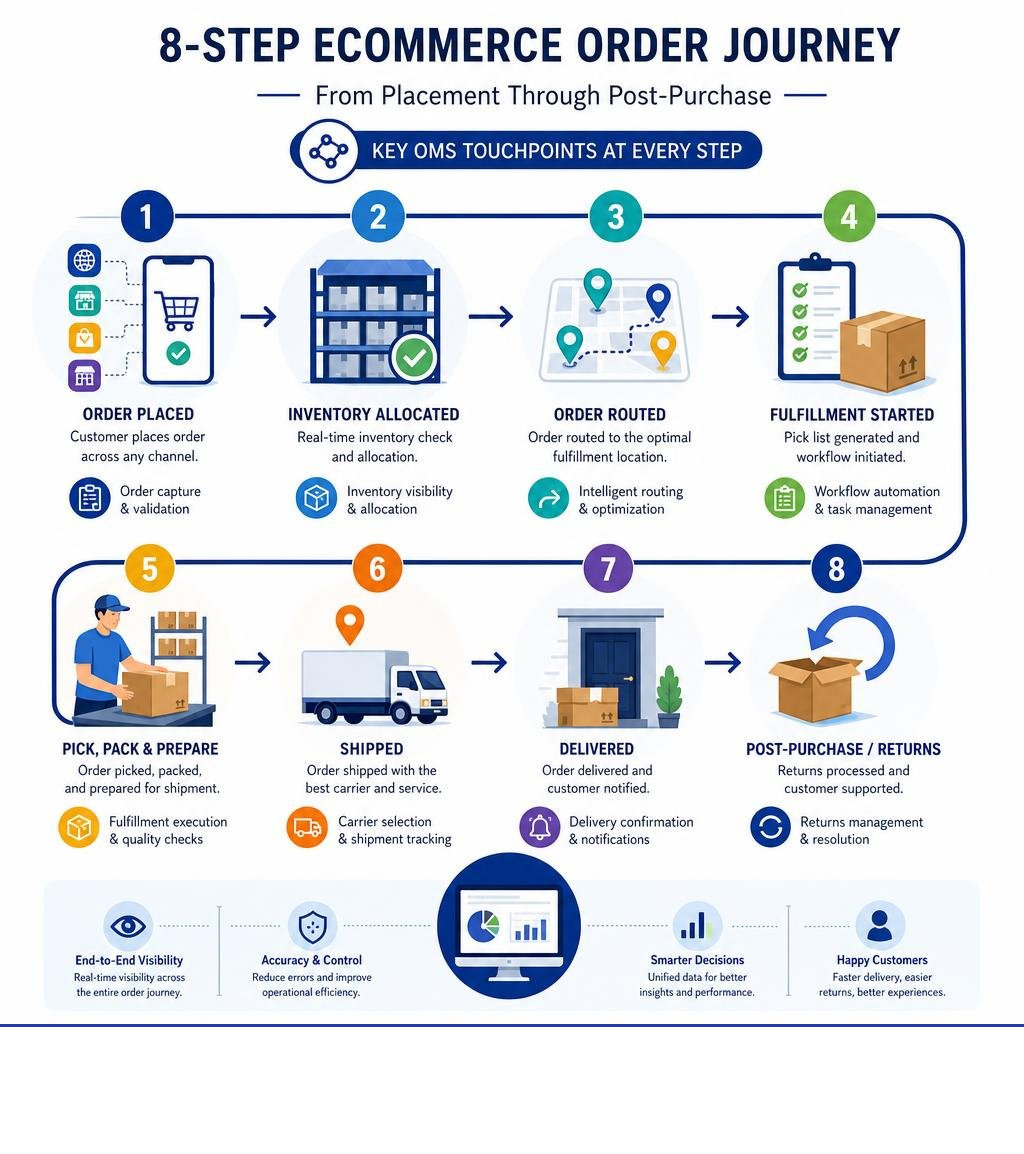
An ecommerce order management system, often called an OMS, is software that captures ecommerce orders, checks available inventory, applies fulfillment rules, routes orders to the right fulfillment location, and tracks order status from placement through shipment and returns.
In practice, an ecommerce OMS acts as the order orchestration layer between digital sales channels, inventory availability, fulfillment nodes, and warehouse execution systems.
For LD Systems, the most important question is not which OMS platform a retailer chooses. It is whether the OMS can connect cleanly to the warehouse systems, material handling equipment, inventory workflows, and fulfillment processes that physically execute each order.
An OMS may decide where an order should go. The warehouse still needs the right WMS, WCS, WES, scanning, storage design, conveyors, sortation, robotics, and operator workflows to pick, pack, stage, ship, and process returns accurately.
| OMS Function | Warehouse Execution Requirement | Systems Involved |
|---|---|---|
| Order capture | Orders enter the fulfillment workflow without manual re-entry | OMS, ERP, WMS |
| Inventory availability | Available-to-promise inventory reflects actual warehouse stock and location status | OMS, WMS, scanners, RFID, AS/RS, inventory tracking |
| Order routing | Orders are assigned to a warehouse or fulfillment node that can execute them | OMS, WMS, WES, carrier/shipping systems |
| Warehouse execution | Orders are picked, packed, sorted, staged, and shipped accurately | WMS, WCS, WES, conveyors, sortation, goods-to-person, AMRs, scanners |
| Returns | Returned inventory is inspected, dispositioned, restocked, or routed to exceptions | OMS, WMS, returns workflows, QA areas, inventory updates |
How an Ecommerce OMS Affects Warehouse Fulfillment
When ecommerce order management is disconnected from warehouse execution, the symptoms often show up as overselling, delayed order release, mispicks, split shipments, backorders, late carrier handoffs, and avoidable customer service issues.
During warehouse assessments, operations leaders frequently observe how administrative bottlenecks choke physical throughput. When sales channels are disconnected from the warehouse floor, order processing delays pile up before a picker receives clear work instructions.
Manual data entry, batch-processing delays, and poor inventory visibility are common culprits. Without reliable synchronization, a customer might purchase an item online that is no longer available at the assigned distribution center. That can trigger backorders, split shipments, inventory corrections, and customer service inquiries before the warehouse team can resolve the exception.
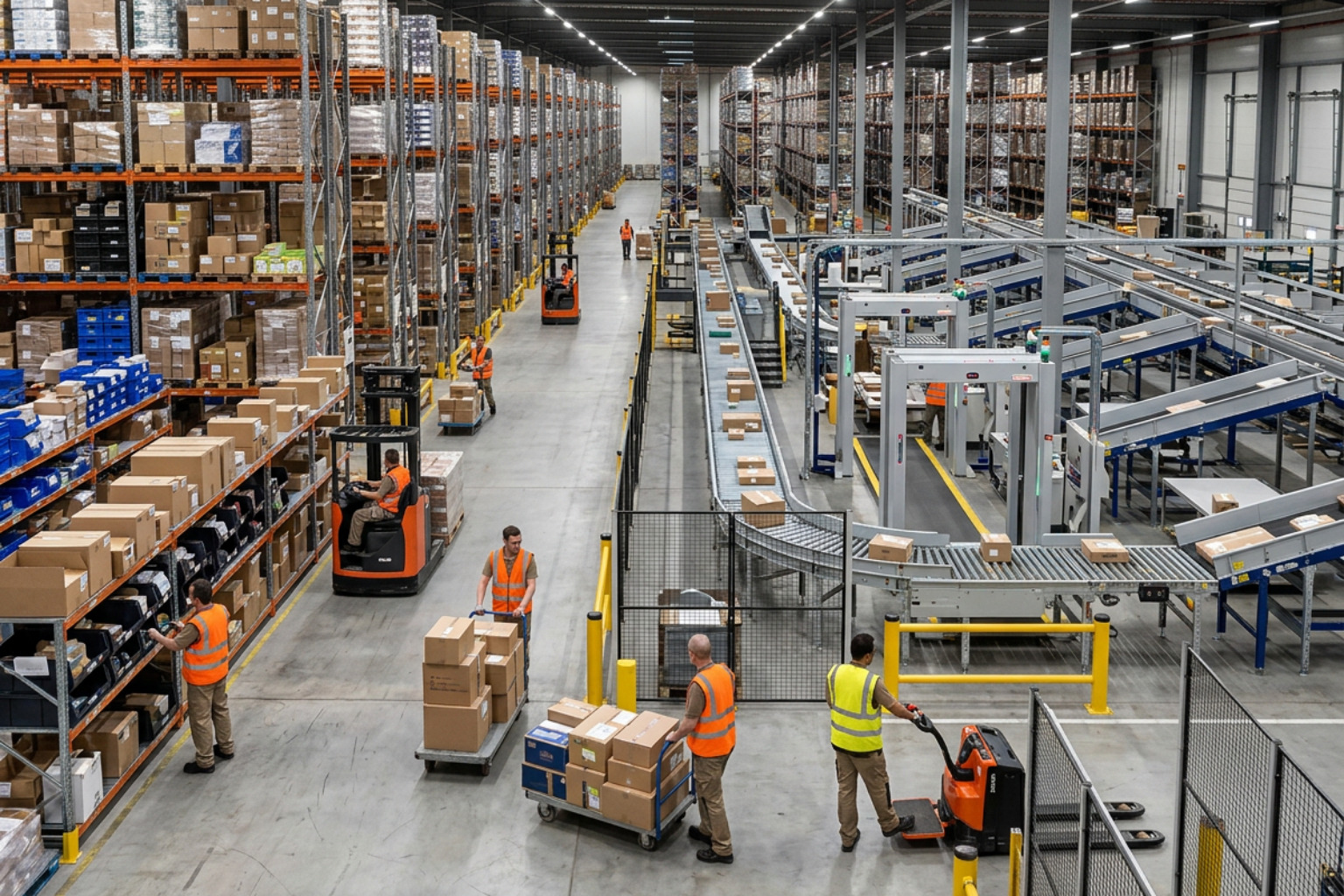
A modern OMS can help coordinate order flow, but it does not physically move product. It must pass accurate order data to the warehouse systems and controls that direct picking, packing, labeling, sorting, staging, and shipping.
OMS vs. WMS vs. WCS/WES in Ecommerce Fulfillment
An ecommerce order management system decides how orders should be captured, allocated, split, routed, and tracked across sales channels and fulfillment nodes. A warehouse management system directs the physical work inside the warehouse, including receiving, putaway, replenishment, picking, packing, shipping, and returns.
WCS and WES layers help connect the WMS to physical automation such as conveyors, sorters, AS/RS, AMRs, goods-to-person systems, scanners, and controls. In high-volume ecommerce operations, the OMS, WMS, WCS, and WES need to exchange reliable data so digital order promises match what the warehouse can actually execute.
This distinction matters because OMS planning, inventory management, omnichannel fulfillment, and transportation management are related but separate decisions. The OMS may determine the promise and routing logic. Warehouse execution determines whether labor, storage, automation, software, controls, and material flow can meet that promise at scale.
For LD Systems, the focus is not software vendor selection. The focus is how ecommerce order management connects to the systems, equipment, and workflows required to execute orders inside real warehouses.
Multi-Channel Order Processing and Inventory Visibility
One factor many operations overlook is the distinction between physical inventory and available-to-promise inventory. If inventory data only updates once a day, an ecommerce business can oversell during high-volume periods even when the warehouse team is operating efficiently.
An OMS helps coordinate inventory availability across ecommerce storefronts, marketplaces, stores, regional distribution centers, and 3PL partners. The warehouse still needs accurate scanning, location control, replenishment workflows, and WMS updates so that available-to-promise inventory reflects what is actually in the building.
For ecommerce operations that rely on barcode-based product identification across channels and fulfillment partners, GS1 barcode standards can provide a useful framework for consistent item identification and data capture.
When preparing for volume spikes, this level of visibility needs to be paired with physical capacity. Operations leaders can explore that connection in LD Systems’ guide to preparing warehouse operations for ecommerce demand surges.
Intelligent Order Routing and Fulfillment Automation
Intelligent order routing rules allow brands to define how orders should travel through a fulfillment network. An operator might route orders to the closest warehouse, reserve certain inventory for wholesale customers, or split orders only when the service promise justifies the added handling and parcel cost.
Those routing decisions only create value when the receiving warehouse can execute them. If the WMS, WCS, WES, conveyor controls, scanners, and labor workflows are not aligned, the order may still wait in a queue, require manual intervention, or move through an inefficient pick-pack-ship path.
For a deeper look at aligning ecommerce demand with warehouse layout, automation, and material flow, explore LD Systems’ insights on optimizing ecommerce warehouse operations.
Mapping the Tech Stack: How OMS Differs from ERP, WMS, WCS, and WES
To build a scalable fulfillment engine, it is important to understand where each software system starts and stops. Many enterprises struggle when they expect an ERP, OMS, WMS, or execution layer to perform the role of the entire fulfillment stack. The result can be rigid workflows, duplicate data entry, and expensive customization.
OMS and WMS integration is especially important because digital order routing only creates value when the warehouse can receive, prioritize, pick, pack, sort, and ship the order accurately.
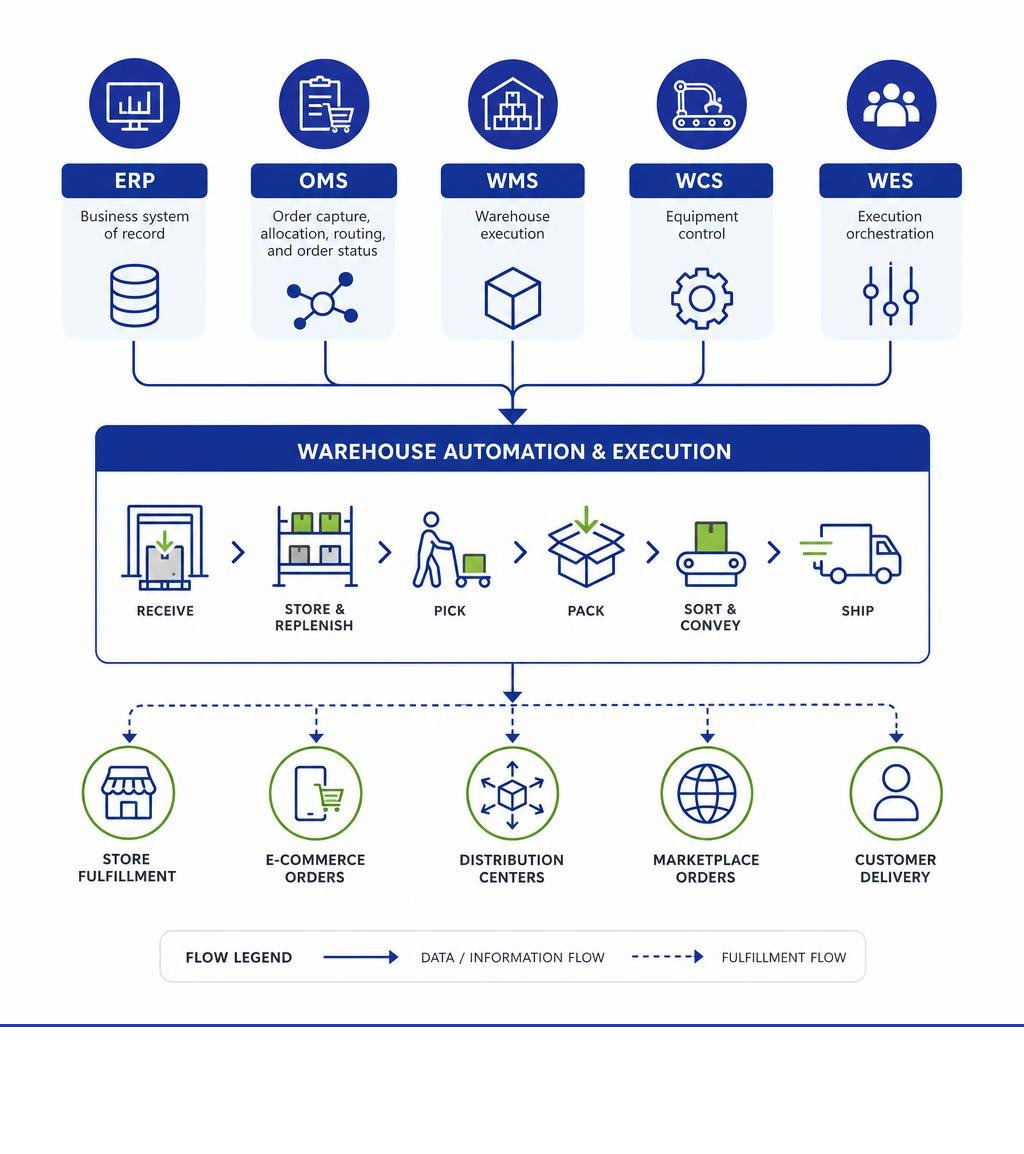
| System | Primary Role | Warehouse/Fulfillment Impact |
|---|---|---|
| ERP | Business system of record | Supports financial, purchasing, inventory, and enterprise data. |
| OMS | Order capture, allocation, routing, and order status | Decides where orders should be fulfilled and how exceptions are managed. |
| WMS | Warehouse execution | Directs receiving, putaway, replenishment, picking, packing, shipping, and inventory movement. |
| WCS | Equipment control | Coordinates conveyors, sorters, scanners, AS/RS, and other equipment-level activity. |
| WES | Execution orchestration | Balances work across labor, automation, order priorities, and equipment capacity. |
The Operational Boundaries of WMS and OMS
While an OMS excels at external order orchestration, it does not know every physical constraint inside a facility. It does not know that SKU-A is in Aisle 4, Shelf 2, that a replenishment task is blocking a forward pick location, or that a specific sorter lane is temporarily unavailable. Those execution details belong in the WMS, WCS, WES, controls, and operator workflows.
The OMS receives the order from the storefront, determines which warehouse should fulfill it, and passes that order to the warehouse execution layer. The WMS then manages inventory locations, pick paths, packing workflows, and shipping processes, while WCS and WES layers help coordinate automated equipment and real-time task flow.
For brands running high-velocity distribution centers, this handoff is critical to maintaining throughput. Operations looking to see the software-to-execution connection in practice can review LD Systems’ work improving ecommerce distribution efficiency for Chico’s, where synchronized systems and physical automation supported faster, more reliable order flow.
Ecommerce OMS Capabilities That Affect the Warehouse
For warehouse and distribution leaders, the most important OMS capabilities are the ones that affect physical execution inside the facility.
- Order capture: Orders from ecommerce sites, marketplaces, B2B portals, or stores should enter the warehouse workflow without manual re-entry.
- Available-to-promise inventory: The OMS should use inventory data that reflects actual stock status, allocation rules, and fulfillment constraints.
- Order allocation: Orders should be assigned to fulfillment nodes that have the inventory, labor, equipment, and cutoff capacity to execute them.
- Split-shipment logic: The system should balance speed, inventory availability, shipping cost, and warehouse workload before splitting an order.
- Exception handling: Backorders, shorts, substitutions, damages, and returns need clear workflows that update both customer-facing systems and warehouse systems.
- Warehouse integration: The OMS needs reliable handoffs to WMS, WCS, WES, scanners, sortation, conveyors, AS/RS, and other fulfillment systems.
Operational Benefits and Customer Experience
Implementing or upgrading order management capabilities can be a meaningful operational investment, but ROI depends on more than software functionality. The strongest gains usually come when order orchestration is paired with warehouse systems integration, accurate data capture, efficient material flow, and automation that fits the facility’s SKU profile, order volume, labor model, and service requirements.
Potential operational benefits include:
- Reduced manual intervention: Cleaner system handoffs can reduce rekeying, exception handling, and order reconciliation.
- Better labor utilization: When the WMS and automation layer receive accurate order data, supervisors can focus labor on picking, packing, staging, and exceptions rather than administrative fixes.
- Faster fulfillment flow: Properly integrated routing, picking, packing, sortation, and staging can help orders move through the building with fewer delays.
- Improved order accuracy: Scanning, validation, sortation, and WMS-directed workflows can reduce the chance that incorrect items reach the shipping dock.
- More scalable operations: Integrated systems make it easier to add channels, facilities, automation, and process changes without relying on disconnected manual workarounds.
Mitigating the High Cost of Fulfillment Errors
Fulfillment errors can create avoidable cost and service problems. When a picker sends the wrong item, or an order is delayed because inventory availability was not synchronized, the effects can compound across return shipping, labor, replacement handling, customer service time, and lost future revenue.
The OMS may flag order status and route the order to the right node, but preventing errors inside the facility depends on execution controls. Barcode scanning, WMS validation, cartonization rules, packing checks, sorter confirmations, and exception workflows all help convert digital order instructions into accurate physical shipments.
To prevent these errors from reaching the shipping dock, many operations integrate physical sortation systems with their software stack. For example, LD Systems’ project involving dual-sided narrow belt sortation for ecommerce fulfillment shows how the right material handling design can support more controlled outbound flow when it is integrated with the broader fulfillment process.
Integrating Software and Hardware for Coordinated Material Flow
An ecommerce order management system is only as effective as the warehouse execution environment supporting it. If the OMS routes an order quickly, but the facility lacks the layout, storage strategy, picking method, automation, and controls to execute that order, delivery performance can still suffer. Strong performance requires coordinated integration between software orchestration and physical material flow.
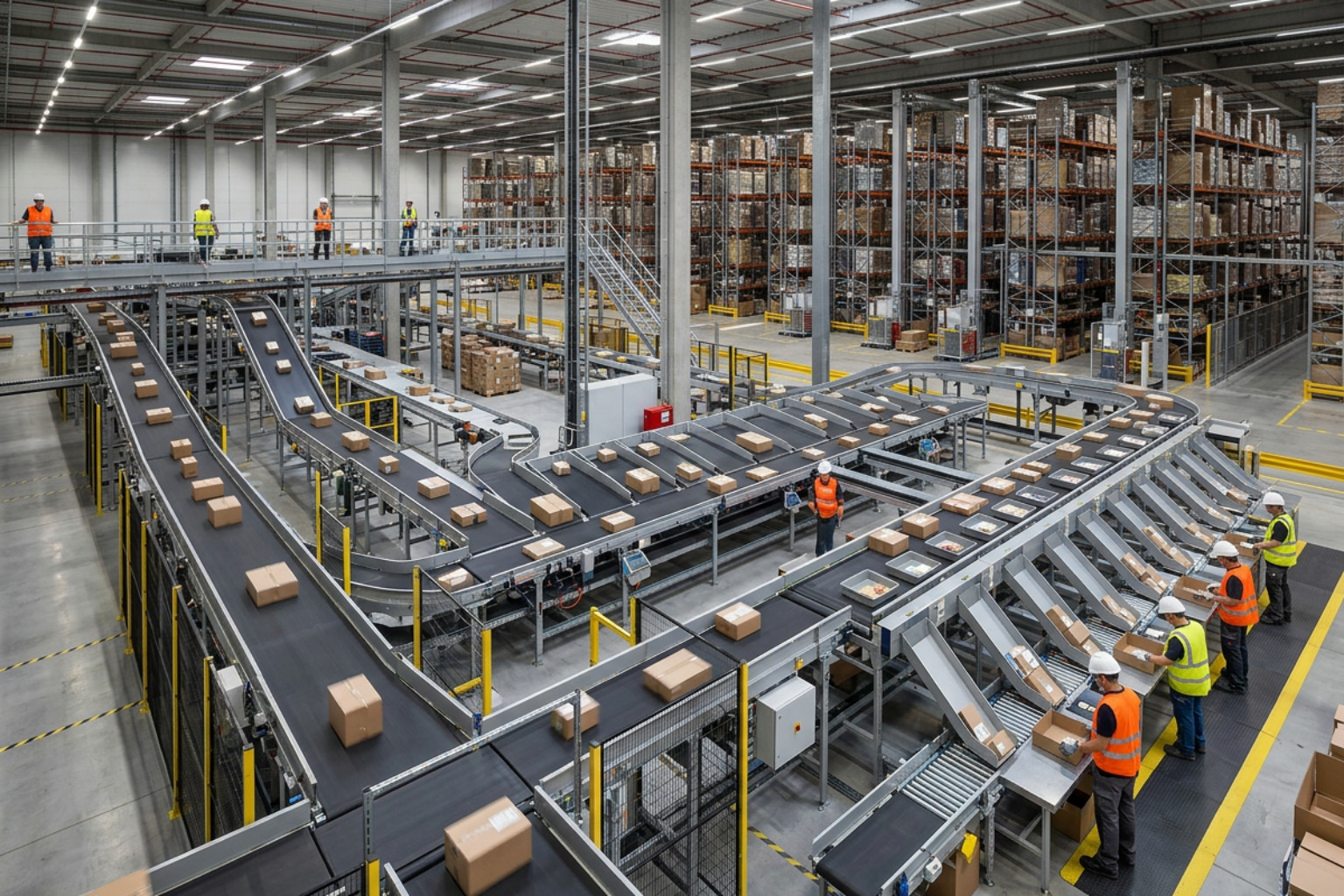
To achieve this, OMS, WMS, WCS, and WES layers must communicate reliably with the physical automation equipment on the warehouse floor. APIs, EDI connections, middleware, controls, and equipment-level logic translate digital order instructions into practical workflows for conveyors, sorters, storage systems, picking technologies, packing areas, and shipping lanes.
Connecting Your Ecommerce Order Management System to Warehouse Automation
When scaling fulfillment operations, integrating hardware and software is often what determines whether order routing can translate into real throughput gains. Automated Storage and Retrieval Systems (AS/RS), autonomous mobile robots (AMRs), goods-to-person picking stations, scanners, print-and-apply systems, conveyors, and sorters all depend on timely, accurate order and inventory data.
For example, when an order is routed by the OMS, a WES can direct the next execution step based on inventory location, labor availability, equipment status, and downstream shipping requirements. The item may be retrieved from storage, presented to a picker, validated by scan, packed, labeled, conveyed, sorted, and staged for carrier pickup.
Operations looking for real-world examples of hardware-software coordination can review LD Systems’ work integrating ecommerce storage, picking, conveyor, and sorter systems to see how custom-engineered material handling systems can support higher order capacity when properly integrated.
When an Ecommerce OMS Is Not Enough
An OMS can only perform as well as the warehouse systems and physical workflows that support it. If order routing becomes more advanced but the warehouse still relies on manual picking, poor slotting, delayed replenishment, or disconnected automation, the facility may struggle to keep up with customer promises.
Warning signs include delayed order release, frequent short picks, excessive split shipments, picker congestion, missed carrier cutoffs, poor returns visibility, and manual exception workarounds. These issues usually require more than a software change. They require a review of inventory accuracy, warehouse layout, picking method, packing flow, sortation, WMS/WCS/WES integration, and material handling capacity.
In those cases, the issue is not only order management. It is the connection between order management, warehouse execution, inventory accuracy, equipment capacity, and physical material flow.
| Warning Sign | Likely Integration Issue | What to Evaluate |
|---|---|---|
| Orders release late to the warehouse | OMS/WMS handoff delay or batching issue | Order release rules, API/EDI timing, WMS queue logic |
| Frequent short picks | Inventory availability does not match physical stock | ATP logic, scan discipline, replenishment, cycle counting |
| Picker congestion | Order routing does not account for warehouse capacity | Pick paths, zone balance, labor planning, WES logic |
| Missed carrier cutoffs | Order priority and physical execution are misaligned | Wave release, sortation, staging, packing flow |
| Manual exception workarounds | OMS, WMS, and automation are not sharing timely status data | Integration points, exception workflows, dashboard visibility |
Ecommerce Fulfillment Case Studies from LD Systems
LD Systems case studies show why ecommerce order management needs to connect with physical warehouse execution, storage, picking, sortation, and software integration.
- Chico’s e-commerce distribution case study: LD Systems helped reduce order cycle time from 3 hours to 30 minutes, tripled picking productivity, and reduced order errors.
- Thomson e-commerce storage, picking, conveyor, and sorter case study: LD Systems documented a 50% productivity boost, 99.93% order accuracy, and a cycle time reduction from 2 hours to 25 minutes.
- Thomson dual-sided narrow belt sorter case study: LD Systems documented a 40% productivity boost, 99.95% accuracy, and a cycle time reduction from 2 hours to 30 minutes.
- HSN order cycle time case study: LD Systems supported an automated garment-on-hanger system that reduced order cycle time from 2 hours to 20 minutes, achieved 99.94% order accuracy, and delivered a 50% productivity boost.
These results are project-specific, but they show why ecommerce order management should be evaluated alongside warehouse automation, WMS/WCS/WES integration, sortation, storage, and material flow.
Frequently Asked Questions About Ecommerce Order Management
What is the difference between an OMS and a WMS?
An OMS manages the order lifecycle across sales channels and fulfillment nodes, including order capture, inventory availability, allocation, routing, order status, and returns visibility. A WMS manages execution inside the warehouse, including receiving, putaway, replenishment, picking, packing, shipping, inventory movement, and returns processing.
How do WCS and WES fit with an ecommerce order management system?
WCS and WES layers help connect warehouse software decisions to physical automation. They coordinate equipment, task flow, conveyor movement, sortation logic, goods-to-person systems, scanners, and controls so warehouse operations can execute the order instructions received from the OMS and WMS.
How does an OMS improve delivery speed and reduce shipping costs?
An OMS can improve delivery speed by routing orders to appropriate fulfillment nodes and applying rules for inventory allocation, split shipments, and carrier options. Shipping cost and speed improvements depend on the accuracy of inventory data, the design of the fulfillment network, and the warehouse’s ability to pick, pack, sort, and ship efficiently.
When should a growing brand transition from native platform tools to a dedicated OMS?
A growing brand may need a dedicated OMS when it sells through multiple channels, operates more than one fulfillment node, relies on 3PL partners, experiences overselling or inventory synchronization issues, or needs more advanced allocation and routing rules. Before selecting software, operations leaders should also evaluate whether warehouse systems, material flow, scanning, and automation can support the planned order volume.
How LD Systems Supports Ecommerce Order Management Integration
An ecommerce order management system can route orders, allocate inventory, and manage order status, but the warehouse must still execute the physical work. That requires coordinated storage design, picking strategy, packing flow, sortation, WMS/WCS/WES integration, controls, and material handling equipment.
LD Systems helps warehouses, distribution centers, fulfillment operations, and manufacturing facilities evaluate how ecommerce order flow moves through the facility. As a technology-agnostic warehouse systems integrator, LD Systems does not sell OMS software. Instead, the team helps align warehouse automation, material handling systems, controls, and software integration with the fulfillment promises the business needs to support.
Ready to connect ecommerce order management with warehouse execution? Request a consultation with LD Systems to evaluate your order flow, WMS/WCS/WES integration, fulfillment bottlenecks, material handling capacity, and automation opportunities.
