

What Are ASRS Systems?

ASRS systems, also called automated storage and retrieval systems or AS/RS systems, are warehouse automation technologies that store and retrieve inventory from defined locations using cranes, shuttles, carousels, vertical lift modules, robotic storage systems, software, and controls.
For a neutral industry overview, MHI defines automated storage and retrieval systems as computer-controlled systems that automatically place and retrieve loads from defined storage locations.
In warehouses, distribution centers, fulfillment operations, and manufacturing facilities, ASRS systems are used to improve storage density, reduce manual travel, support controlled inventory access, and connect storage activity with WMS, WCS, WES, scanners, and material handling equipment.
For LD Systems, the key question is not whether ASRS technology is impressive. It is whether the selected ASRS system fits the facility’s SKU profile, load type, throughput requirements, building constraints, replenishment strategy, software environment, labor model, and long-term growth plan.
| ASRS System Function | What It Supports | Why It Matters |
|---|---|---|
| Automated storage | Inventory is placed into controlled storage locations | Improves location control and storage organization |
| Automated retrieval | Loads are retrieved for picking, replenishment, production, or shipping | Reduces manual search and travel time |
| High-density storage | Vertical cube, narrow aisles, dense racks, trays, bins, or grid storage are used more effectively | Can help facilities increase storage capacity within an existing footprint |
| Goods-to-person flow | Some systems deliver totes, trays, or bins to workstations | Can improve ergonomics and picking flow when the application fits |
| Software integration | ASRS activity connects with WMS, WCS, WES, scanners, PLCs, and inventory data | Keeps storage and retrieval activity aligned with warehouse execution |
This guide focuses on ASRS systems as a practical comparison problem: which system fits the load type, facility constraints, data readiness, software environment, and implementation risk profile of the operation.
ASRS Systems vs. Automated Racking Systems
ASRS systems are broader than automated racking alone. An ASRS may include cranes, shuttles, vertical lift modules, carousels, robotic cube storage, goods-to-person workstations, controls, and warehouse software integration. Automated racking systems are one category of storage-focused automation that may be part of an ASRS strategy.
This distinction matters because the right system depends on more than storage density. Operations also need to evaluate retrieval speed, replenishment flow, picking method, software integration, maintenance access, safety requirements, and how the ASRS connects to the rest of the warehouse.
For a focused comparison of storage-focused automation, see LD Systems’ guide to automated racking systems.
To understand how ASRS fits into a broader automation plan, it helps to look at the foundational concepts of automated storage and retrieval that govern how material flows through a modern facility. At its core, an AS/RS replaces some manual storage and retrieval steps with a more controlled workflow that may support goods-to-person picking, automated replenishment, production support, or high-density reserve storage depending on the application.
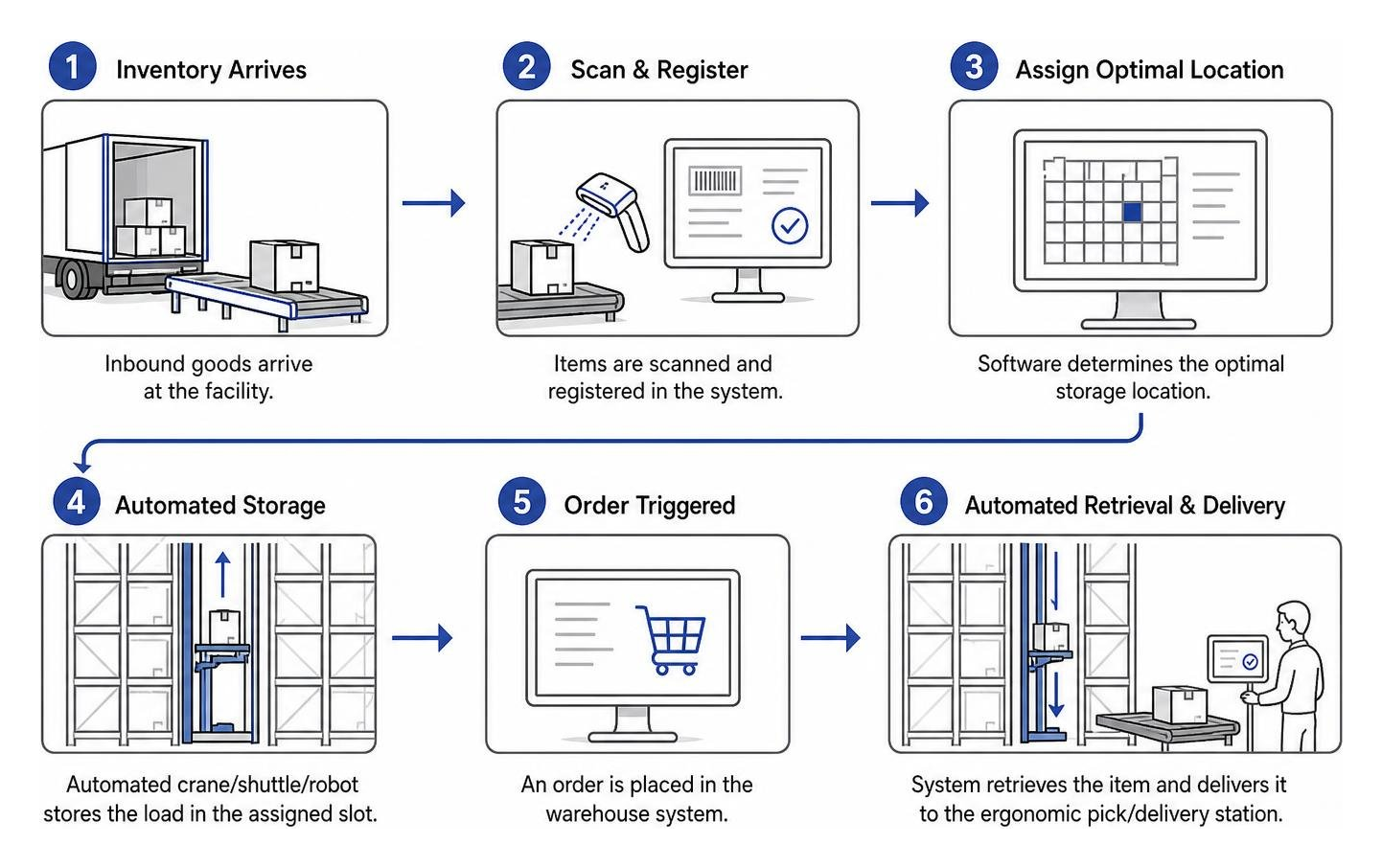
When inventory arrives at the facility, it is scanned and registered into the system. The software identifies an appropriate storage location based on size, weight, velocity, storage rules, and availability. Automated cranes, shuttles, carousels, robots, or lift modules then move the load into controlled storage. When an order, replenishment task, or production request is released, the system retrieves the item and routes it to the next process step.
When ASRS Systems Make Sense
ASRS systems can be a strong fit when the warehouse problem is tied to storage density, travel time, picking flow, inventory control, labor constraints, or controlled access to high-value, fast-moving, or space-constrained inventory.
ASRS automation should be evaluated as part of the full warehouse system, not as a standalone storage upgrade.
| Operational Problem | Why It Matters | ASRS Evaluation Question |
|---|---|---|
| Limited floor space | The facility needs more storage capacity without expanding the footprint | Can vertical cube, dense storage, or automated retrieval improve capacity without slowing access? |
| Excessive travel time | Operators spend too much time walking, searching, or transporting inventory | Would goods-to-person, VLMs, shuttles, or ASRS-supported picking reduce non-value-added movement? |
| Inventory accuracy issues | Stock is misplaced, hard to find, or not updated quickly enough | Can controlled storage locations, scan validation, and WMS/WCS integration improve visibility? |
| Replenishment delays | Pick faces, workstations, or production points run short during active work | Can ASRS retrieval logic support more reliable reserve-to-forward movement? |
| Growth pressure | Order volume or SKU count is outgrowing the current layout | Can the system support future throughput, SKU changes, and automation expansion? |
Types of ASRS Systems
Different ASRS systems are designed for different load types, storage profiles, throughput requirements, and facility constraints. The right choice depends on what the facility stores, how often inventory moves, how orders are picked, and how the system must connect with warehouse software and controls.
Because ASRS warehouse systems vary widely by load profile and fulfillment model, system selection should start with facility data rather than equipment preference.
| ASRS System Type | Common Load Profile | Best-Fit Applications | Key Design Consideration |
|---|---|---|---|
| Unit-load ASRS | Pallets or large loads | Bulk storage, manufacturing, reserve storage, cold storage, pallet handling | Building height, pallet profile, floor loading, throughput, and maintenance access |
| Mini-load ASRS | Totes, cartons, trays, or small containers | Parts storage, ecommerce, kitting, split-case picking | SKU count, tote design, workstation flow, and pick/replenishment logic |
| Shuttle systems | Totes, cartons, or pallets depending on design | High-throughput fulfillment, sequencing, goods-to-person workflows | Throughput profile, redundancy, sequencing needs, and integration with WES/WCS |
| Vertical lift modules | Trays, parts, tools, or small items | Maintenance parts, high-value inventory, manufacturing support, space-constrained storage | Item dimensions, tray configuration, ergonomic access, and inventory control |
| Horizontal or vertical carousels | Bins, cartons, parts, or small items | Batch picking, parts retrieval, controlled storage, high-access small parts | Pick rate, pod design, operator workflow, and software-directed batching |
| Robotic cube storage | Bins or totes | High-density small-item fulfillment and goods-to-person picking | SKU mix, bin compatibility, retrieval sequencing, workstation design, and exception handling |
Crane-Based vs. Shuttle-Based ASRS Systems
When choosing between crane-based and shuttle-based architectures, operations leaders are essentially balancing storage density, throughput speed, redundancy, service access, and implementation complexity.
Crane-based systems typically use a stacker crane in an aisle. The crane moves horizontally along a rail and vertically to access storage locations. These systems can be a strong fit for bulk storage, pallet handling, high-bay buildings, controlled access inventory, or applications where dense storage is more important than extremely high transaction rates. Because the aisle depends on a crane, the design must account for maintenance access, redundancy strategy, and how the operation will continue during service windows.
Shuttle-based systems use multiple carriers that travel along dedicated rails, often with lifts that move totes, cartons, or pallets between levels. Separating horizontal and vertical movement can support higher transaction rates and more flexible redundancy than a single-crane aisle, depending on the design. Shuttle systems require careful planning around lift capacity, controls logic, replenishment, workstation design, and the flow of inbound and outbound containers.
Robotic Cube Storage and Next-Gen ASRS Systems
Robotic cube storage changes the space planning conversation because inventory bins are stored in a dense grid instead of conventional aisles. Robots travel across the top of the grid, retrieve bins, and deliver them to ports or workstations.
This architecture can be attractive where standardized bins, small-item fulfillment, constrained floor space, and controlled goods-to-person picking are priorities. Software logic typically keeps faster-moving inventory easier to access, while slower-moving inventory can sit deeper in the grid.
Cube-style systems are not automatically the best fit for every operation. They require bin-compatible inventory, defined decanting and replenishment processes, workstation planning, controls integration, and a clear strategy for order peaks. To learn more about how robotics are changing the landscape of material handling, read about integrating robotics with automated storage.
ASRS Systems Integration with WMS, WCS, and WES
An ASRS system delivers the most value when it can exchange reliable data with the warehouse software and controls that manage inventory, order release, replenishment, picking, and exceptions.
In many facilities, the WMS manages inventory status and warehouse tasks, the WCS coordinates equipment-level movement, and the WES may help balance work across labor, automation, order priorities, and equipment capacity. PLCs and equipment controls then execute the physical movement of cranes, shuttles, lifts, conveyors, scanners, or robotic systems.
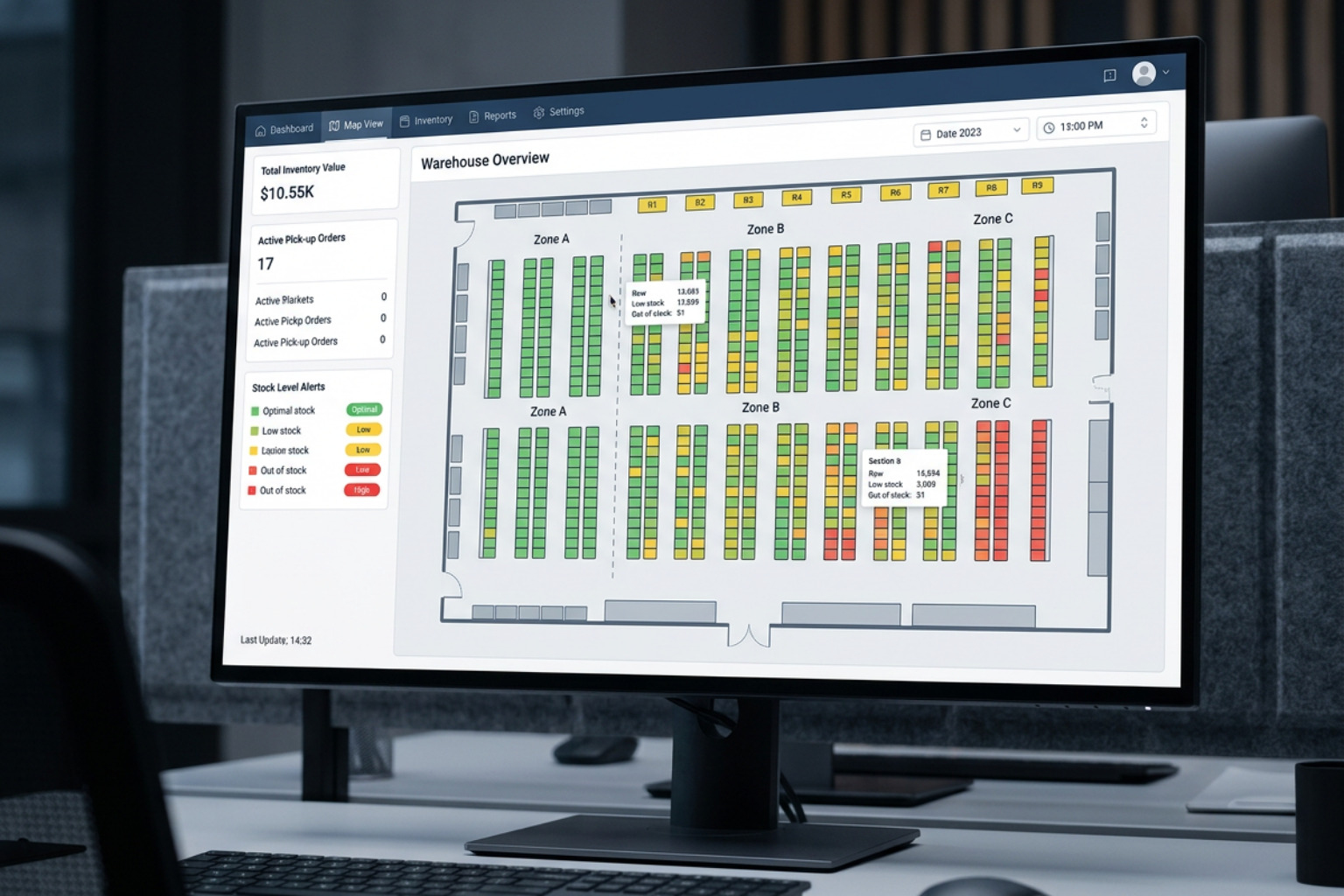
ASRS integration should be reviewed early because poor data quality, unclear ownership between WMS/WCS/WES layers, or weak exception handling can reduce system performance after installation.
Facility constraints also matter. Building height, slab condition, floor loading, fire protection, aisle clearances, maintenance access, utilities, and safety requirements should be evaluated with qualified engineering, safety, and facility stakeholders before selecting an ASRS system.
ASRS Business Value: Space, Labor, Throughput & ROI
Investing in automated storage is a significant capital commitment, which means operations leaders must build a rigorous, data-driven business case before selecting a system. The potential value is real, but it must be calculated against the specific facility, SKU profile, labor model, order profile, building constraints, and integration scope.
Actual space savings, labor impact, throughput, accuracy, and ROI depend on SKU profile, load dimensions, facility layout, storage medium, picking strategy, software integration, and implementation scope.
Key areas to evaluate include:
- Space utilization: ASRS systems can help facilities use vertical height, dense racks, trays, bins, or grid storage more effectively. The improvement depends on the existing layout, clear height, aisle requirements, fire protection, load dimensions, and storage strategy.
- Labor efficiency: Automated storage and retrieval can reduce walking, searching, manual replenishment, and repetitive handling. The labor impact depends on order volume, pick strategy, shift structure, workstation design, exception handling, and how the system is staffed.
- Throughput and flow: The right ASRS can support more predictable material movement by connecting storage activity with picking, production, replenishment, packing, or shipping. Throughput gains depend on system type, order profile, software coordination, equipment availability, and downstream constraints.
- Accuracy and control: ASRS systems can improve location control and transaction discipline when scanning, WMS/WCS/WES integration, and operator workflows are designed correctly. Automation does not replace the need for accurate master data, slotting logic, and inventory governance.
- Energy and environment: In cold storage or controlled environments, dense storage and reduced manual traffic may support operational efficiency, but energy impact depends on building design, refrigeration strategy, door cycles, storage density, and system configuration.
To calculate the financial impact on your specific footprint, you can explore our resources on maximizing warehouse space utilization. In certain applications, LD Systems has helped automation projects target measurable ROI in as little as 17 months. Actual results depend on facility layout, order volume, labor model, technology selection, software integration, and implementation scope.
When ASRS May Not Be the First Step
ASRS systems are most effective when the facility has reliable inventory data, clear SKU profiles, defined storage rules, stable replenishment logic, and enough volume or space pressure to justify automation. If SKU dimensions are incomplete, inventory accuracy is poor, replenishment rules are inconsistent, or the WMS is not being used consistently, ASRS may expose those problems faster rather than solve them.
In some facilities, the better first step is SKU profiling, slotting improvement, WMS configuration, barcode/RFID discipline, layout redesign, or process standardization before adding automated storage equipment.
ASRS and Storage Automation Case Studies from LD Systems
LD Systems case studies show why ASRS systems and storage automation need to be evaluated as part of a broader warehouse design that includes storage density, picking flow, controls, software, and material handling equipment.
- Ocean Spray space utilization case study: LD Systems improved space utilization by 60%, enhanced productivity by 50%, and helped save $11 million in new racking costs by repurposing and relocating existing racking.
- Honeywell distribution network case study: LD Systems supported small-parts picking and distribution improvements, including 60% faster picking, 50% space utilization improvement, and 7,200 pick facings.
- Tucson Electric Power parts retrieval case study: LD Systems supported parts retrieval improvements, including reduced order cycle time, faster retrieval, improved accuracy, and a 50% productivity boost.
- Cabela’s storage and retrieval case study: LD Systems improved storage and retrieval flow for retail inventory, supporting faster retrieval and better product availability.
These results are project-specific, but they show why ASRS systems should be selected around facility data, storage profile, software integration, and material flow rather than storage density alone.
Frequently Asked Questions About AS/RS
Can AS/RS operate in cold storage or deep-freeze environments?
ASRS systems can be effective in temperature-controlled and deep-freeze environments when the equipment, controls, storage medium, maintenance strategy, and safety procedures are designed for those conditions. In cold storage, space is expensive to build and operate, so dense automated storage may help reduce the refrigerated footprint required for a given inventory profile. It can also reduce manual exposure to harsh environments depending on how picking, replenishment, and access points are designed.
What is the typical payback period for an AS/RS investment?
The payback period depends on local labor rates, real estate costs, system complexity, throughput requirements, order profile, implementation scope, and software integration. Rather than applying a generic ROI assumption, LD Systems evaluates the current process, future volume, labor model, storage constraints, and automation alternatives to estimate whether ASRS is financially justified. In certain applications, LD Systems has helped automation projects target measurable ROI in as little as 17 months. Actual results depend on facility layout, order volume, labor model, technology selection, software integration, and implementation scope.
How does an automated storage system handle mixed product sizes?
Modern automated systems can handle a diverse mix of product sizes and weights when properly configured. For small, non-uniform items, goods are often placed into standardized totes, trays, or partitioned bins before entering the system. The software tracks the position of each SKU within those containers. For larger pallet loads, unit-load systems can accommodate defined pallet profiles and weights within the system’s design limits. Proper front-end slotting, product profiling, and data quality are essential to keep the system operating effectively.
How LD Systems Supports ASRS System Design and Integration
Choosing an ASRS system is not simply a storage equipment decision. It requires a coordinated plan for facility layout, SKU profile, load type, storage density, retrieval requirements, workstation flow, WMS/WCS/WES integration, controls, safety, maintenance access, and long-term scalability.
LD Systems helps warehouses, distribution centers, fulfillment operations, and manufacturing facilities evaluate ASRS opportunities, compare system types, identify integration requirements, and design storage automation strategies around the operation’s actual material flow.
As a technology-agnostic warehouse systems integrator, LD Systems does not force operations around one ASRS product or manufacturer. The team helps select and integrate the right mix of storage, automation, controls, and software based on the facility’s requirements.
Ready to evaluate ASRS systems for your warehouse? Request a consultation with LD Systems to review your storage constraints, inventory profile, WMS/WCS/WES integration needs, and automation opportunities.
