

What Is ASRS?

ASRS stands for automated storage and retrieval system, also commonly written as AS/RS. It refers to computer-controlled warehouse automation used to store, locate, retrieve, and deliver inventory with minimal manual handling. In warehouses, distribution centers, manufacturing plants, and fulfillment operations, ASRS may handle pallets, cases, totes, trays, bins, cartons, or small parts. The Material Handling Institute describes automated storage and retrieval systems as technologies that automatically place and retrieve loads from defined storage locations.
| ASRS at a Glance | Details |
|---|---|
| Full meaning | Automated Storage and Retrieval System, often written as AS/RS |
| Purpose | Automatically store, track, retrieve, and deliver inventory with reduced manual handling |
| Common types | Unit-load ASRS, mini-load ASRS, shuttle systems, VLMs, carousels, and cube-style robotic storage |
| Best for | Warehouses, distribution centers, manufacturing facilities, cold storage, e-commerce, and 3PL operations |
| Key benefit | Improves storage density, accuracy, throughput, ergonomics, and material flow when properly integrated |
At its best, ASRS is not simply a piece of equipment. It is a storage, movement, controls, and software strategy that connects inventory to demand more efficiently than traditional manual storage. The key question for warehouse leaders is which automation strategy fits the operation without creating new bottlenecks.
LD Systems helps warehouse and manufacturing leaders evaluate ASRS from a systems integration perspective: whether automation is justified, where it should fit, and how it should connect to conveyors, robotics, software, picking, packing, pallet handling, and shipping.
What ASRS Means in Warehouse Operations
In warehouse operations, ASRS means automated inventory placement and retrieval. The system receives inventory, assigns a storage location, tracks it, retrieves it when needed, and delivers it to the next process.
That next process may be:
- A goods-to-person picking workstation
- A conveyor line
- A palletizing or depalletizing area
- A production line
- A kitting cell
- A replenishment zone
- A packing or shipping operation
ASRS is part of a broader material handling system. It may work alongside industrial storage systems, conveyors, sortation, robotics, warehouse management software, warehouse control systems, and warehouse execution systems.
Why Companies Consider ASRS
Warehouse leaders usually evaluate ASRS because one or more operating constraints have become too expensive to solve manually.
Common drivers include:
- The building is running out of usable storage capacity.
- Pickers spend too much time walking.
- Forklift congestion is slowing replenishment and shipping.
- Manual putaway creates delays or location errors.
- Order accuracy is inconsistent.
- Labor is difficult to hire, train, or retain.
- Safety risks are increasing.
- Cold storage areas are difficult to staff.
- SKU counts are rising faster than available floor space.
During warehouse assessments, one challenge commonly seen is that companies focus on the storage problem first, when the deeper issue is often material flow. ASRS can create value only when receiving, induction, replenishment, picking, packing, and shipping are engineered as one connected system.
What ASRS Is Not
ASRS is not automatically the best solution for every warehouse. It is also not just a racking purchase.
A common misconception is that ASRS alone will fix labor, space, and throughput challenges. In reality, ASRS depends on process discipline, accurate data, software integration, reliable load standards, and downstream capacity.
ASRS is not:
- A replacement for sound warehouse process design
- A one-size-fits-all automation project
- A standalone machine that can be dropped into any operation
- A substitute for accurate inventory records
- A solution that succeeds without WMS, WCS, or WES integration
- Always the first investment a facility should make
In some operations, slotting improvements, conveyor upgrades, pick-to-light, better WMS discipline, or workstation redesign may produce a faster return before ASRS is justified.
How Does ASRS Work Inside a Warehouse Automation System?
ASRS works by combining storage structures, automated handling equipment, controls, sensors, and software into a repeatable storage and retrieval process.
At a high level, warehouse software sends a command, the system identifies the required inventory, retrieves it from storage, and delivers it to the correct destination. The technology may be a crane, shuttle, lift, carousel, vertical lift module, or robotic storage vehicle. The value comes from how that equipment is engineered into the complete operation.
For more practical planning context, LD Systems explains how AS/RS can support smoother warehouse operations.
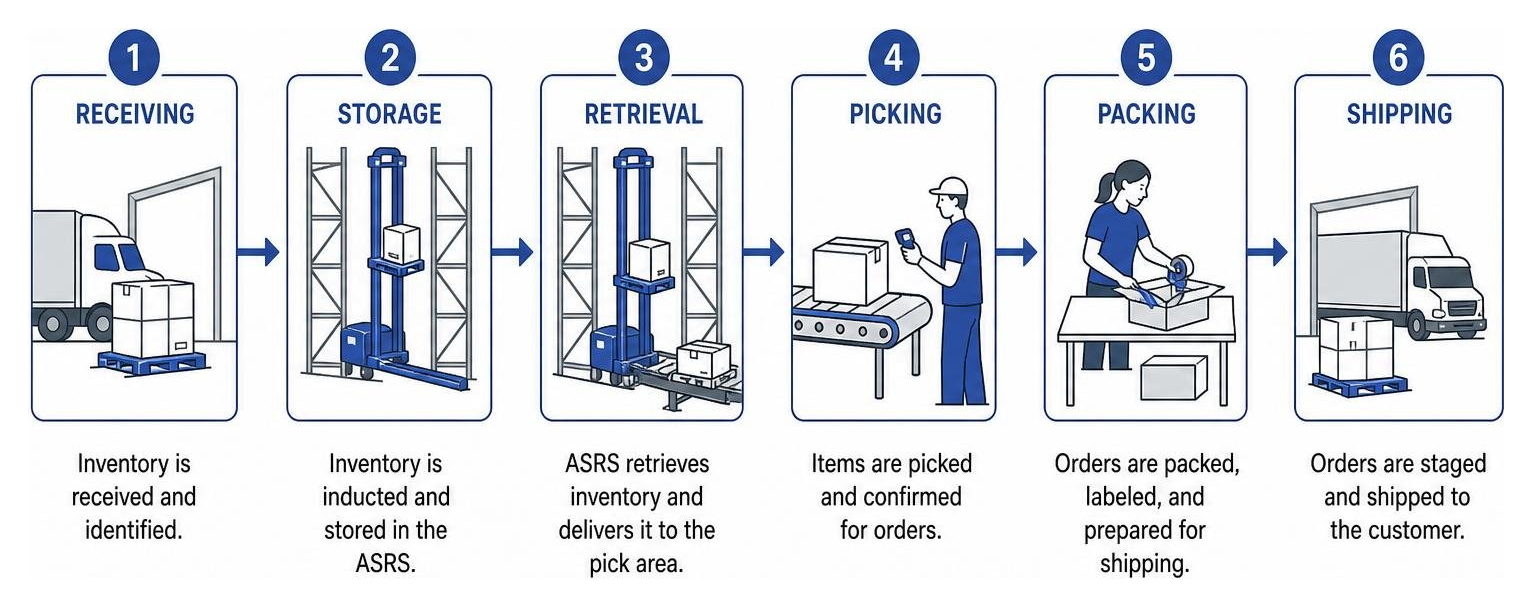
The Basic ASRS Workflow
A typical ASRS workflow includes these steps:
- Inventory is received and identified.
- Loads are scanned, weighed, measured, or verified.
- Software assigns the best storage location based on rules such as SKU velocity, size, weight, lot, temperature zone, FIFO, FEFO, or demand.
- The ASRS stores the load automatically.
- Inventory records are updated.
- An order, replenishment task, or production requirement triggers retrieval.
- The system sequences the load based on priority.
- Inventory is delivered to picking, packing, production, kitting, palletizing, replenishment, or shipping.
The goal is to reduce walking, searching, manual lifting, forklift travel, and non-value-added movement.
The Main Components of an ASRS
Most ASRS designs include several integrated components:
| Component | Role in the System |
|---|---|
| Storage rack, grid, or structure | Holds inventory in dense, organized locations |
| Crane, shuttle, lift, carousel, VLM, or robot | Performs automated storage and retrieval |
| Load handling device | Transfers pallets, totes, trays, cartons, or bins |
| Conveyors or transfer equipment | Moves inventory between ASRS and other areas |
| Pick/put stations | Allow operators to pick, replenish, inspect, or process goods |
| Controls and PLCs | Execute machine-level commands |
| Sensors and safety devices | Verify position, load presence, access control, and safe operation |
| WMS, WCS, WES, ERP | Manage inventory, execution, orchestration, and enterprise transactions |
One factor many operations overlook is that the storage machine is only one part of the solution. If induction, conveyors, workstations, packing, or shipping cannot keep up, the ASRS may be underutilized.
How ASRS Improves Goods-to-Person Fulfillment
Goods-to-person fulfillment changes the work model. Instead of operators walking to inventory, inventory comes to operators.
This can improve:
- Pick rates
- Ergonomics
- Order accuracy
- Training time
- Workstation consistency
- Labor planning
- Order sequencing
- Space utilization
A well-designed station may include scanning, pick-to-light, put-to-light, weighing, labeling, cartonization support, dunnage, packing materials, and exception handling. Workstation design matters because it determines how efficiently people and automation interact.
Why Software Integration Determines Performance
Software integration is where many ASRS projects succeed or struggle.
Each software layer has a different role:
- WMS manages inventory, orders, locations, and warehouse business rules.
- WCS controls machine-level execution, conveyor routing, and automation commands.
- WES balances waves, labor, automation resources, and real-time priorities.
- ERP provides enterprise-level order, demand, purchasing, and financial data.
Poor integration can cause stock mismatches, unnecessary touches, sequencing errors, blocked conveyors, manual workarounds, and poor utilization. During automation planning, transaction ownership should be defined clearly, including inventory status, order priority, location assignment, exception handling, and replenishment decisions.
What Types of ASRS Are Available?
ASRS selection should start with the operation, not the equipment. The right system depends on load type, SKU profile, order mix, throughput goals, storage density, building constraints, labor strategy, software maturity, and expansion plans.
Common ASRS categories include unit-load systems, mini-load systems, vertical lift modules, carousels, shuttle-based systems, cube-style robotic storage, and specialized automated storage technologies.
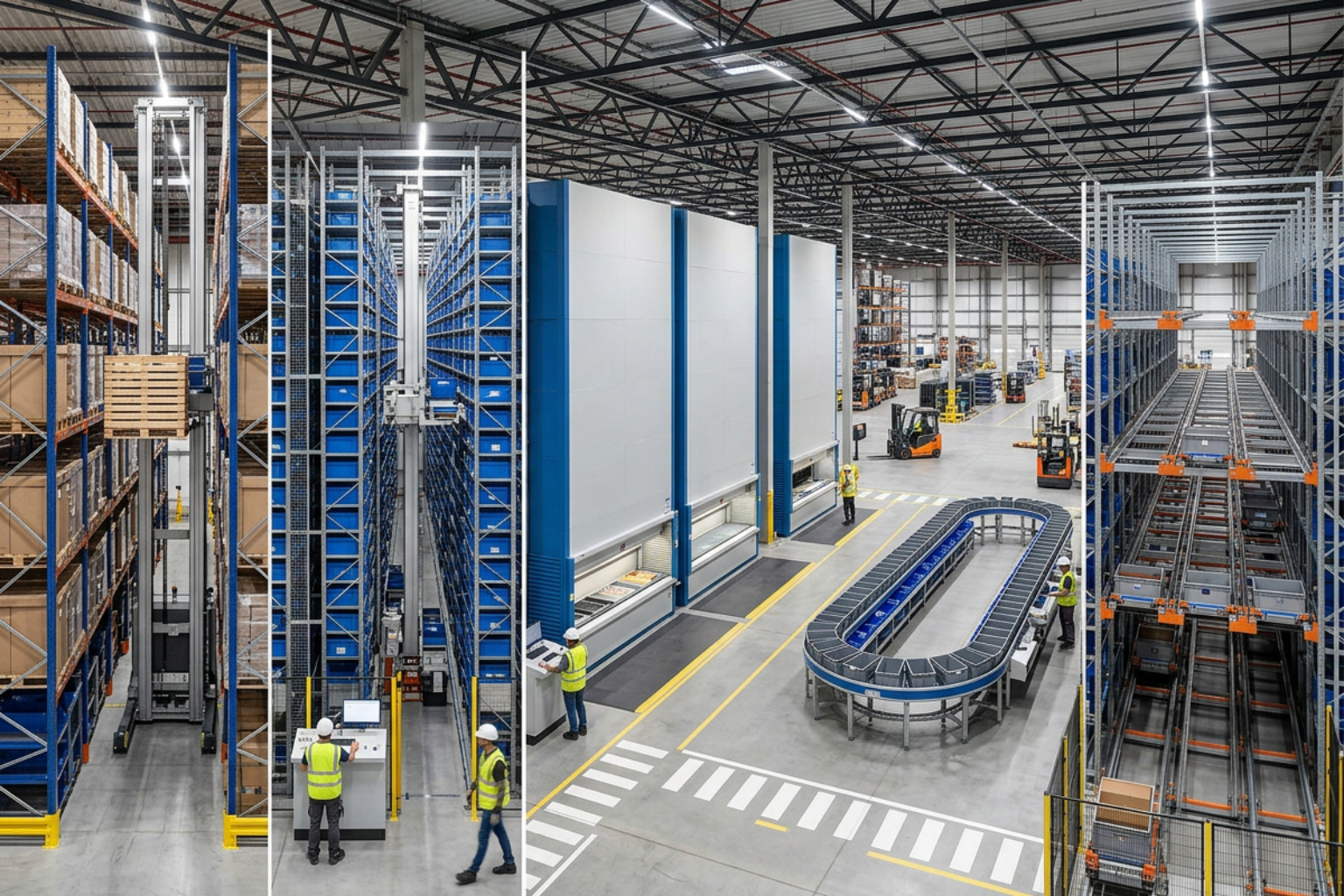
| ASRS Type | Typical Load | Density | Throughput | Scalability | Integration Complexity | Best-Fit Applications |
|---|---|---|---|---|---|---|
| Unit-load ASRS | Pallets, heavy loads | High | Medium | High | High | Manufacturing, cold storage, finished goods, high-bay pallet storage |
| Mini-load ASRS | Totes, trays, cases | High | Medium to high | High | Medium to high | E-commerce, spare parts, retail, electronics, kitting |
| Shuttle-based ASRS | Totes, cartons | High | Very high | High | High | Omnichannel, high-volume fulfillment, buffering, sequencing |
| Vertical lift module | Small parts, trays | High | Low to medium | Medium | Low to medium | MRO, tools, parts rooms, manufacturing cells |
| Horizontal carousel | Bins, small items | Medium | Medium to high | Medium | Medium | Batch picking, parts distribution, goods-to-person cells |
| Cube-style robotic ASRS | Totes, bins | Very high | Medium to high | High | Medium to high | E-commerce, retail, micro-fulfillment, small SKU storage |
Unit-Load ASRS for Pallets and Heavy Loads
Unit-load ASRS is designed for pallets and heavy loads. It is often used in manufacturing, food and beverage, cold storage, raw materials storage, finished goods storage, and high-bay warehouses.
It can reduce forklift travel, improve pallet storage density, support automated replenishment, and create more controlled inventory movement. Planning should address pallet quality, load stability, overhang, stretch-wrap condition, fire protection, slab condition, clear height, seismic requirements, temperature zones, and pallet flow to production or shipping.
Mini-Load and Tote-Based ASRS for Cases, Totes, and Small Items
Mini-load and tote-based ASRS systems are common in high-SKU environments where operators pick eaches, small parts, components, or mixed orders.
They are often a strong fit for e-commerce fulfillment, retail distribution, spare parts, pharmaceuticals, electronics, kitting, maintenance and repair operations, and high-SKU manufacturing support. Planning considerations include tote standards, SKU cube, pick velocity, replenishment strategy, batch picking logic, workstation design, and order sequencing.
Shuttle-Based ASRS for High Throughput
Shuttle-based ASRS is typically used when operations need fast tote or carton movement at high volume. These systems can separate horizontal and vertical movement, allowing higher throughput than some traditional crane-based designs.
They are well suited for omnichannel fulfillment, high-velocity e-commerce, retail replenishment, order buffering, sequenced delivery to packing or shipping, and high-volume goods-to-person operations. Planning should account for peak demand, aisle count, lift capacity, redundancy, software orchestration, and downstream capacity.
Vertical Lift Modules and Vertical Carousels for Space-Constrained Operations
Vertical lift modules and vertical carousels use vertical height to store trays or carriers in a compact footprint. They are often used in parts rooms, tool storage, MRO inventory, manufacturing cells, healthcare support areas, labs, and lower-to-medium throughput picking environments.
They can improve space utilization, item security, ergonomic access, inventory control, and parts organization. They may operate as standalone systems or as part of a broader automation strategy.
Horizontal Carousels and Goods-to-Person Cells
Horizontal carousels rotate bins or shelves to an operator. They are frequently used for batch picking, small-item fulfillment, parts distribution, and high-labor manual picking zones.
They are often paired with pick-to-light, put-to-light, scanning, workstation software, batch picking logic, and order consolidation. Planning should address pod configuration, SKU velocity, replenishment access, operator balancing, and future scalability.
Cube-Style Robotic Storage and Dense Robotic ASRS
Cube-style robotic ASRS stores inventory in dense grids or compact storage structures, with robots retrieving bins or totes as needed. These systems can provide high storage density and modular scalability.
They are often evaluated for e-commerce, retail fulfillment, micro-fulfillment, high-SKU small item storage, and space-constrained operations. Planning considerations include access sequencing, tote depth, SKU velocity, peak demand, workstation count, decanting, induction, packing, and conveyor integration.
How Do You Build the Business Case for ASRS?
An ASRS business case should include more than equipment cost. The true investment includes engineering, controls, software, integration, installation, facility modifications, training, support, and long-term operating impact.
For additional background, see LD Systems’ guide to automated storage and retrieval systems.
What ASRS Costs Include
ASRS costs may include:
- Equipment
- Storage rack, grid, or structure
- Load-handling devices
- Conveyors and transfer equipment
- Controls engineering
- WMS, WCS, WES, or ERP integration
- Electrical work
- Compressed air requirements, where applicable
- Fire protection modifications
- Safety systems and guarding
- Workstation design
- Installation labor
- Testing and commissioning
- Operator and maintenance training
- Project management
- Spare parts
- Lifecycle support
Cost varies widely. Depending on scope, modular ASRS projects may start in the hundreds of thousands of dollars, while larger integrated systems can exceed $1 million. Complex enterprise-scale systems may reach tens of millions when they involve extensive controls, software integration, building modifications, and high-throughput equipment.
How to Calculate ASRS ROI
ASRS ROI should be evaluated over a realistic 10-to-20-year operating horizon, not just the first-year capital cost.
Important ROI drivers include:
- Labor reduction or redeployment
- Pick and putaway travel time reduction
- Overtime reduction
- Warehouse expansion or lease cost avoided
- Higher throughput
- Improved order accuracy
- Lower product damage
- Reduced forklift use
- Better inventory control
- Improved safety
- Lower energy usage in temperature-controlled facilities
- Scalability for future growth
Many ASRS projects are evaluated over a multi-year payback period, with ROI depending on labor savings, space recovery, throughput gains, accuracy improvements, avoided expansion costs, and system scope. In some applications, LD Systems has helped automation projects target measurable ROI in as little as 17 months.
Which Operational Metrics Should Be Measured Before ASRS Design?
Before selecting equipment, operations leaders should measure:
- Lines per hour
- Units per hour
- Orders per day
- Peak-to-average demand ratio
- SKU count and SKU growth
- Order profile
- Inventory turns
- Cube utilization
- Travel distance
- Replenishment frequency
- Mis-pick rate
- Dock-to-stock time
- Labor hours by function
- Storage occupancy
- Seasonal volatility
- Service-level requirements
During warehouse assessments, a common issue is that companies know total order volume but not the activity-level details that determine system design. ASRS sizing depends heavily on peaks, SKU velocity, cube, replenishment patterns, and downstream flow.
When Does ASRS Usually Deliver the Strongest ROI?
ASRS tends to deliver the strongest ROI when the operation has high labor content, limited building footprint, expensive expansion options, high SKU complexity, frequent picking or replenishment, cold or difficult work environments, strict traceability requirements, high accuracy expectations, multi-shift operations, or rapid e-commerce and omnichannel growth.
When May ASRS Not Be the Right First Investment?
ASRS may not be the best first investment when SKU master data is poor, item dimensions and weights are unreliable, order volume is low, packaging is inconsistent, operational goals are unclear, receiving errors are unresolved, inventory accuracy is weak, packing or shipping is already the main bottleneck, WMS discipline is lacking, or the facility may relocate before payback.
In these cases, process improvement, slotting, software cleanup, conveyor improvements, or basic storage redesign may need to come first.
How Should ASRS Integrate With Warehouse Automation?
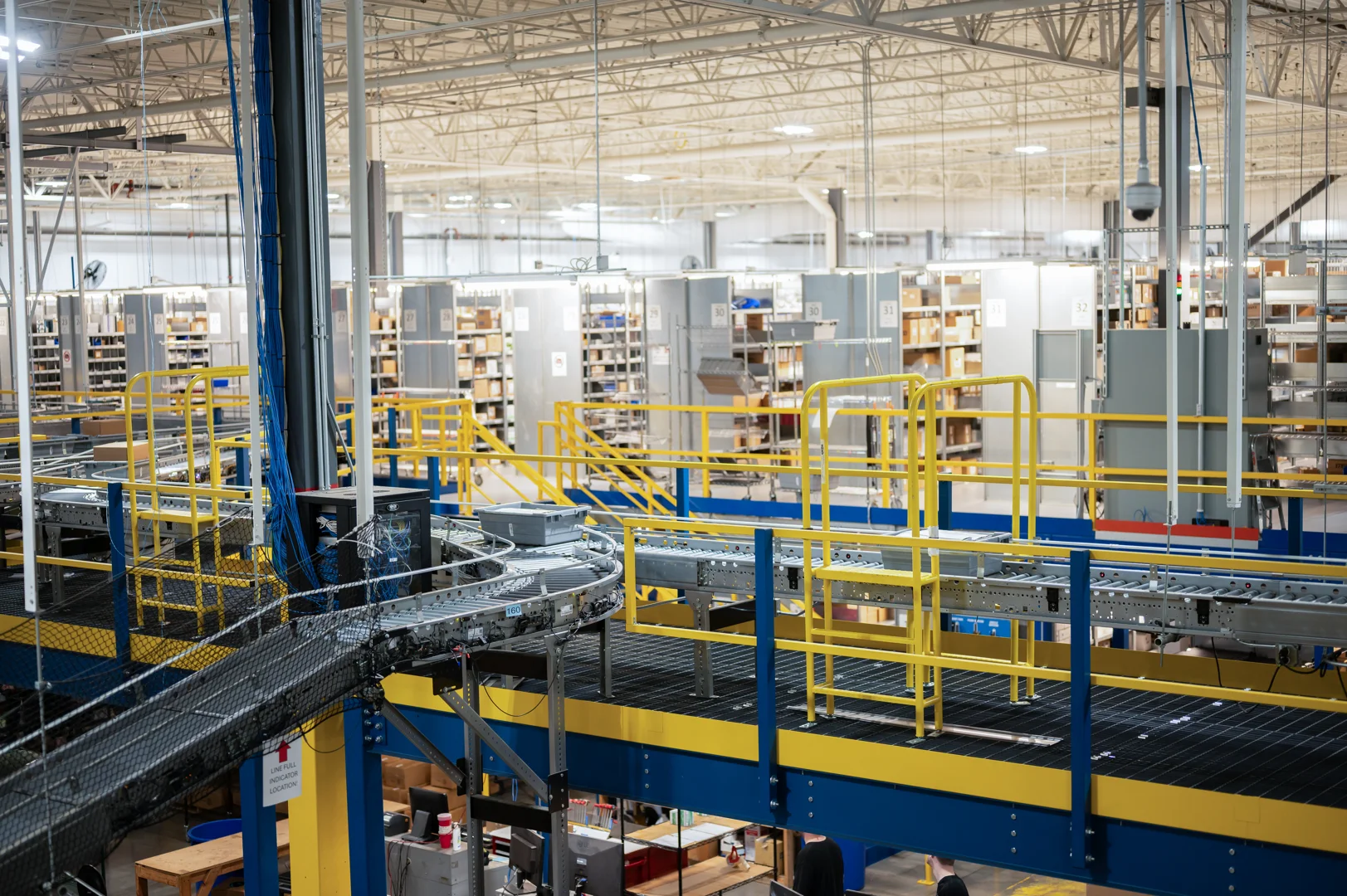
ASRS value depends on how well it fits into the complete material flow. A high-performance ASRS can still disappoint if conveyors, packing, labor planning, software, or shipping cannot keep pace.
LD Systems approaches ASRS as one part of an integrated warehouse automation architecture, not as an isolated equipment purchase. For more context, see how ASRS, robotics, and automated warehouse robots can work together in modern warehouse automation.
Before selecting an ASRS, teams should answer:
- What upstream processes feed the system?
- What downstream processes receive inventory from it?
- What throughput must each connected area support?
- Which software system owns inventory decisions?
- How will exceptions be handled?
- How will replenishment be triggered?
- How will peak demand be sequenced?
- What manual processes remain?
- What happens if a workstation, conveyor zone, or automation module goes down?
- How will performance be measured after launch?
ASRS Compared With Traditional Storage and Retrieval
Traditional racking and forklifts offer flexibility and lower upfront cost. They can fit lower-volume operations, irregular loads, highly variable products, or facilities with minimal growth pressure.
ASRS offers stronger density, repeatability, accuracy, safety, and traceability. It is usually a better fit when labor, space, speed, or inventory control is limiting growth. Many successful facilities use a hybrid strategy: ASRS for high-value, high-velocity, space-constrained, or labor-intensive inventory, with traditional storage supporting oversized, slow-moving, or irregular products.
ASRS and Conveyor Systems
Conveyors connect ASRS to receiving, induction, picking, packing, sortation, palletizing, and shipping. Conveyor design must match ASRS throughput and sequencing requirements.
One factor many operations overlook is that an ASRS can retrieve faster than downstream areas can process. If packing benches, print-and-apply stations, palletizing, or shipping lanes are undersized, automation simply moves the bottleneck.
ASRS and Warehouse Robotics
Warehouse robotics can complement ASRS in several ways:
- AMRs can move totes, carts, or completed orders between zones.
- AGVs can support automated pallet movement.
- Robotic picking can automate item handling at goods-to-person stations.
- Mobile robots can support flexible transport where fixed conveyor is not ideal.
The value depends on SKU handling characteristics, task repeatability, exception rates, travel distance, labor availability, and software orchestration.
ASRS and Goods-to-Person Picking
ASRS often becomes the storage engine for goods-to-person fulfillment. The benefits include less walking, better ergonomics, faster order cycles, and improved accuracy.
However, the workstation must be engineered carefully. Operations should evaluate pick presentation height, reach distances, lighting, scanning, labeling, weigh verification, dunnage access, replenishment flow, exception handling, packing adjacency, and operator balancing.
ASRS and WMS, WCS, and WES Integration
Successful ASRS integration requires clear software ownership.
Key questions include:
- Which system owns inventory location?
- Which system releases work?
- Which system prioritizes urgent orders?
- Which system manages automation queues?
- Which system handles exceptions?
- Which system reports performance?
- Which system updates ERP transactions?
Fragmented controls can create manual workarounds. A properly integrated WMS, WCS, and WES environment gives teams visibility into uptime, throughput, inventory accuracy, queue status, and labor balance.
ASRS in E-Commerce and Retail Fulfillment
E-commerce and retail fulfillment are common ASRS use cases because they often involve high SKU counts, small orders, fast cycle times, and peak volatility.
ASRS can support each picking, batch picking, store replenishment, micro-fulfillment, returns processing, order consolidation, peak season buffering, and omnichannel fulfillment. The challenge is sequencing inventory to meet carrier cutoffs, packing priorities, order promises, and returns volume.
ASRS in Manufacturing, Food, Pharmaceutical, Automotive, and Cold Storage
ASRS also has strong applications outside e-commerce:
- Manufacturing: raw materials, WIP, kitting, line-side replenishment, and production buffering
- Food and beverage: temperature control, FIFO/FEFO, traceability, and dense storage
- Pharmaceutical: security, lot control, documentation, and controlled access
- Automotive: heavy components, sequencing, and just-in-time material flow
- Cold storage: reduced freezer labor, higher density, and improved inventory control
In cold environments especially, automation can reduce the time employees spend in difficult conditions while improving storage density and retrieval consistency.
What Challenges Should You Consider Before Implementing ASRS?
ASRS can produce significant operational gains, but it can also underperform if designed around equipment instead of process. The most successful projects begin with data, material flow analysis, operational modeling, and integration planning.
Common ASRS Implementation Challenges
Common ASRS challenges include:
- Poor SKU data
- Inaccurate item dimensions or weights
- Insufficient peak demand modeling
- Underestimating software integration
- Ignoring replenishment strategy
- Weak exception handling
- Inadequate operator training
- Limited maintenance access
- Building columns or clear-height constraints
- Slab limitations
- Fire suppression requirements
- Safety systems and guarding
- Workstation design
These issues can affect project scope, timeline, commissioning, uptime, and ROI. They should be addressed during assessment and design rather than discovered after equipment selection.
How to Reduce ASRS Implementation Risk
Teams can reduce ASRS implementation risk by validating operational data early, defining software ownership, modeling peak demand, confirming load standards, planning exception workflows, and designing workstations around the people who will use them.
It also helps to phase implementation where practical. A phased roadmap can let the operation improve data discipline, stabilize upstream processes, test automation assumptions, and expand capacity as volume grows.
Frequently Asked Questions About ASRS
How much space can ASRS save?
ASRS can significantly increase storage density by using vertical height, tighter storage configurations, and automated access paths. Actual savings depend on building height, load type, SKU profile, fire code, aisle requirements, throughput needs, and expansion plans.
How long does ASRS implementation take?
Implementation timelines vary by system complexity, building readiness, software integration, equipment lead times, permitting, installation phasing, and commissioning requirements. Smaller modular systems may deploy faster, while large integrated systems require deeper engineering, testing, and operational coordination.
Is ASRS right for a midsize warehouse?
Yes, in some cases. Midsize operations with labor constraints, high SKU counts, limited space, accuracy problems, or growth pressure may benefit from modular ASRS. The decision should be based on data, ROI, process fit, and scalability rather than facility size alone.
Is ASRS the same as warehouse automation?
No. ASRS is one type of warehouse automation focused on storing and retrieving inventory. Warehouse automation is broader and may also include conveyors, sortation, robotics, palletizing, depalletizing, WMS, WCS, WES, scanning, and automated packing or shipping workflows. ASRS often becomes one part of a larger warehouse automation strategy.
How LD Systems Helps You Choose and Implement ASRS
The right ASRS strategy starts with operational goals, not a preferred equipment category. LD Systems is a warehouse and material handling systems integrator that evaluates technologies based on each facility’s needs, then designs, engineers, integrates, installs, and supports complete automation systems tailored to throughput targets, labor models, space constraints, and ROI requirements.
From its Daytona Beach, Florida location, LD Systems supports warehouse, distribution, fulfillment, and manufacturing operations with ASRS, conveyor and sortation systems, goods-to-person workflows, warehouse robotics, pallet handling, controls engineering, installation, commissioning, and long-term support. The team also supports software integration, including WMS, WCS, and WES coordination where required.
With more than 50 years of combined experience, LD Systems focuses on practical outcomes: higher throughput, better inventory accuracy, improved labor efficiency, denser storage, safer workflows, and scalable automation roadmaps.
Explore LD Systems’ automated storage and retrieval systems or review the Cabela’s storage and retrieval optimization case study.
What LD Systems Evaluates During an ASRS Assessment
During an ASRS assessment, LD Systems evaluates:
- Current material flow
- SKU profile
- Facility layout
- Storage density
- Labor model
- Order profile
- Inventory accuracy
- Throughput constraints
- Safety risks
- Software environment
- Expansion plans
- ROI targets
- Operational risk
- Phased implementation options
The goal is to determine whether ASRS is the right fit and, if so, how it should be integrated into the broader automation system.
How LD Systems Designs Technology-Agnostic Solutions
LD Systems matches technology to operational need. That may include ASRS, conveyors, robotics, goods-to-person workstations, pallet handling, sortation, software integration, or a phased combination of technologies.
The company’s technology-agnostic approach helps avoid over-automation and isolated automation islands. Instead of starting with equipment, LD Systems identifies bottlenecks, models operational requirements, and designs integrated systems around business goals.
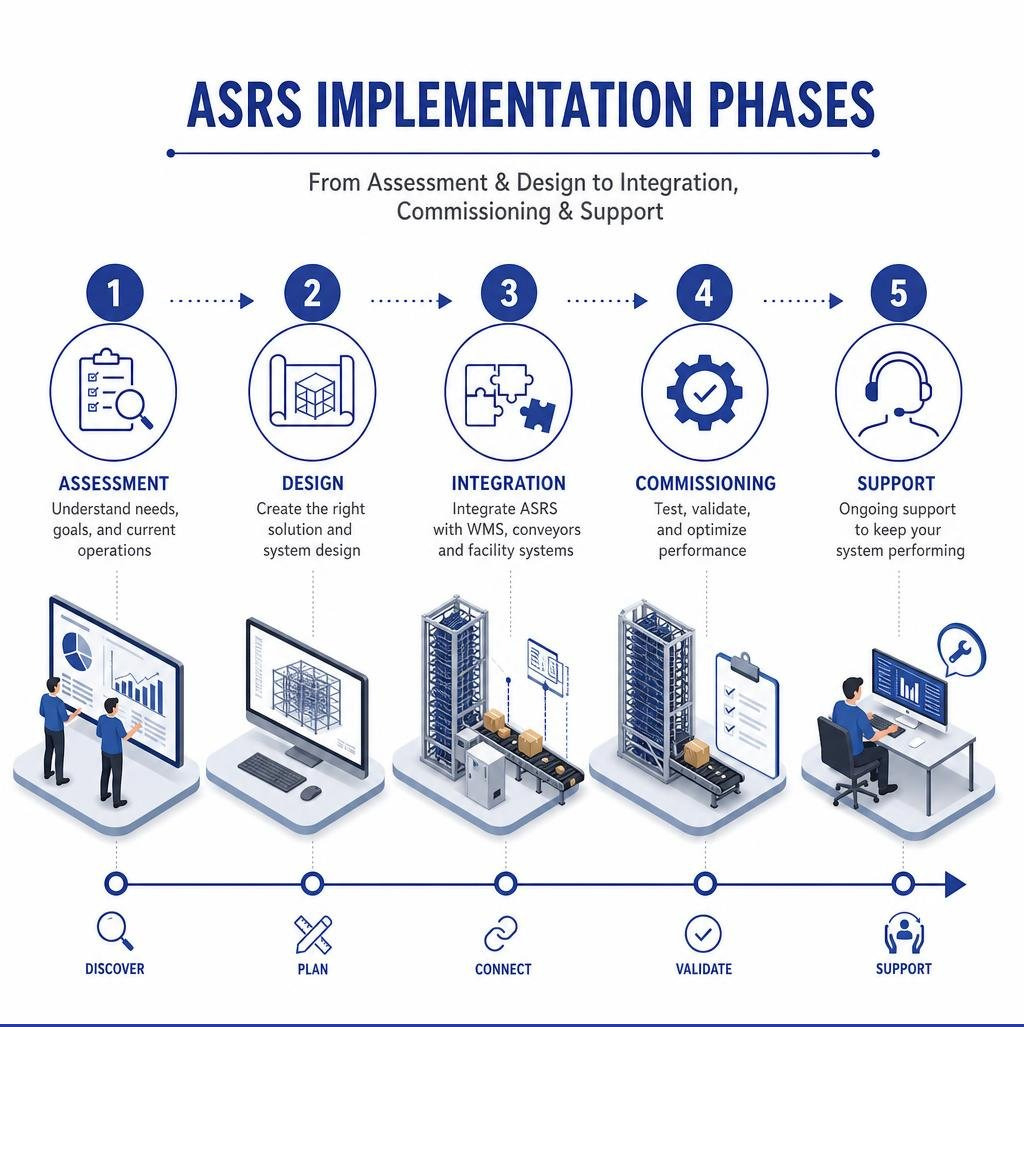
What a Practical ASRS Roadmap Looks Like
A practical ASRS roadmap typically includes:
- Discovery and data collection
- Operational assessment
- Concept design
- Throughput modeling or simulation where needed
- ROI and budget development
- Engineering
- Software integration planning
- Installation phasing
- Commissioning
- Training
- Performance validation
- Long-term support
This roadmap helps reduce risk and ensures the system is designed for measurable operational improvement.
For operations evaluating ASRS, the most important first step is not selecting equipment. It is understanding the bottleneck, modeling the business case, and designing a system that fits the facility’s real material flow. LD Systems helps companies evaluate ASRS opportunities with engineering discipline, integration experience, and a practical focus on measurable ROI.
