

What Is Automated Racking?

Automated racking is transforming how modern warehouses store, manage, and retrieve inventory — and for operations leaders facing tighter margins, labor constraints, and rising order complexity, understanding the technology can support better long-term facility planning.
What is automated racking?
Automated racking refers to storage systems that combine rack structures with automated retrieval technology, such as pallet shuttles, stacker cranes, vertical lift modules, mobile racking, or AS/RS controls, to store and retrieve inventory with reduced manual handling. Unlike conventional racking that relies primarily on forklifts and manual travel, automated systems use software-directed equipment to move pallets, totes, cartons, or parts more consistently through the storage process.
| Automated Racking at a Glance | Details |
|---|---|
| Purpose | Store and retrieve pallets, totes, cartons, or parts with reduced manual handling |
| Common technologies | Pallet shuttles, AS/RS, stacker cranes, VLMs, mobile racking, and WMS/WCS integration |
| Benefits | Higher storage density, improved accuracy, reduced travel time, and better scalability |
| Best for | Warehouses, distribution centers, cold storage, manufacturing, e-commerce, and 3PL operations |
Automated racking systems can significantly improve storage density, reduce manual travel, increase picking accuracy, and help facilities reclaim usable floor space, depending on the building layout, SKU profile, throughput requirements, and system design.
Facilities that evaluate automated storage early can often make better long-term decisions about space utilization, labor planning, and future throughput requirements.
During warehouse assessments, one pattern appears consistently: operations that rely entirely on manual racking and forklift-based retrieval often hit a throughput ceiling before they run out of physical space. The constraint is not always the building itself — it is frequently the storage and retrieval process inside it.
This guide is built for operations managers, distribution center leaders, and engineering teams evaluating whether automated storage is the right investment for their facility. We’ll cover how the technology works, which systems fit which operations, how to approach integration and retrofitting, and what realistic ROI considerations look like.
Traditional Racking vs. Automated Racking: Key Differences
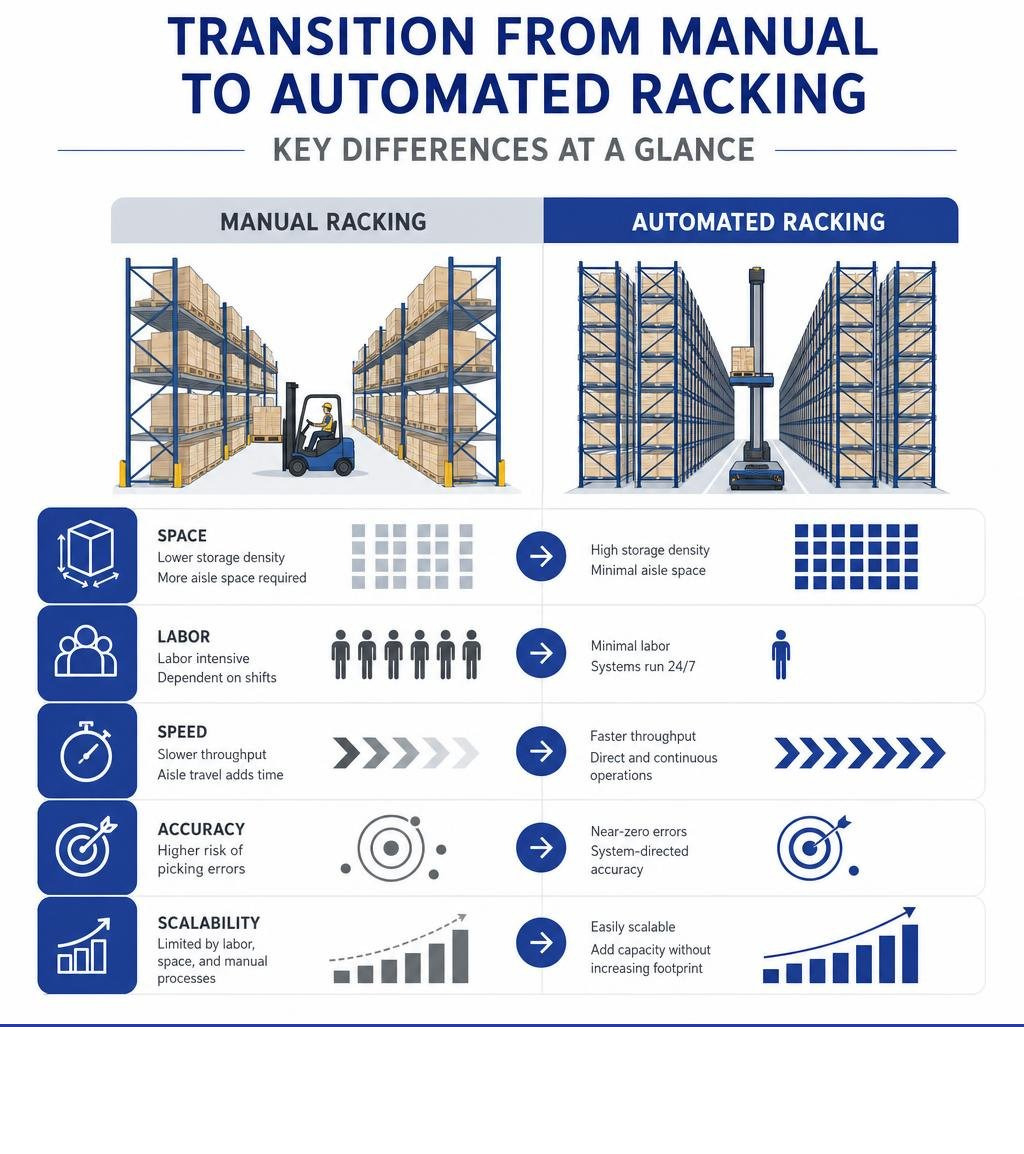
To understand the value of automated racking, it helps to look at the operational limitations of traditional warehouse storage. Conventional layouts are often built around the forklift. Because human operators must drive down aisles to store or retrieve pallets, a meaningful portion of the warehouse footprint is dedicated to travel space rather than storage positions.
In a standard selective pallet rack layout, aisle requirements can limit the building’s total storage density and force pickers or forklift operators to spend a significant share of their shifts traveling between locations. That travel time becomes a hidden tax on throughput, especially in facilities with high SKU counts, long pick paths, or frequent replenishment activity.
Manual operations are also more dependent on consistent scanning, labeling, and operator discipline. Misplaced pallets, incorrect picks, and delayed inventory updates can occur when workers must locate a specific SKU among thousands of rack positions while balancing speed and accuracy expectations.
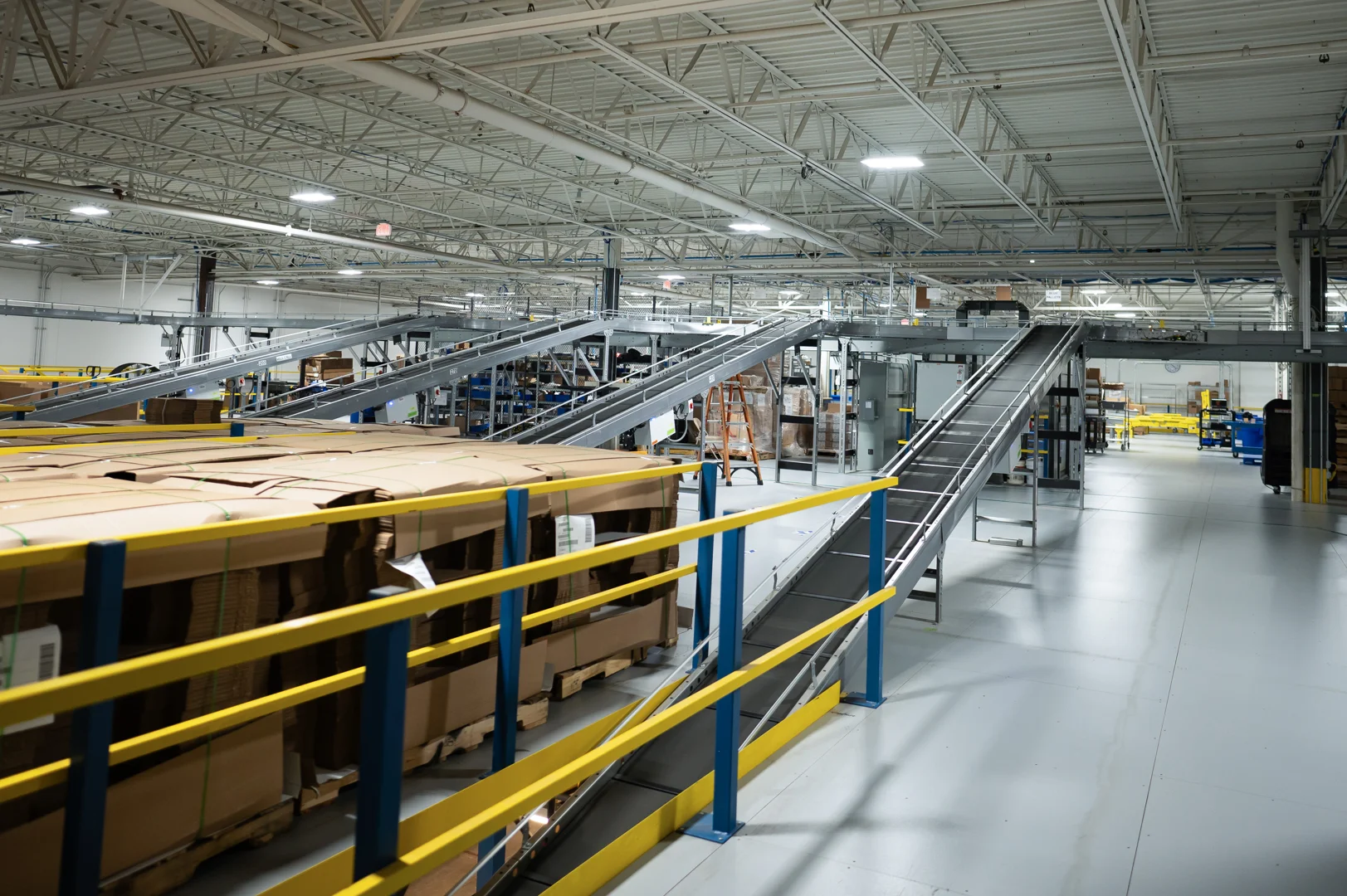
Automated racking systems reduce these bottlenecks by pairing dense storage structures with machine-accessible retrieval methods. Robotic shuttles, cranes, vertical lifts, or mobile bases can reduce the need for wide forklift aisles and allow facilities to use vertical clearance more effectively. OSHA’s powered industrial trucks guidance is also useful context when evaluating forklift-heavy workflows and workplace safety controls.
The difference in operational dynamics is summarized below:
| Operational Metric | Traditional Pallet Racking | Automated Racking Systems |
|---|---|---|
| Space Utilization | Moderate; aisles and manual access requirements consume usable floor area | Higher; dense storage designs can improve cube utilization |
| Throughput Speed | Limited by forklift travel, walking time, and manual picking workflows | Higher potential when retrieval, sequencing, and picking are automated |
| Inventory Accuracy | Dependent on manual scanning, labeling, and operator consistency | Improved when integrated with WMS/WCS controls and verification workflows |
| Labor Requirements | Requires forklift operators, pickers, and manual replenishment activity | Reduces manual travel and shifts labor toward supervision, exception handling, and value-added work |
| Workplace Safety | Greater interaction between pedestrians, forklifts, and stored loads | Helps separate people from automated equipment when properly guarded and controlled |
| Scalability | Often requires layout changes, re-slotting, or added space | Can often scale through additional equipment, zones, software changes, or phased expansion |
When evaluating these options, operations managers must weigh the long-term cost of space, labor, safety, and throughput. Static storage like those discussed in types of pallet racking serves a vital purpose for low-velocity inventory, while higher-throughput environments may require a more dynamic approach. For a deeper look at maximizing your footprint, see our guide on saving space with warehouse storage racks. LD Systems also supports broader industrial storage solutions when facilities need to compare static rack layouts, dense storage, and automation-ready designs.
Core Technologies in Modern Automated Racking
Automated storage is not a single product; it is a category of distinct technologies designed for different load types, SKU volumes, and throughput requirements. At its core, an automated racking system integrates structural storage with retrieval equipment and intelligent control software. MHI describes Automated Storage and Retrieval Systems as equipment and controls used to handle, store, and retrieve materials with a defined degree of automation.

By implementing automated storage and retrieval workflows, warehouses can transition from a manual “person-to-goods” model toward a more efficient “goods-to-person” process. Rather than workers searching through aisles, the system retrieves the required item and delivers it to an ergonomic picking or transfer point.
For a broader look at these engineering concepts, explore LD Systems’ guide to automated storage and retrieval systems (AS/RS). Let’s break down the primary automated racking technologies used in modern distribution and manufacturing.
Pallet Shuttle and High-Density Automated Racking
For operations handling high volumes of palletized goods with low to medium SKU counts, pallet shuttle systems can offer an effective balance of density and throughput. These systems use semi-automated or fully automated shuttles that run on tracks built within deep-lane racking structures.
In a typical configuration, a forklift operator places the shuttle at the entry of a lane, and the shuttle transports the pallet into the rack to store it. The process is reversed for retrieval. This reduces the need for forklifts to drive into racking lanes, which can help limit rack damage and improve traffic control.
To scale throughput further, more advanced shuttle configurations can move horizontally along a level and may connect with lifts or other transfer equipment. This creates a high-density storage engine where pallets can be managed with less manual intervention. You can learn more about how these systems streamline heavy-duty operations by reading about pallet shuttle technology.
Mini-Load AS/RS and Tote-Based Automated Storage
When the inventory profile consists of smaller parts, cartons, totes, or bins rather than full pallets, a mini-load AS/RS may be the right engineering choice. These systems typically feature a crane, shuttle, or robotic handling device traveling through high-density shelving or rack structures to retrieve containers and deliver them to conveyor systems, workstations, or other transfer points.
Mini-load systems are effective for operations managing large SKU counts, such as parts distribution, e-commerce fulfillment, or manufacturing support. They support high-velocity picking and can use vertical space that would be difficult or inefficient for manual picking.
Autonomous mobile robots and automated guided vehicles can also support automated storage workflows by transporting goods between storage, picking, packing, and shipping areas. However, they are not usually automated racking systems by themselves; they are supporting technologies that can connect racking, workstations, conveyors, and software into a broader warehouse automation strategy.
Vertical Lift Modules (VLMs) and Mobile Racking
For facilities looking to maximize floor space in a compact footprint, Vertical Lift Modules (VLMs) and mobile racking systems provide useful space-saving alternatives.
A VLM is an enclosed system consisting of two columns of trays with an inserter/extractor mechanism running down the center. When an operator selects an item, the internal lift retrieves the appropriate tray and delivers it to an access window. Because the system can store trays based on item height, it reduces wasted vertical space and is often used for spare parts, tools, or high-value inventory near production lines.
Mobile racking mounts heavy-duty selective pallet racks onto motorized mobile bases that move along floor-mounted rails. Instead of maintaining a permanent aisle between every row of racks, a mobile racking system opens an aisle only where access is needed. This can improve storage density while preserving access to individual pallet positions.
To understand how these different configurations fit into a broader warehouse strategy, read LD Systems’ breakdown on how automated storage and retrieval systems work.
Benefits of Automated Racking Systems
The decision to transition from manual storage to automated racking is typically driven by clear business challenges: space constraints, labor availability, inventory accuracy, and the need for higher throughput. When engineered correctly, these systems can improve the economics of a facility without requiring every process to be fully automated at once.
The actual return depends on SKU mix, order velocity, ceiling height, pallet dimensions, inventory rotation requirements, and the quality of software integration.
The most immediate impact is often felt in space utilization. By reducing forklift aisles, improving cube utilization, and taking better advantage of vertical clearance, automated racking systems can help facilities store more inventory within the same building. This may help companies defer expansion, avoid unnecessary outside storage, or make room for manufacturing, value-added services, staging, or additional shipping capacity.
Labor savings are another important part of the business case. Automated systems shift non-value-added travel, lifting, and retrieval tasks away from workers and toward controlled equipment. Instead of walking long distances or driving repetitive storage routes, workers can remain at ergonomic goods-to-person stations, manage exceptions, verify picks, replenish inventory, or perform higher-value tasks.
Beyond labor and space, automated solutions can support improvements in accuracy and safety when the system is properly designed, integrated, and maintained:
- Improved Picking Accuracy: Automated systems can improve accuracy when paired with WMS/WCS controls, scan verification, light-directed picking, or screen-based workstation instructions.
- Enhanced Workplace Safety: Forklift traffic and pedestrian interaction are common concerns in industrial environments. Automated racking can help improve separation between people and moving equipment when the system is properly guarded, monitored, and controlled.
- More Consistent Operations: Automated systems can support extended operating hours, seasonal demand spikes, and more predictable retrieval sequences when the equipment, software, and maintenance plan are properly designed.
- Modular Scalability: Many modern automated systems are designed to grow incrementally. An operation can start with a baseline configuration and scale up by adding shuttle carts, extending racking, adding workstations, or expanding software-controlled zones.
When Automated Racking May Not Be the Right Fit
Automated racking is not the right solution for every warehouse. In some facilities, traditional pallet racking, carton flow, push-back rack, or selective storage may still be the better choice depending on inventory profile, order volume, and capital planning.
| Automated racking may be a strong fit when… | Traditional or semi-automated storage may be better when… |
|---|---|
| SKU velocity, order volume, or replenishment demand is increasing | Inventory turns slowly and does not require frequent access |
| Labor availability is limiting throughput | Labor is stable and storage activity is low-volume |
| The facility is constrained by floor space or expansion costs | The building has ample space and low storage density requirements |
| Accuracy, sequencing, or traceability requirements are high | Manual scanning and standard rack processes meet operational needs |
| The operation has enough volume to justify software and controls integration | The facility does not yet have the order volume or process discipline to support automation |
To explore how these benefits apply to specific facility layouts and operational workflows, read more about LD Systems’ automated storage and retrieval systems.
Integrating Automated Systems with WMS and Warehouse Software
An automated racking system is only as effective as the software that directs it. While the steel racks and automated equipment handle the physical movement of goods, a layered software architecture coordinates the operation and helps inventory flow smoothly from receiving to shipping.
This software ecosystem typically consists of three primary layers:
- Warehouse Management System (WMS): The WMS tracks inventory levels, manages customer orders, and determines where stock should be allocated.
- Warehouse Execution System (WES): The WES coordinates order release, batching, sequencing, and task prioritization across labor and equipment.
- Warehouse Control System (WCS): The WCS interfaces directly with equipment such as shuttles, cranes, conveyors, lifts, scanners, and controls devices.
When these systems are integrated well, the warehouse gains better real-time inventory tracking and material flow control. For example, after an order is released, the WMS and WES can coordinate the retrieval sequence while the WCS directs the physical equipment to move the correct pallets, totes, or cartons to the next process step.
This software integration can also support inventory management strategies such as First-In, First-Out (FIFO), Last-In, First-Out (LIFO), batch picking, wave planning, and dynamic slotting. By analyzing SKU velocity and order patterns, the software can help position frequently needed items in more efficient storage locations and reduce avoidable travel or retrieval delays.
For facilities evaluating automation, software fit is just as important as equipment selection. LD Systems can help connect racking, conveyors, controls, and warehouse systems integration into a practical automation roadmap, including WMS, WCS, and WES coordination where the facility requires it.
Implementation Planning, Retrofitting, and ROI Expectations
One of the most common misconceptions about automated racking is that it requires a brand-new, purpose-built facility. While building a greenfield automated warehouse offers the most design flexibility, retrofitting existing warehouses is a common and viable path to modernization.
| Facility Need | Better-Fit Technology |
|---|---|
| High pallet volume | Pallet shuttle or AS/RS |
| Small parts storage | VLM or mini-load AS/RS |
| Limited floor space | VLM, mobile racking, or high-density storage |
| Fast e-commerce picking | Goods-to-person or shuttle-based storage |
| Existing warehouse retrofit | Modular pallet shuttle, VLM, or mobile racking |
During the planning phase, a systems integrator will perform a comprehensive warehouse assessment to evaluate the physical constraints of the existing building. Key considerations include:
- Ceiling Height and Clearances: Automated systems often benefit from vertical space. Integrators will evaluate the building’s clear height to determine the optimal racking height and technology fit.
- Floor Slab Capacity: High-density automated storage can concentrate weight into a smaller footprint. The thickness, levelness, and load-bearing capacity of the existing concrete slab must be carefully analyzed.
- Power and Network Infrastructure: Automated systems require stable electrical power and reliable network coverage or wired controls infrastructure to maintain communication with equipment and software.
- SKU Profile and Order Flow: The system should be designed around load types, SKU velocity, replenishment patterns, order profiles, and seasonal demand rather than equipment preference alone.
Smaller modular systems may be implemented faster than large crane-based AS/RS projects, but timelines vary based on facility readiness, permitting, installation sequencing, controls integration, and testing requirements. Working with an experienced systems integrator is critical to minimizing disruption to daily operations.
From a financial perspective, automated racking typically requires a higher upfront investment than traditional static racks, but the business case should be evaluated across the full life of the system. Many projects are evaluated on a multi-year ROI basis, with payback depending on labor savings, space recovery, throughput gains, error reduction, and avoided expansion costs.
These savings are realized through a combination of reduced manual travel, better use of warehouse space, fewer avoidable picking errors, and more consistent material flow. In cold storage environments, denser storage can also reduce the amount of space that needs to be cooled, which may improve energy efficiency when the system is properly designed.
To help determine which path makes the most sense for your specific facility, take a look at LD Systems’ practical guide to choosing the right warehouse storage rack.
Frequently Asked Questions About Automated Racking
Navigating the transition to automated warehousing brings up many practical questions. Here are some of the most common inquiries operations leaders ask when evaluating these systems.
Can automated racking systems be retrofitted into existing warehouses?
Yes, many automated racking systems can be retrofitted into existing facilities. Modular automated systems, such as pallet shuttles, vertical lift modules, mobile racking, or selected AS/RS configurations, can often be implemented within an existing footprint when the building conditions support the design.
The primary constraints to evaluate are the levelness and load capacity of your concrete slab, vertical clear heights, column spacing, fire protection requirements, power availability, and software integration needs. In cases where the building’s layout limits traditional high-density configurations, alternative solutions like those discussed in traditional vs. fast flow racks can still offer meaningful improvements in density and throughput.
Is automated racking the same as AS/RS?
Automated racking and AS/RS are closely related, but they are not always the same thing. Automated racking generally refers to storage rack systems that use shuttles, cranes, lifts, mobile bases, or software-directed retrieval technology to reduce manual handling. AS/RS is a broader category of automated storage and retrieval systems that may include pallet shuttle systems, mini-load systems, crane-based systems, vertical lift modules, carousels, and other automated storage technologies. In practice, many automated racking systems are part of an AS/RS strategy, but the right terminology depends on the load type, equipment design, and level of automation.
What is the typical ROI timeline for automated storage systems?
There is no universal ROI timeline for automated storage projects. The payback period depends on the facility’s labor costs, building constraints, inventory profile, order volume, current error rates, equipment selection, and growth plans.
The primary drivers of ROI include:
- Labor savings: Reducing non-value-added travel time and repetitive manual handling.
- Real estate savings: Improving storage density so the facility can delay expansion, avoid outside storage, or use existing space for higher-value operations.
- Error reduction: Improving picking and inventory accuracy through software-directed storage, retrieval, and verification workflows.
- Operational efficiency: Increasing throughput consistency and improving order fulfillment flow.
- Scalability: Designing a system that can expand as order volume, SKU count, or service requirements change.
What should you look for in an automated pallet racking system company?
When evaluating an automated pallet racking system company, look for a partner that can assess pallet profiles, SKU velocity, building constraints, software integration, safety requirements, and ROI — not just sell a rack or shuttle product.
Which industries benefit most from automated racking?
Any industry managing high SKU counts, strict inventory rotation, high labor demands, or expensive real estate can benefit from automation, but several sectors often see especially strong use cases:
- Cold Storage: Denser storage can reduce the physical footprint that needs to be cooled, while automation can limit manual travel in harsh environments.
- E-commerce and Retail: High order volumes and seasonal spikes often require faster, more accurate picking and replenishment workflows.
- Pharmaceuticals: Traceability, lot control, and environmental requirements make controlled automated storage attractive for many applications.
- Manufacturing: Automated storage near production lines can help organize critical parts, raw materials, tools, and work-in-process inventory to reduce delays.
Why Work with an Automated Racking Systems Integrator
Implementing an automated racking system is not about making a standalone equipment purchase; it is about designing a complete, integrated system that solves specific operational bottlenecks. Because every facility has a unique mix of SKUs, order profiles, physical constraints, and growth goals, a cookie-cutter approach to automation rarely delivers the expected results.
Companies searching for an automated pallet racking system company should look for a systems integrator that evaluates layout, pallet profiles, throughput goals, software requirements, and long-term scalability before recommending equipment.
As a technology-agnostic warehouse systems integrator, LD Systems specializes in designing, engineering, installing, and supporting turnkey automation solutions tailored to each customer’s business objectives. Rather than manufacturing proprietary hardware, LD Systems evaluates the entire market to select and integrate appropriate technologies for your specific application — whether that involves industrial storage solutions, conveyor systems, robotics, pallet handling, controls, software, material handling systems, or advanced AS/RS.
With more than 50 years of combined experience, the engineering team at LD Systems helps midsize and large organizations throughout the United States and Canada analyze their current workflows, identify inefficiencies, and implement scalable material handling systems that maximize ROI. From initial feasibility studies and controls engineering to final software integration and ongoing support, LD Systems remains a committed partner through every stage of your modernization journey.
Ready to find the right automated storage solution for your operation? LD Systems can evaluate your facility, identify storage and throughput constraints, and design an integrated automation strategy around your goals. Explore our automated storage and retrieval systems or contact LD Systems to start a facility assessment.
