
What Is Warehouse Slotting?
Warehouse slotting is the process of assigning SKUs, pallets, cartons, cases, parts, or other goods stored in a facility to the right storage and pick locations. The goal is to make inventory easier to store, replenish, pick, and move through the warehouse without creating unnecessary travel, congestion, or handling steps.
Slotting decisions are usually based on SKU velocity, order profile, item size, cube, weight, handling requirements, storage medium, replenishment needs, and downstream material flow. A fast-moving SKU may belong in a forward pick location near packing or shipping, while slower-moving goods may be better suited for reserve storage, upper rack levels, or less accessible areas.
For LD Systems, warehouse slotting is not just a bin-location exercise. It is part of a broader warehouse design and material handling strategy that connects storage locations, racking systems, picking workflows, replenishment paths, WMS/WES data, conveyors, ASRS, and labor planning.
Why Warehouse Slotting Matters for Goods Stored in the Facility
The way goods are stored affects how efficiently people, forklifts, carts, conveyors, and automation move through the facility. Poor slotting can create long travel paths, crowded aisles, frequent replenishment interruptions, hard-to-reach pick faces, and avoidable touches between receiving, reserve storage, picking, packing, and shipping.
Better slotting can help a warehouse use space efficiently by placing inventory where it best fits the facility’s layout, equipment, labor model, and order profile. That does not always mean putting every fast-moving item closest to shipping. The best location also depends on replenishment flow, carton size, pick-face capacity, product compatibility, ergonomic access, and downstream bottlenecks.
During warehouse assessments, one issue operations teams often overlook is the tradeoff between a short pick path and a replenishment path that constantly crosses active pick traffic. A practical slotting strategy balances both sides of the workflow so storage locations support the full material flow, not just one isolated metric.
Warehouse Slotting vs. Layout, Racking, and Inventory Management
Warehouse slotting is related to warehouse layout, racking, and inventory management, but it is not the same as any one of them. Layout determines how major areas of the facility are arranged. Racking systems determine how goods are stored and accessed. Inventory management tracks what inventory exists and where it should be recorded. Slotting focuses on whether each item is assigned to the right physical location for the way it moves through the operation.
This distinction matters because a warehouse can have accurate inventory records and still be poorly slotted. A SKU may be recorded correctly in the WMS, but if it is stored far from the pick path, placed in the wrong pick face, difficult to replenish, or located where it creates congestion, the warehouse may still lose time during daily execution.
For broader storage context, warehouse slotting should be evaluated alongside warehouse racking systems, warehouse inventory data, replenishment rules, and material handling equipment.
Macro Slotting vs. Micro Slotting
Slotting decisions often happen at two levels: macro slotting and micro slotting.
| Slotting Level | What It Determines | Example Questions |
|---|---|---|
| Macro slotting | Where broad inventory groups, departments, zones, or storage areas belong within the facility | Should fast-moving ecommerce inventory be closer to packing? Should reserve storage sit behind the forward pick area? Should bulky goods be separated from each-pick workflows? |
| Micro slotting | Where individual SKUs, cases, cartons, bins, or pick faces belong within a zone | Which shelf, bin, bay, rack level, or pick face should hold this SKU based on velocity, size, weight, and replenishment needs? |
Fixed Slotting vs. Dynamic Slotting
Many warehouses use a mix of fixed and dynamic slotting depending on the inventory profile and software environment.
| Slotting Strategy | How It Works | Common Fit |
|---|---|---|
| Fixed slotting | Specific SKUs are assigned to defined locations or pick faces | Stable SKU sets, dedicated forward pick areas, predictable demand, and operations where consistent location familiarity is useful |
| Dynamic slotting | Inventory is assigned to available locations based on rules, system direction, or changing demand | Higher SKU churn, variable demand, automated storage, WMS-directed putaway, or operations with strong scan discipline and location control |
Neither approach is automatically better. Fixed slotting may simplify picking but can waste space if demand changes. Dynamic slotting may improve space use but depends on accurate inventory data, clear location rules, scanning discipline, and software support.
Key Slotting Factors: Velocity, Size, Weight, Cube & Handling Requirements
Warehouse slotting works best when decisions are based on facility data rather than habit or guesswork. The most useful inputs usually include order history, SKU velocity, item dimensions, carton or case size, weight, cube, pick frequency, replenishment frequency, product compatibility, and handling requirements.
These inputs help determine which goods should be stored in forward pick locations, which should remain in reserve storage, which items should be grouped near one another, and which products require special handling or controlled access.
| Slotting Factor | What It Helps Determine | Why It Matters |
|---|---|---|
| SKU velocity | Which items move most often and need easier access | High-activity items may need locations that reduce unnecessary travel and congestion. |
| Item size and cube | How much space each item needs in the pick face or storage location | Oversized or poorly sized locations can waste space or create replenishment problems. |
| Weight and handling requirements | Where items should be placed for safe and practical handling | Heavier, fragile, awkward, or regulated items may need dedicated storage and handling rules. |
| Order affinity | Which SKUs are often ordered together | Related items may be placed near each other when it improves pick flow without creating congestion. |
| Replenishment frequency | How often forward pick locations need to be refilled | A fast pick path can fail if replenishment constantly interrupts active picking. |
| Storage medium | Whether the item belongs in rack, shelving, carton flow, ASRS, bins, pallets, or other storage | Slotting should match the item to the storage method that supports access, density, and material flow. |
Velocity-Based Slotting and ABC Analysis
Many operations start slotting analysis by grouping SKUs by activity level. Fast-moving items may need more accessible pick faces, while slower-moving items may be better suited for less prominent locations or reserve storage. This type of velocity-based review can help identify whether prime storage space is being used for the goods that create the most daily activity.
ABC analysis can be useful as a starting framework, but it should not be the only rule. A high-velocity item may still require a different location if it is heavy, fragile, oversized, hazardous, temperature-sensitive, difficult to replenish, or commonly picked with other products.
Product Affinity and Handling Constraints
Product affinity looks at which items are frequently ordered, picked, kitted, or replenished together. When related items are stored in locations that support the same workflow, the warehouse may reduce unnecessary movement and make picking more consistent.
Handling constraints also matter. Heavy items, fragile items, regulated goods, high-value products, oversized cases, and items with special storage requirements should be slotted with safety, accessibility, replenishment, and downstream flow in mind.
How WMS, WES, and Warehouse Data Support Slotting
Warehouse slotting depends on accurate data. If item dimensions, inventory locations, order history, replenishment rules, or pick activity are incomplete or outdated, the slotting plan may look good on paper but fail during daily execution.
A WMS may help maintain inventory locations, item master data, replenishment rules, and directed picking workflows. A WES may help coordinate work release, replenishment, picking priorities, automation, and material flow when the facility requires more dynamic execution.
Warehouse data can support slotting decisions by showing which goods stored in the facility move most often, which pick faces run short, where replenishment interrupts picking, and where travel or congestion is increasing.
| Data Area | Slotting Use | Common Risk if Data Is Weak |
|---|---|---|
| Order history | Identifies fast-moving, slow-moving, seasonal, and commonly paired items | Products may be placed based on assumptions instead of actual demand. |
| Item master data | Supports location decisions based on dimensions, weight, case pack, handling, and compatibility | Incorrect dimensions or weights can lead to poor space use and handling problems. |
| Inventory locations | Shows where goods are stored, picked, replenished, staged, and moved | Slotting changes can create confusion if physical and system locations do not match. |
| Pick activity | Helps identify high-activity pick faces, travel concentration, and congestion points | Busy areas may stay overloaded while underused locations remain available elsewhere. |
| Replenishment history | Shows which pick faces run short and how often reserve inventory must be moved forward | Pick locations may be too small or poorly located for the actual demand pattern. |
Manual spreadsheet reviews may be enough for a small or stable operation, but growing facilities often need stronger WMS data, scan discipline, warehouse analytics, or execution-layer visibility to keep slotting decisions current.
Slotting, Replenishment, and Pick-Face Design
A slotting plan needs to account for both picking and replenishment. Placing fast-moving goods in an easy-to-pick location can help the picking team, but if that location is too small or too difficult to replenish, the improvement may not last during active fulfillment.
Pick-face design should consider how much inventory needs to be available for the picking window, how often reserve stock must replenish the location, and whether replenishment traffic interferes with operators who are picking orders.
| Slotting Area | What to Evaluate | Why It Matters |
|---|---|---|
| Forward pick location | Which SKUs should be placed closest to active picking, packing, or consolidation points | Good forward-pick placement can reduce unnecessary travel and improve workflow consistency. |
| Reserve storage | Where backup inventory should be stored relative to the pick face | Reserve inventory should support replenishment without constantly crossing active pick traffic. |
| Pick-face size | How much space each SKU needs to support expected demand between replenishment cycles | Undersized locations may run short; oversized locations may waste valuable forward-pick space. |
| Replenishment path | How goods move from reserve storage to the forward pick area | Poor replenishment paths can create congestion and interrupt order picking. |
| Storage medium | Whether goods belong in rack, shelving, carton flow, bins, ASRS, or another storage method | The storage medium should fit the item profile, access needs, and material flow. |
How to Use Space Efficiently Through Better Slotting
Using space efficiently does not always mean filling every open location. It means assigning goods stored in the facility to locations that support access, replenishment, picking, safety planning, and downstream flow.
A warehouse may use space more efficiently by moving slow-moving goods out of prime pick faces, right-sizing pick locations, grouping compatible items, consolidating inactive inventory, improving reserve-to-forward replenishment, or matching storage media to the way each item is actually handled.
Slotting should also be evaluated with material handling systems, racking, conveyors, ASRS, WMS/WES workflows, and shipping requirements so space decisions support the full warehouse operation.
Slotting Before Automation and Storage Redesign
Warehouse slotting should often be reviewed before a facility invests in larger storage redesigns or automation projects. If slow-moving goods occupy prime pick faces, fast-moving goods are difficult to replenish, or product dimensions are inaccurate, automation may expose those problems faster rather than solve them.
In some facilities, slotting improvements can clarify whether the real issue is poor item placement, insufficient pick-face capacity, weak replenishment rules, poor scan discipline, outdated WMS data, or a layout that no longer fits the order profile.
Once those fundamentals are understood, the operation can make better decisions about racking, conveyors, ASRS, goods-to-person systems, WMS/WES workflows, and other automation investments.
How Slotting Connects to ASRS, Conveyors, and Material Flow
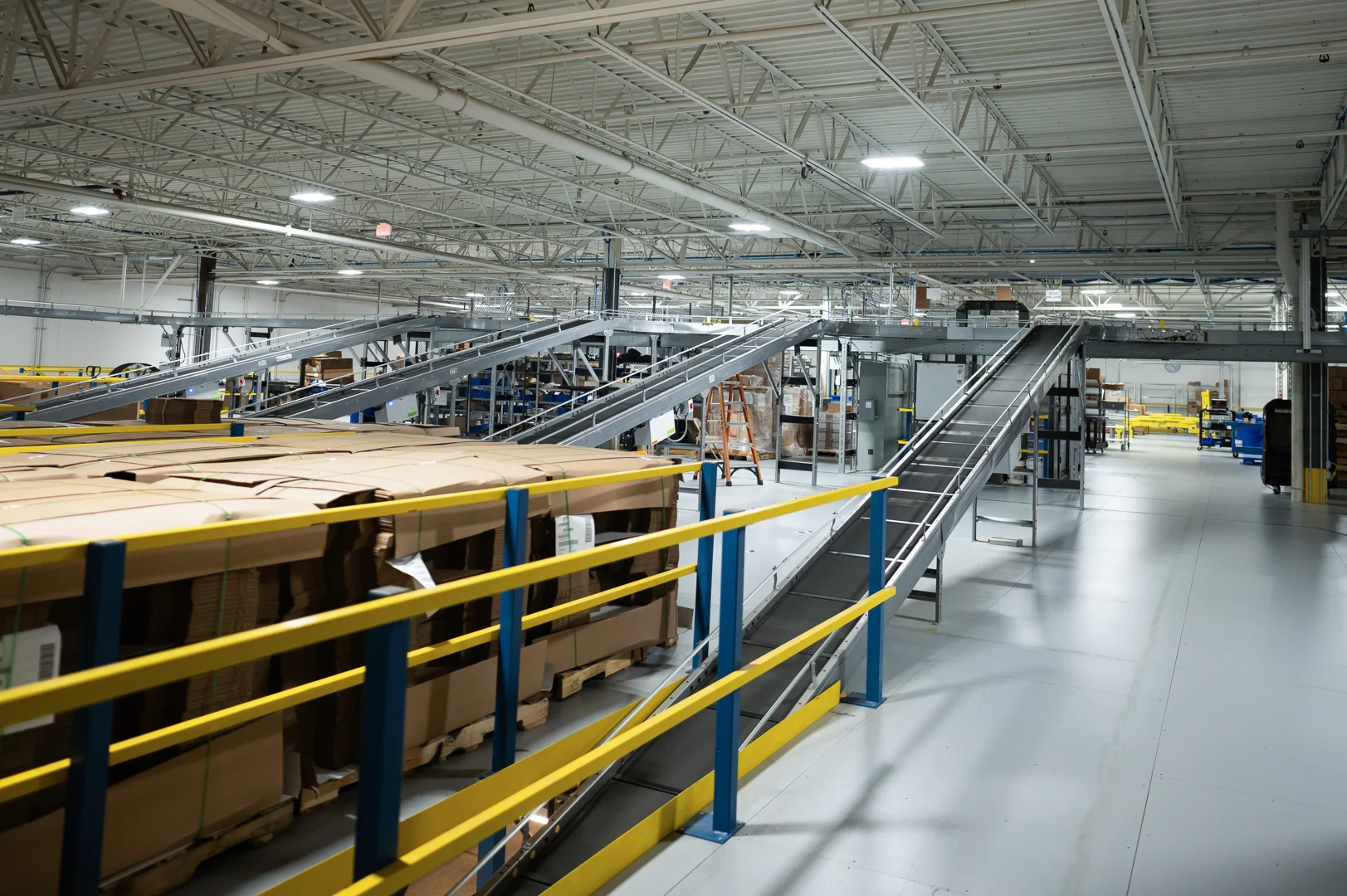
Slotting does not disappear when automation is added. ASRS, conveyors, sortation, and goods-to-person systems still depend on accurate SKU data, storage logic, replenishment strategy, and work sequencing.
For example, ASRS systems may need slotting logic that accounts for load type, retrieval frequency, storage location, software integration, and workstation flow. Conveyor-fed operations may need slotting decisions that support induction, picking, packing, and shipping without creating new bottlenecks.
The goal is to align slotting, storage, material handling, warehouse software, and labor planning so inventory moves through the facility in a way that supports the operation’s actual demand pattern.
Warehouse Slotting Case Studies from LD Systems
LD Systems case studies show why warehouse slotting should be evaluated alongside storage layout, pick-face design, product facings, parts retrieval, material handling, and facility flow.
- Honeywell distribution network case study: LD Systems supported small-parts picking and distribution improvements, including 60% faster picking for small parts, 50% space utilization improvement, and 7,200 pick facings.
- WIX Filters distribution efficiency case study: LD Systems documented a 400% increase in product facings, a 60% productivity boost, and an order cycle time reduction by two-thirds.
- Ocean Spray space utilization case study: LD Systems improved space utilization by 60%, enhanced productivity by 50%, and helped save $11 million in new racking costs.
- Tucson Electric Power parts retrieval case study: LD Systems supported parts retrieval improvements, including reduced order cycle time, faster retrieval, improved accuracy, and a 50% productivity boost.
These results are project-specific, but they show why slotting decisions should be made around inventory profile, pick-face design, product velocity, replenishment flow, storage media, and material handling requirements rather than location labels alone.
Frequently Asked Questions About Warehouse Slotting
What Is Warehouse Slotting?
Warehouse slotting is the process of assigning SKUs, pallets, cartons, cases, parts, or other goods stored in a facility to the right storage and pick locations. A good slotting strategy considers item velocity, size, weight, cube, replenishment needs, picking workflow, storage media, and material flow.
How Does Warehouse Slotting Help Use Space Efficiently?
Warehouse slotting can help use space efficiently by matching goods to the right storage locations, right-sizing pick faces, moving slow-moving items out of prime locations, reducing wasted travel, and improving reserve-to-forward replenishment. Space efficiency depends on inventory profile, layout, equipment, software data, and operating requirements.
What Are Goods Stored in Warehouse Slotting?
In warehouse slotting, goods stored may include pallets, cartons, cases, parts, eaches, bins, kits, reserve inventory, or forward-pick inventory. The way those goods are stored affects picking, replenishment, congestion, safety planning, and downstream flow.
How Often Should a Warehouse Review Slotting?
Slotting should be reviewed when demand patterns, SKU mix, seasonality, packaging, order profiles, storage capacity, or fulfillment requirements change. Some facilities may review slotting on a regular cadence, while others may focus on event-driven reviews before seasonal peaks, product launches, layout changes, or automation projects.
When Is Warehouse Slotting Not Enough?
Warehouse slotting may not be enough when the larger problem is poor inventory data, weak WMS configuration, insufficient storage capacity, poor layout, inadequate material handling equipment, labor constraints, or downstream packing and shipping bottlenecks. In those cases, slotting should be evaluated as part of a broader warehouse systems review.
How LD Systems Supports Warehouse Slotting and Material Flow
Warehouse slotting is most effective when it is evaluated as part of the full facility system. Storage locations, racking, replenishment, picking workflows, conveyors, ASRS, WMS/WES data, labor planning, packing flow, and shipping requirements all affect whether goods move efficiently through the operation.
LD Systems helps warehouses, distribution centers, fulfillment operations, and manufacturing facilities evaluate slotting opportunities as part of a broader material handling, warehouse storage, and automation strategy. As a technology-agnostic warehouse systems integrator, LD Systems does not treat slotting as a standalone spreadsheet exercise or force every operation toward the same automation path.
The team helps align warehouse slotting, storage layout, material handling equipment, warehouse software, automation, and facility flow with the operation’s actual requirements.
Ready to evaluate warehouse slotting and material flow? Request a consultation with LD Systems to review your inventory profile, storage locations, replenishment flow, picking process, WMS/WES integration, and automation opportunities.
